





 Portuguese
  English
  Spanish
  8 min of reading
  1 comment


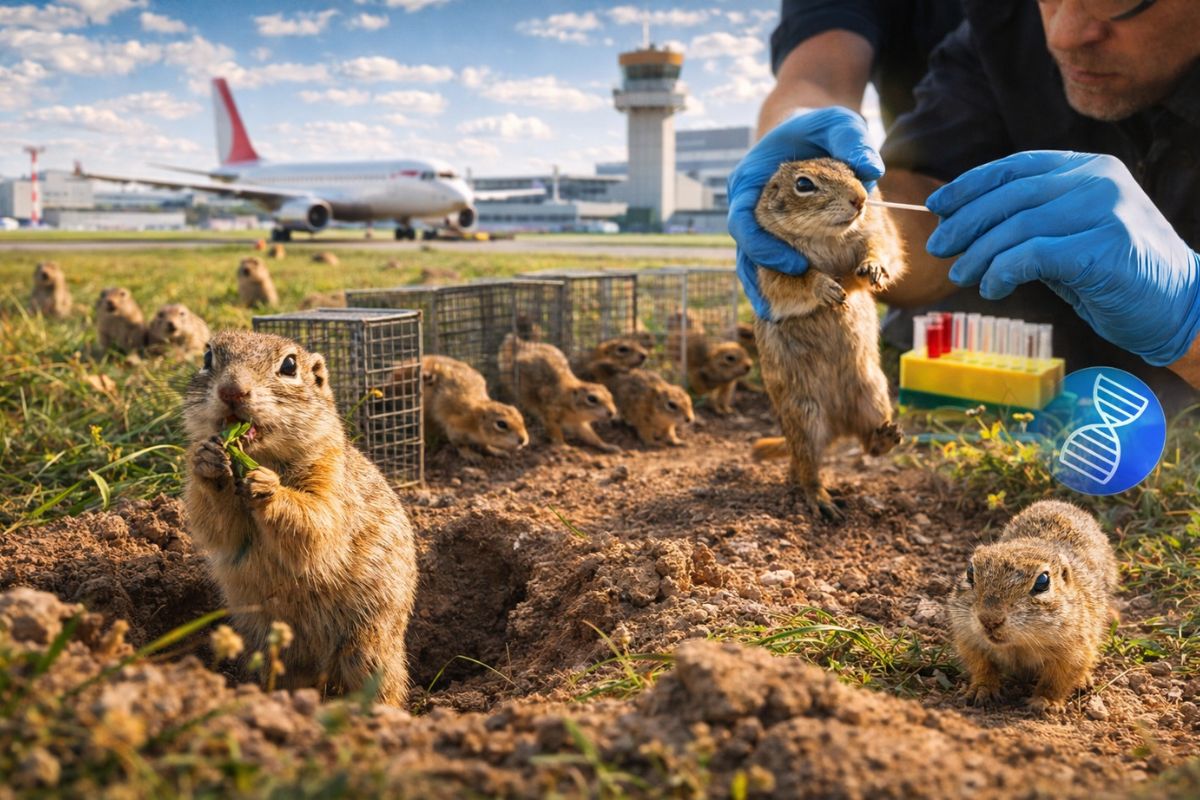


While The Souslik Population Plummets 99 Percent In 50 Years In Slovakia, 800 Ground Squirrels Are Captured At Airports, Have Their DNA Collected, Receive Special Marking And Are Taken To Form New Colonies In Safe Places In An Attempt To Save An Entire Species From The Red List Of Threatened Species.
The 800 squirrels that have now become a species of “airport refugees” represent much more than a curious conservation project. They synthesize a story of silent decline, landscapes transformed into monocultures, and a last real chance to prevent the European souslik from disappearing, as has already happened with other once-abundant species. Around the bustling runways of Bratislava Airport, amidst the noise of jets and trucks, survives one of the last truly thriving populations of this small mammal, which is now the basis of an ambitious rescue plan.
At the same time that the species vanishes from vast areas of the continent, this robust colony has become a takeoff pad for an unprecedented renaturalization strategy. Capturing, transporting, and releasing 800 ground squirrels between airports may sound strange, but it reveals a precise logic: if the ideal habitat today hides in well-groomed grassy edges alongside runways, why not replicate exactly that environment in other places where the souslik still has a chance to recover?
A Noisy Airport As A Last Refuge
According to a report from the organization Mossy Earth, responsible for the project, the European souslik population in Slovakia has suffered a decline of about 99% in 50 years, which prompted a structured operation for large-scale capture and translocation.
-
With a cost per shot close to zero, the DragonFire laser could change naval warfare in 2027 and provide British ships with nearly unlimited defense against drones.

-
A British startup creates tires that generate electricity in electric vehicles when passing over potholes, speed bumps, and cracks.

-
Scientists have created robots made with living cells that have their own nervous system, swim on their own, explore the environment, and self-organize without any genetic engineering, and now they want to do the same with human cells.

-
Students create a solar-powered ambulance that operates without a plug, without fuel, and still keeps medical equipment running in remote areas.


In 2022, 840 individuals were translocated from more stable colonies, such as the one at Bratislava Airport, to reinforce weakened populations and establish new colonies in areas with suitable habitat, following a planned dispersal strategy.
When someone announces “ground squirrel spotted at terminal one,” the image that comes to mind seems like a joke. But at Bratislava Airport, the scene is part of the routine for researchers and conservationists.
There, not inside the terminal, but alongside the runways, lives one of the last strong populations of European souslik in the entire country.
It is an apparently contradictory place for conservation efforts. Constant noise, heavy traffic, asphalt all around.
Still, the ground squirrels are thriving there while disappearing in almost all of Europe, which provides a crucial clue about what they really need to live well.
The short grass strips, maintained under control for aviation safety, end up reproducing the kind of open prairie that the species has always used.
For biologists, this noisy airport has become the equivalent of a last refuge. In a rural landscape taken over by monocultures, pesticides, and loss of diversity, the trimmed lawn next to the runway has become the remaining piece of functional habitat.
If the last viable place for a threatened species is an airport, the problem is not with the animal but with the landscape surrounding it.
Who Are The European Sousliks

The protagonist of this story is the European ground squirrel, also called the southern European squirrel, a small mammal of the genus Spermophilus.
It measures about twenty centimeters, weighs around 300 grams, and lives in large colonies in open fields.
In practice, it resembles a “distant cousin” of meerkats: it stands upright on its hind legs, watches the horizon, and issues danger alerts to keep the group safe.
This behavior directly depends on a simple yet rare condition these days, the grass needs to be short and the field open so that the squirrels can maintain visual contact with each other.
Because of this, they have always been close to prairies, grassy slopes, pastures, and edges of agricultural areas.
In wilder times, herds of large herbivores kept these areas trimmed. Later, livestock, diversified agriculture, and cultivated meadows took over this role.
Moreover, the European souslik functions as a keystone species in the ecosystem. The burrows opened by the squirrels end up providing shelter for lizards, for bumblebees that build nests in already abandoned cavities, and even for solitary bees, which need bare soil to dig.
By protecting 800 squirrels, the project is also protecting an entire network of smaller and discreet species, that depend indirectly on the natural engineering of these small rodents.
From Peak In Prairies To “Cabbage Apocalypse”
Until the 1960s, the scenario was different. In many countries across Europe, ground squirrels were considered agricultural pests, so abundant that they multiplied at the edges of crops, meadows, and pastures.
The combination of different land uses, with mosaics of cultures, pastured areas, and lawns, created an ideal environment for these colonies.
With the advance of intensive agricultural models, everything changed. The previously varied landscape transformed into what conservationists describe as a true “cabbage apocalypse,” a metaphor for the sea of uniform monocultures that spread for miles.
Entire fields became dominated by a single cash crop, with little diversity and almost no opportunity for wild species to survive there.
The result came quickly and was severe. Ground squirrels have completely disappeared from countries like Germany, Poland, and Croatia, and in others, such as Slovakia, their populations plummeted dramatically.
In less than fifty years, Slovakia has seen a drop of about 99 percent in the souslik population, which has led the species to be classified as endangered on the IUCN Red List. It is in this context that the 800 squirrels become a symbol of a last chance to reverse the situation.
How 800 Squirrels Became Airport Refugees
Today, experts describe three major metapopulations of ground squirrels in Slovakia: one in the west, another in the central region, and a third in Cerová vrchovina.
Each is made up of small isolated colonies, with their own difficulties and a constant risk of disappearing.
At the same time, within each metapopulation, there is still at least one robust colony that can act as a donor, providing individuals to reinforce other areas.
In the Western Slovakia metapopulation, the focus is specifically on Bratislava Airport, which hosts the most prosperous colony.
From there, the plan was born that involves capturing and translocating 800 ground squirrels to create five new colonies and reinforce ten existing colonies that were in decline.
Simultaneously, other groups of squirrels are collected from five more locations where populations are still strong but need genetic resilience.
The urgency became even greater when it was discovered that part of this airport colony had spread to a grassy field in a nearby industrial zone, an area already planned for future development.
Suddenly, 800 squirrels ceased to be just a project number and became a real race against time, an evacuation of wildlife before the habitat became concrete and asphalt.
Capture, Marking And DNA To Track Each Individual

To safely get the squirrels from one airport to another, each step needs to be planned.
The teams use live traps designed by zoologists, set up next to the burrows. Inside them, a simple combination of technology and temptation: a metallic mechanism that closes when the animal enters to nibble on a fresh apple.
Researchers monitor the area with binoculars and know there is a captured squirrel when the little latch on the trap changes position.
The capture is usually quick, and soon the animals are transferred to transportation boxes specifically designed to reduce stress.
The idea is not to capture 800 squirrels at any cost, but to ensure that each individual is part of a long-term conservation plan.
Then comes the more technical part. DNA samples are collected from each squirrel so that scientists can track how this genetic material mixes with existing populations in the release areas over the years.
Additionally, the animals receive a simple visual mark, done on the fur, allowing them to be identified later in field monitoring.
Marking sometimes on the right side, sometimes on the left, and recording this information helps to know if that individual is still present in the colony in the future.
New Colonies In Smaller Airports And A Race Against Time
One of the destinations for these 800 squirrels is a very different airport from Bratislava. Instead of jets and large terminals, it is a small aeroclub, with quieter runways and a much more peaceful environment.
At first glance, it may seem like a less “natural” place for a threatened animal, but the logic is similar: open fields, grass kept short, and little direct urban interference.
Before being released, researchers carefully choose suitable burrows, often existing well-positioned holes, such as sloped tunnels that serve as escape routes in case of predators.
It is not enough to open the box and let the squirrel run, because it does not know the area and might simply run the wrong way, cross fields, and never find the colony.
Therefore, each animal is guided to a specific entrance capable of providing immediate shelter until it calms down and begins to explore its new home.
Not everything always goes perfectly. Fugitives happen, some animals try to escape in open fields, others “freeze” and play dead out of sheer panic, giving the team a chance to recover them and safely relocate them.
However, throughout the summer, the process is repeated in various locations. In the end, more than 800 squirrels are captured, transported, and released in new areas, reinforcing fragile colonies and establishing previously non-existent nuclei.
Financed Conservation In Detail And Thought Of In Network
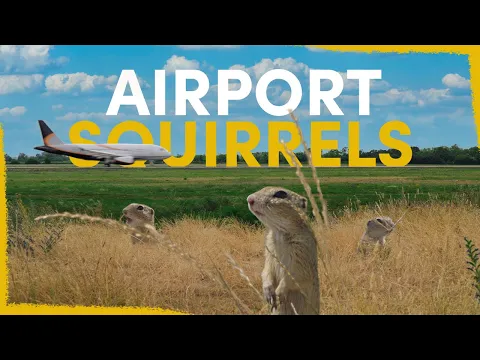

Behind the 800 squirrels in transportation boxes, there is a relatively modest yet decisive human and financial infrastructure.
The project mobilizes local organizations, such as BROZ, that know the territory well, and receives support from initiatives like Mossy Earth, which channels contributions from members for concrete actions.
For a single summer of intense work with traps, transport, and logistics, the costs are around 13,700 euros, with a commitment to support the project with about 54,000 euros until 2027.
In global conservation numbers, it may seem small, but every euro spent here represents a real chance of keeping colonies alive that, without intervention, would likely disappear silently.
Furthermore, the project with the 800 ground squirrels connects to a larger network of actions, ranging from the depths of the ocean to arid deserts, passing through cold forests and tropical forests.
The same approach that saves a species of rodent in airport prairies inspires work in completely different ecosystems, always with a combination of science, planning, and close contact with local reality.
Conservation Lessons That Go Beyond The 800 Squirrels
The story of the 800 European souslik squirrels, transformed into airport refugees, serves as a reminder of other warnings that humanity ignored in the past, such as that of the passenger pigeon in North America, which once represented a huge slice of birds on the continent and was hunted to extinction. This time, however, the signs are being noticed before reaching the point of no return.
By capturing, genetically monitoring, and relocating 800 squirrels, scientists and conservationists show that there is still time to act when society chooses to invest in concrete solutions.
The question that remains is whether this effort will be enough and if it will come with broader changes in how we use land, produce food, and plan landscapes.
Ultimately, what happens to these small European rodents inside and outside airports is a portrait of how far we are willing to go to prevent another species from disappearing.
If an airport has become a refuge, perhaps it’s time to think about the kind of world we are building outside the runways.
And you, what do you think of this strategy to rescue 800 squirrels from airports to create new colonies and try to save the European souslik from extinction?






Achei sensacional! Renovei um pouco da minha fé na humanidade! Parece que o ser humano tem alguma chance de salvação…