





 Portuguese
  English
  Spanish
  4 min of reading
  0 comments


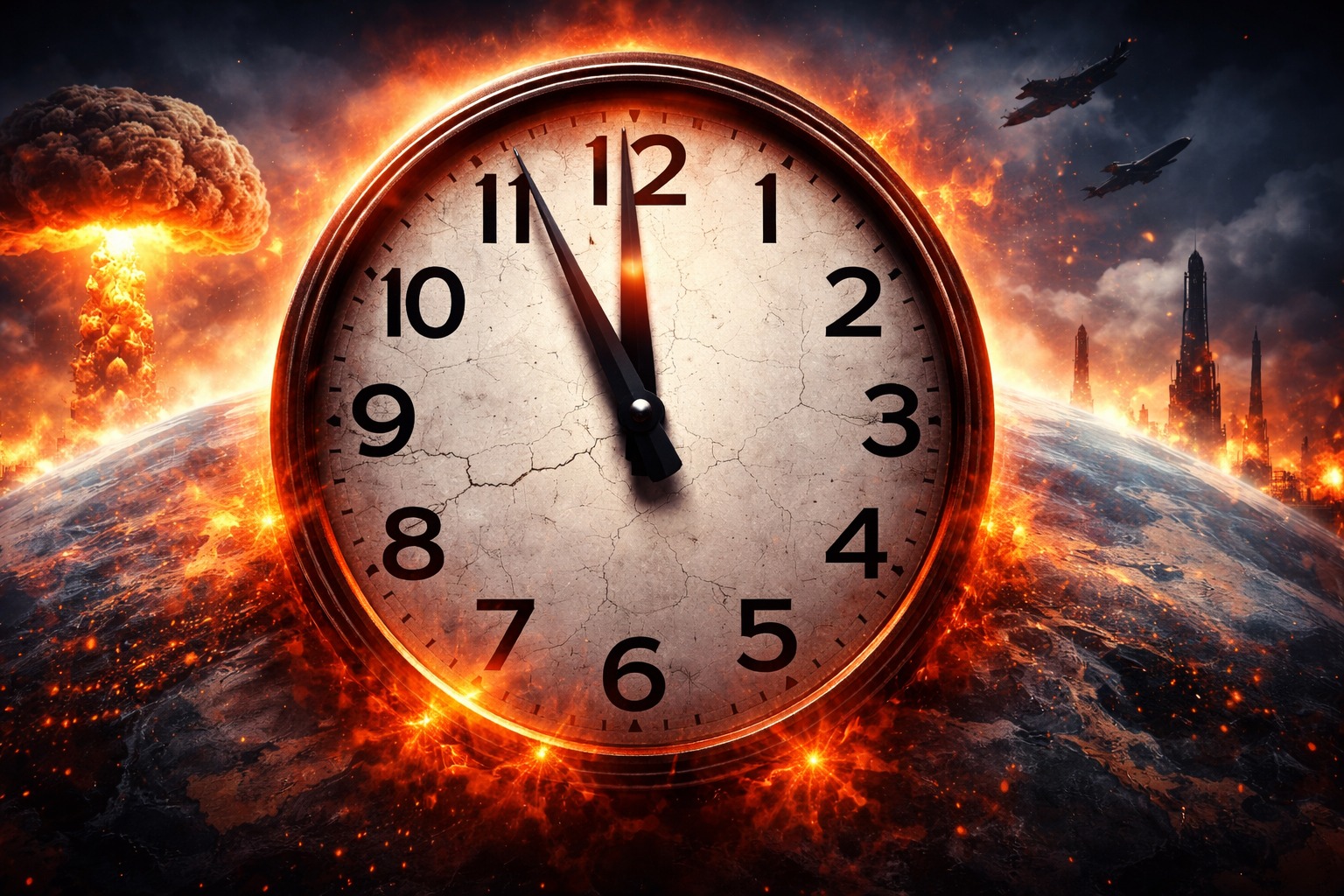
The Decision Announced on January 23, 2026 by the Bulletin of the Atomic Scientists Reflects the Convergence of Nuclear Tensions, Diplomatic Impasses, Record Climatic Impacts and Risks Associated with Artificial Intelligence and Biotechnology, Putting the Planet at Only 85 Seconds to Symbolic Midnight
On January 23, 2026, the Bulletin of the Atomic Scientists adjusted the Doomsday Clock to 85 seconds before midnight, the closest point to global catastrophe in 77 years, citing nuclear threats, climate crisis, unregulated biotechnology, and military use of artificial intelligence.
The announcement marked the most severe setting ever recorded since the clock’s creation nearly eight decades ago. According to the Bulletin, the adjustment did not stem from a single event, but from a systemic convergence of global risks exacerbated by the deterioration of international security mechanisms.
Scientists stated that governments have been repeatedly warned about the increasing threats, but most have maintained or intensified policies deemed destabilizing. The described scenario combines nuclear rearmament, technological acceleration, climate collapse, and a breakdown in coordination among powers.
-
With a cost per shot close to zero, the DragonFire laser could change naval warfare in 2027 and provide British ships with nearly unlimited defense against drones.

-
A British startup creates tires that generate electricity in electric vehicles when passing over potholes, speed bumps, and cracks.

-
Scientists have created robots made with living cells that have their own nervous system, swim on their own, explore the environment, and self-organize without any genetic engineering, and now they want to do the same with human cells.

-
Students create a solar-powered ambulance that operates without a plug, without fuel, and still keeps medical equipment running in remote areas.


The Erosion of Nuclear Control and the Escalation of Strategic Rivalries
The Bulletin highlighted that the weakening of global cooperation was crucial for the new clock adjustment. Central structures for strategic arms control have stagnated or disintegrated, replaced by a logic of rivalry among great powers.
The United States, Russia, and China, according to the analysis, have entered a new phase of military and technological competition, abandoning decades of strategic dialogue in favor of unilateral maneuvers. This shift heightened the risk of miscalculations in high-tension scenarios.
Three regional conflicts in 2025 illustrated this environment. Russia’s war in Ukraine continued with veiled nuclear threats. In May, clashes between India and Pakistan escalated to missile and drone exchanges. In June, Israeli and American airstrikes targeted Iranian nuclear facilities.
Meanwhile, nuclear modernization accelerated. China expanded its arsenal, Russia tested new systems, and the United States advanced with the Golden Dome, a space-based missile defense network to intercept long-range threats using orbital resources.
With the imminent expiration of the New START Treaty, there is no existing agreement among the major nuclear powers to limit strategic weapons, increasing systemic risk in an already fragmented scenario.
Climate Crisis Advances Amid Weak International Response
In the climate arena, the Bulletin pointed to 2025 as a year marked by inaction, despite the intensification of environmental impacts. Global temperatures remained close to the record set in 2024, while CO₂ concentrations reached 150% of pre-industrial levels.
The effects were widespread and distributed. Europe faced its third extreme summer in four years, with over 60,000 heat-related deaths. The Amazon basin, southern Africa, and Peru experienced prolonged droughts.
In the Congo River basin and southeastern Brazil, more than 850,000 people were displaced by flooding, straining already overwhelmed humanitarian systems. The Bulletin categorized the global response to these events as profoundly destructive.
According to the statement, the last three UN climate summits failed to impose a phase-out of fossil fuels or establish effective mechanisms for monitoring global carbon emissions.
In the United States, the Trump administration reversed several federal clean energy programs, hindering the achievement of national emission targets. Although technical advances in renewable energy continue, the political infrastructure to implement them has weakened.
Artificial Intelligence and Synthetic Biology Expand Vectors of Instability
The 2026 report highlighted artificial intelligence and synthetic biology as new vectors of global instability. Both have rapidly evolved without international regulatory frameworks considered adequate by scientists.
By the end of 2025, researchers from nine countries warned about the lab synthesis of “mirror life,” genetically modified organisms with inverted chirality compared to natural life. These microbes could escape biological control and spread unpredictably.
Scientists advocated for an international ban, but there is currently no global regulatory framework for this type of research. The Bulletin assessed the absence of governance as a growing risk.
In the field of artificial intelligence, AI-based systems are already integrated into the defense strategies of the United States, China, and Russia, including possible applications in early warning systems and nuclear decision-making.
In 2025, the US government revoked an executive order on AI security and auditing, prioritizing unregulated development. The Bulletin cited this decision as evidence of a growing indifference to the risks associated with technology.
Diplomatic Collapse and Absence of New Governance Mechanisms
The Doomsday Clock’s projection for 2026 reflects not only the accumulation of risks but the collapse of institutions intended to manage them. Traditional diplomatic structures have lost ground to zero-sum strategies among nuclear and technological powers.
This scenario has complicated the collective management of crises. Scientific collaboration has stagnated, arms control negotiations remain frozen, and regulatory dialogues on biotechnology and artificial intelligence security have yet to begin.
The Bulletin noted that international accountability mechanisms, such as verification protocols and transparency measures, have been marginalized by nationalist political agendas, resulting in a disorganized global environment.
Despite the escalation of risks, no new treaty has been established to regulate space weapons, synthetic organisms, or restrict the use of artificial intelligence in strategic command systems, keeping the clock perilously close to midnight.








-

-

-

-

5 pessoas reagiram a isso.