





 Portuguese
  English
  Spanish
  3 min of reading
  0 comments


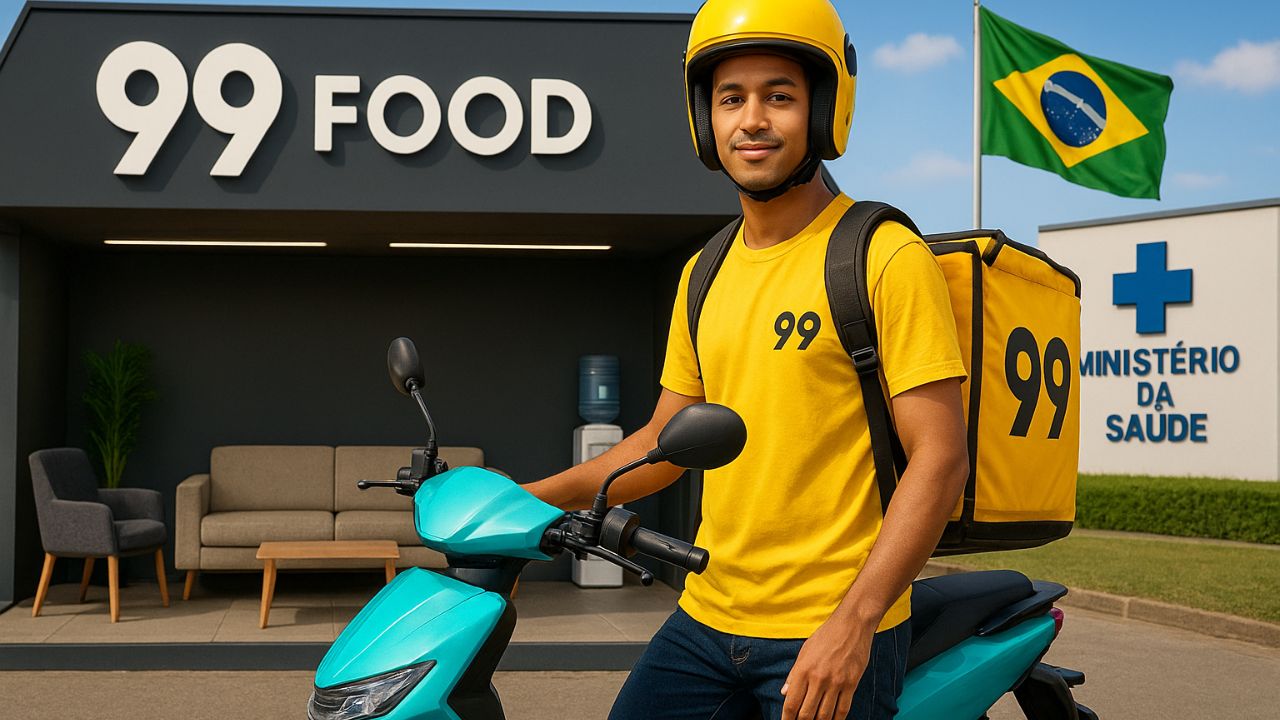
99 Food Invests R$ 2 Billion in Brazil with Support for Delivery Workers, Electric Motorcycle Factory, and Partnership with the Ministry of Health.
99 Food announced on Monday (09/15/25) an investment of R$ 2 billion in Brazil until June 2026.
The plan includes the creation of support points in all capitals for registered delivery workers and a strategic partnership with an electric motorcycle factory, which aims to enhance accessibility and reduce costs for those working in the sector.
The announcement was made in Brasília, after a meeting between President Luiz Inácio Lula da Silva and company executives.
-
A new law being voted on in Brazil proposes a minimum fare of R$ 10 per trip and R$ 2.50 per kilometer for Uber and 99 drivers, and promises to ensure they earn as well as taxi drivers did during the golden age of taxis in the country.
-
Bauer Group collapses after failed judicial recovery: 25 years, 800 vehicles, and a network of gas stations leave a debt of R$ 50 million and 100 layoffs, exposing costs, tight margins, and expensive credit in Brazil.
-
Premium Brazilian brand born during the pandemic brings fine cocoa from Bahia to Switzerland, Germany, and France, has won 9 awards, and claims to have the 2nd best milk chocolate in the world: meet Luz Cacau.

-
Júnior Friboi has just purchased one of the largest feedlots in all of Brazil, located in Goiás, with the capacity to produce 180,000 cattle per year, and the manager has already come forward to reassure employees about layoffs.

Meeting at Planalto Seals New Investments
The decision was officialized after a meeting at the Palácio do Planalto, which included the presence of the CEO of Chinese Didi 99, Will Wei Cheng, and the general director of 99 Food in Brazil, Simeng Wang.
Currently, over 700,000 motorcyclists are registered on the platform. According to Wang, the new support points will be complete spaces, with benches, sofas, water, restrooms, and charging stations for mobile phones.
The forecast is that part of the funding will be specifically allocated to this project, with an estimated cost of R$ 50 million.
Support Points Already Tested in Capitals
Today, the initiative is in a pilot operation in Goiânia and São Paulo. In the capital of Goiás, there are already three units in operation, considered a reference by the company.
“We are planning. Today we operate in two cities – Goiânia and São Paulo. Goiânia has a more mature operation, with three support points. We are analyzing the partnership in São Paulo as well. And we have a partnership with the city hall of Rio de Janeiro to do this,” explained Wang.
The expectation is for national expansion, focusing on providing better working conditions and quality of life for delivery workers.
Partnership with Electric Motorcycle Factory
Another pillar of 99 Food’s investment in Brazil is the partnership with an electric motorcycle factory of Chinese origin.
The goal is to start local production of more affordable vehicles, specially designed for the routines of delivery workers.
“We will have a partnership, we are with a partner that already works with us in Mexico and Colombia and is specialized in offering credit to this audience,” stated Wang.
According to the executive, usage data of motorcycles on the platform is already being shared so that the new model can be designed according to the sector’s needs.
The goal is to offer a motorcycle that meets both food delivery and passenger transport needs.
Incentives and Financial Support
99 Food also announced it is working closely with credit institutions to facilitate the purchase of these motorcycles by delivery workers.
The initiative aims to reduce fuel costs and encourage the use of sustainable alternatives.
Additionally, the company intends to offer differentiated financing conditions, expanding access to the electric fleet.
Partnership with the Ministry of Health
In addition to initiatives aimed at delivery workers, 99 Food also established a partnership with the Ministry of Health.
The agreement provides for the distribution of vouchers for free transportation of patients to public hospitals for consultations and surgeries.
According to Wang, the initiative is already available in 49 hospitals. However, details about the program’s expansion have not yet been disclosed.
Impact on the Delivery and Mobility Sector
The announcement by 99 Food reinforces the trend of transformation in the delivery sector in Brazil, combining investment in infrastructure, technological innovation, and social impact.
With R$ 2 billion being invested by 2026, the expectation is to improve working conditions, facilitate access to sustainable vehicles, and simultaneously contribute to public policies in the health sector.





Seja o primeiro a reagir!