





 Portuguese
  English
  Spanish
 6 min of reading
  9 comments


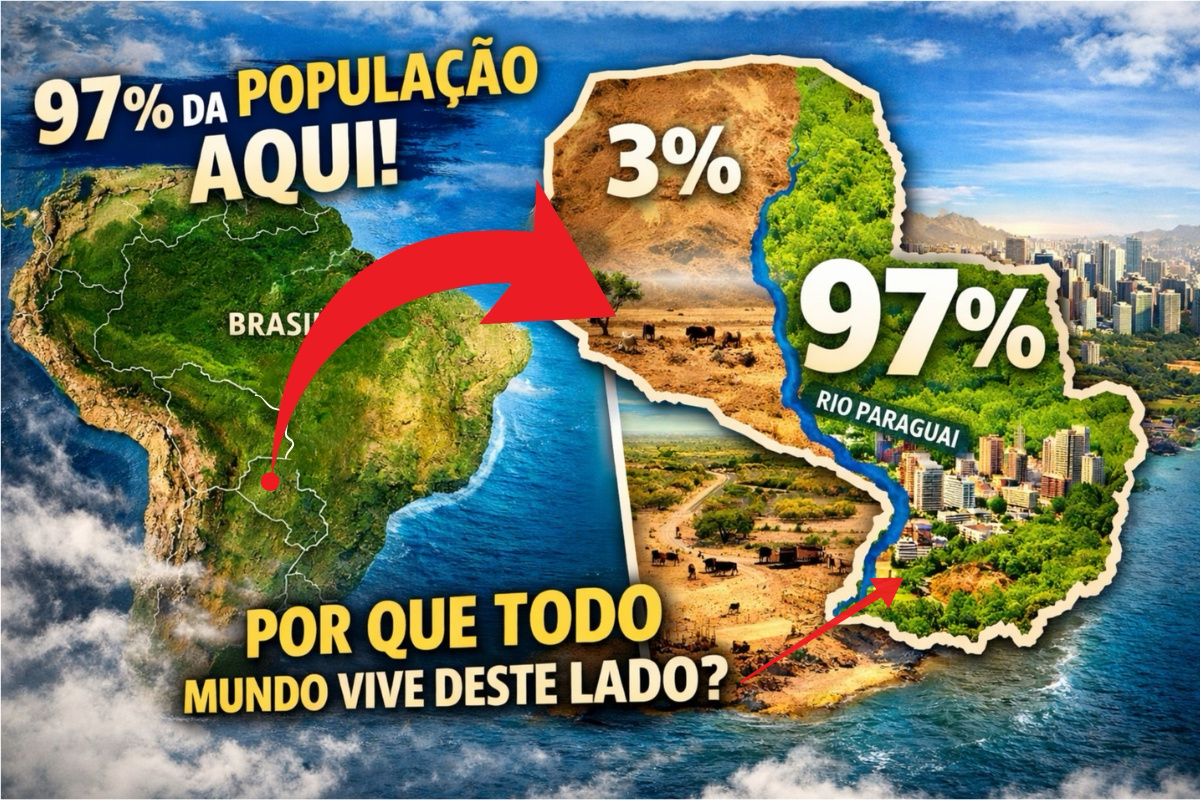


Understand Why 97% of Paraguayans Live on the Eastern Side of the Country, How Rivers Shaped Cities, Why Chaco Is Empty, and What That Has to Do with the Amazon and “Lost Cities” under the Forest.
In the heart of South America, there is a country that intrigues geographers, historians, and curious people. The Paraguay grew, integrated into international trade, and built important cities, but houses its population in an unobvious way. More than half of its territory is almost empty, while almost everyone decided to live on the other side of the map.
That’s exactly what happens in Paraguay: most of the territory is in the west, but almost no one lives there.
It’s not an exaggeration: about 97% of Paraguayans live in just 39% of the national territory. The rest of the country, large and little explored, remains practically untouched.
-
India announces a plan of $3.06 billion to bring aviation to forgotten regions: 100 new airports, $1.07 billion in subsidies, and regional routes guaranteed for 10 years, from 2026 to 2036, away from the centers.
-
Brazil blocked a proposal from the United States at the WTO that would make the exemption from tariffs on digital products like streaming and ebooks permanent, favoring American tech giants at the expense of developing countries.

-
IPTU exemption for seniors in 2026: see how to secure the benefit.

-
The institute that trained the greatest aerospace engineers in Brazil has just opened its first campus outside São Paulo after 75 years: ITA Ceará will have R$ 445 million, new courses in energy and systems, and classes are expected to start in 2027.

Paraguay: A Country in the Center of South America That Defies Logic: 61% of the Territory with Only 3% of the Population
A country without a sea, but far from being isolated: Despite not having access to the ocean, Paraguay has never been completely isolated.
The country is crossed by large rivers, such as the Paraguay River, which are part of the Rio de la Plata Basin.
This river system connects the country directly to the Atlantic Ocean and allows Paraguayan exports to reach markets around the world.
According to data from the World Bank, the Paraguay–Paraná waterway is one of the main economic arteries of the country, being essential for the trade of grains, meat, and other products.
Cities, Rivers, and Population: None of This Is Coincidence
When you look at the urban map, the pattern becomes clear. Of the 11 largest cities in Paraguay (with over 100 thousand inhabitants), 10 have a direct connection to navigable rivers. The only exception is Pedro Juan Caballero, which grew driven by border trade with Brazil.
The rivers have always been roads, markets, and sources of life. Where there was water, there was the circulation of people, goods, and ideas. Where there wasn’t, growth stalled.
Two Paraguays Separated by a River
If the country is divided in half following the course of the Paraguay River, an impressive contrast emerges:
- West (Chaco Paraguaio): 61% of the territory and only 3% of the population
- East: 39% of the territory and about 97% of the inhabitants
In absolute numbers, this means millions of people concentrated in a relatively small strip, while giant expanses remain almost empty.
Asunción: The Great Population Magnet
The capital Asunción explains much of this concentration. The metropolitan area houses about one-third of the country’s population, according to the National Institute of Statistics of Paraguay. Services, jobs, universities, and infrastructure end up attracting people from all over.
This phenomenon is not exclusive to Paraguay, but there it is more intense, precisely because the contrast between east and west is extreme.
Everything Starts Before the Arrival of Europeans
Long before the founding of Asunción, the Guarani peoples already occupied the east of Paraguay. It was not by chance. The region offered fertile lands, regular rainfall, and a more stable climate than the dry and hot west.
The FAO highlights that the east of the country includes some of the most productive agricultural areas in the region, a decisive factor since pre-colonial times.
While other peoples in South America had to develop complex techniques to cultivate in hostile environments, the Guarani found naturally favorable conditions there.
Asunción, the “Mother of Cities”
Founded in 1537, Asunción became the starting point for Spanish occupation in much of the Southern Cone.
From there, explorers and missionaries advanced to other regions, earning the capital the nickname of “Mother of Cities”.
This centralized start marked the country’s growth pattern and helped establish the east as a political and economic nucleus.
Wars That Left Deep Marks on Paraguay
In the 19th century, Paraguay was undergoing a rapid modernization process. The country even built railways and, in some aspects, was ahead of neighbors like Brazil and Argentina. All of this changed with the War of the Triple Alliance.
The conflict was the most devastating in South America’s history. Historical estimates indicate that Paraguay lost about half of its population, including approximately 70% of adult men. The demographic impact was so profound that recovery took decades.
Shortly after, the Chaco War occurred, fought against Bolivia precisely for the western territory. Even though it won, the country paid a heavy price in lives and resources. Still, Chaco remained sparsely populated.
The Chaco: The Large, Hot, and Forgotten Territory in Paraguay
The west of Paraguay, known as Chaco, is one of the most inhospitable regions in South America. The climate is extreme, with temperatures easily exceeding 40 °C in the summer and long periods of drought.
According to climatic data collected by the NASA Earth Observatory, the Chaco is among the warmest subtropical areas on the continent. Water scarcity makes agriculture difficult and turns daily life into a constant challenge.
Additionally, the infrastructure is limited. Many roads are dirt, access to drinking water is restricted, and basic services can be hundreds of kilometers away.
Few People, Few Jobs in Paraguay
The main economic activity in Chaco is livestock farming. Although important, it requires little labor. Without industries, strong commerce, or intensive agriculture, the region cannot retain large population contingents.
Today, departments like Alto Paraguay have territory comparable to entire countries, but with populations that could fit in a football stadium.
The Mennonites and Adaptation to Extremes
Even so, some communities have thrived in Chaco. This is the case of the mennonites, a religious group of European origin that arrived in Paraguay in the 1920s. Fleeing persecution and conflict in Russia and Canada, they found in Paraguay the opportunity to maintain their culture.
The Paraguayan government granted lands and ensured religious freedom and exemption from military service. Today, it is estimated that there are around 40 thousand mennonites in the country, according to data compiled by the Encyclopaedia Britannica.
They transformed parts of Chaco into productive hubs, combining traditional techniques with local innovation.
A Void That Reminds of the Amazon
The situation in Chaco recalls another famous “void” in South America: the Amazon. For a long time, it was believed that the forest had always been sparsely populated. Today, research using LiDAR technology reveals traces of ancient cities and complex societies hidden beneath the vegetation.
According to archaeologists cited by the National Geographic, these discoveries completely change how we understand human occupation in regions considered hostile.
An Open Future
The west of Paraguay continues with enormous economic and environmental potential. Experts from the United Nations Development Programme – UNDP argue that investments in infrastructure, renewable energy, and water management could transform Chaco into an example of sustainable development.
Without this, the region will remain one of the most empty areas of the continent, while the east continues to concentrate people, wealth, and opportunities.
What do you think: with investment in roads, energy, and water, could Chaco become a new hub for the country — or will the climate always “rule” there? Leave a comment with your thoughts, and if this text helped you, share the post with someone who enjoys geography and history of South America.





Se for uma pecuária com niveis de sustentabilidade voltada para rumos tecnologico,sem dúvida,o povo Paraguai e o mundo terá alimento dessa Região.
La carretera bioceanica será el motor principal de desarrollo del chaco Paraguayo, más el puente Héroe del chaco que ya aporta para desarrollo
40 mennonitas? Ha der ser 40 aldeas menno o 40mil mennonitas