





 Portuguese
  English
  Spanish
  4 min of reading
  0 comments


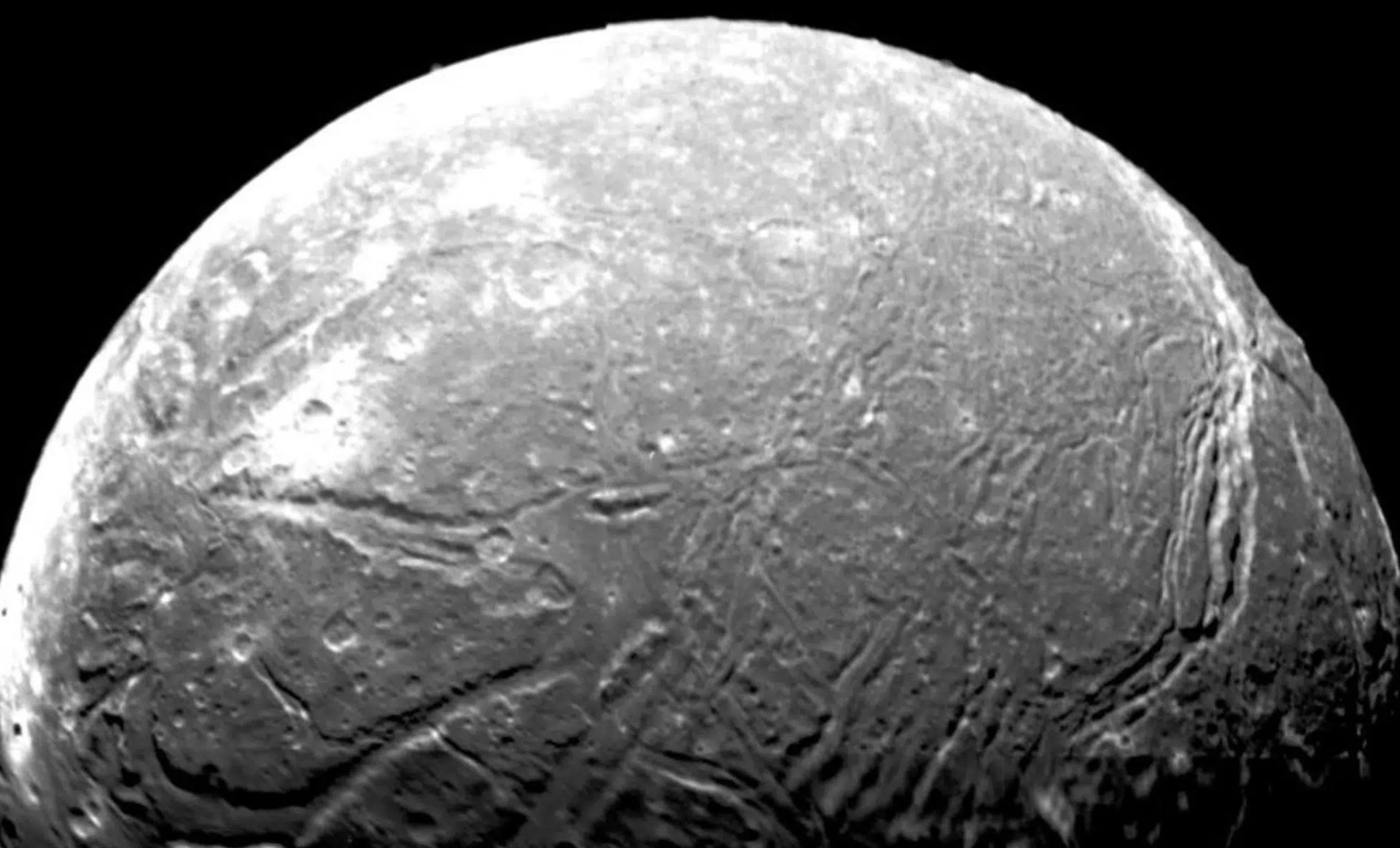
Study Based on Voyager 2 Images and Computational Modeling Indicates That the Uranus Moon Miranda May Have Harbored an Ocean Between 100 and 500 Million Years Ago, With Up to 100 Kilometers in Depth Beneath a 30 Kilometer Crust, Reigniting the Scientific Debate About Liquid Water and Favorable Conditions for Life on Small Bodies Distant From the Sun
A study published in The Planetary Science Journal indicates that the Uranus moon Miranda may have harbored an ocean between 100 and 500 million years ago, with up to 100 kilometers in depth beneath a 30 kilometer crust, expanding the debate about life.
Miranda, a moon of Uranus, has always been considered a cold and lifeless world, distant from the Sun and unlikely to harbor any form of life. Recent research, however, is changing this assumption by suggesting the existence of a hidden ocean beneath its icy surface.
The study points out that this ocean could still be in a liquid state, creating favorable conditions for life. The hypothesis challenges traditional understanding of this Uranus moon and expands the possibilities of habitable environments in the far reaches of the solar system.
-
Motorola launched the Signature with a gold seal from DxOMark, tying with the iPhone 17 Pro in camera performance, Snapdragon 8 Gen 5 that surpassed 3 million in benchmarks, and a zoom that impresses even at night.

-
Satellites reveal beneath the Sahara a giant river buried for thousands of kilometers: study shows that the largest hot desert on the planet was once traversed by a river system comparable to the largest on Earth.

-
Scientists have captured something never seen in space: newly born stars are creating gigantic rings of light a thousand times larger than the distance between the Earth and the Sun, and this changes everything we knew about stellar birth.

-
Geologists find traces of a continent that disappeared 155 million years ago after separating from Australia and reveal that it did not sink, but broke into fragments scattered across Southeast Asia.

The Uranus Moon and the Unexpected Discovery of an Underground Ocean
Since the Voyager 2 spacecraft captured the first detailed images of Miranda in 1986, its peculiar surface has drawn attention. The Uranus moon features deep grooves, towering cliffs, and regions with unusual shapes, described as bizarre and trapezoidal.
Using modern computational modeling techniques, researchers revisited Voyager 2 images to look for clues of an underground ocean. Different scenarios of the geological past were reconstructed to assess the possibility of liquid water beneath the ice.
According to the study, Miranda may have harbored an ocean between 100 and 500 million years ago. This ocean would have reached up to 100 kilometers in depth, located beneath a crust with a maximum thickness of 30 kilometers.
According to planetary scientist Tom Nordheim, co-author of the work, finding evidence of an ocean within a small object like Miranda is incredibly surprising. This assertion reinforces the unexpected nature of the hypothesis.
Computational Modeling and Reconstruction of Geological Past
The researchers used computational modeling to reinterpret data collected by Voyager 2. The analysis focused on the surface characteristics of the Uranus moon, which were considered indicative of past geological activity.
The fragmented formations, grooves, and elevated structures were evaluated as possible signs of internal processes. The team concluded that such marks may be related to the past presence of an underground ocean.
The reconstruction of geological scenarios indicated that the ocean could have remained liquid due to internal mechanisms. The hypothesis contradicts the previous expectation that small, distant bodies from the Sun would be too cold to maintain liquid water.
This reinterpretation of the historical data from Voyager 2 demonstrates that information collected in 1986 can still generate new conclusions about the Uranus moon, expanding scientific understanding of these celestial bodies.
Gravitational Heating as a Possible Energy Source
The study also addresses how an ocean could remain liquid despite the moon’s distance from the Sun. The proposed explanation involves gravitational forces between Miranda and other Uranus moons.
This interaction, known as orbital resonance, can generate internal friction and produce heat. The resulting heating would have the potential to keep the underground ocean in a liquid state for long periods.
The phenomenon is comparable to that observed on Enceladus, a moon of Saturn, which shows signs of underground oceans and geysers of water vapor. The analogy reinforces that gravitational heating can occur even in cold, distant environments.
The possibility of such a small moon maintaining liquid water broadens discussions about the potential for habitable environments in the solar system. The hypothesis places the Uranus moon Miranda at the center of new scientific debates.
Potential Life and Need for Further Investigations
Caleb Strom, a graduate student at the University of North Dakota and a member of the team, stated that the result was a great surprise. The team did not expect Miranda to support such a large ocean.
According to Strom, it is believed that the interior of Miranda has not completely frozen. If it had frozen, specific features on the surface that were not identified in the analyzed images would be visible.
This observation suggests that internal heating mechanisms may still be active. The ocean, although possibly shallower than in the past, could still exist in some form beneath the crust.
Despite the evidence pointed out in the study, the current presence of a liquid ocean on the Uranus moon has not been confirmed. The hypothesis remains dependent on further investigations and future space missions.
Scientists continue to analyze data from Voyager 2 to extract as much information as possible. The team emphasizes that new missions would be essential to confirm whether Miranda can indeed harbor an ocean and conditions conducive to life.
The hypothesis of an ocean up to 100 kilometers deep beneath a crust of up to 30 kilometers reinforces the scientific relevance of the Uranus moon. However, confirmation of these conclusions depends on further exploration and new observational data.








-

-

7 pessoas reagiram a isso.