





 Portuguese
  English
  Spanish
  6 min of reading
  0 comments


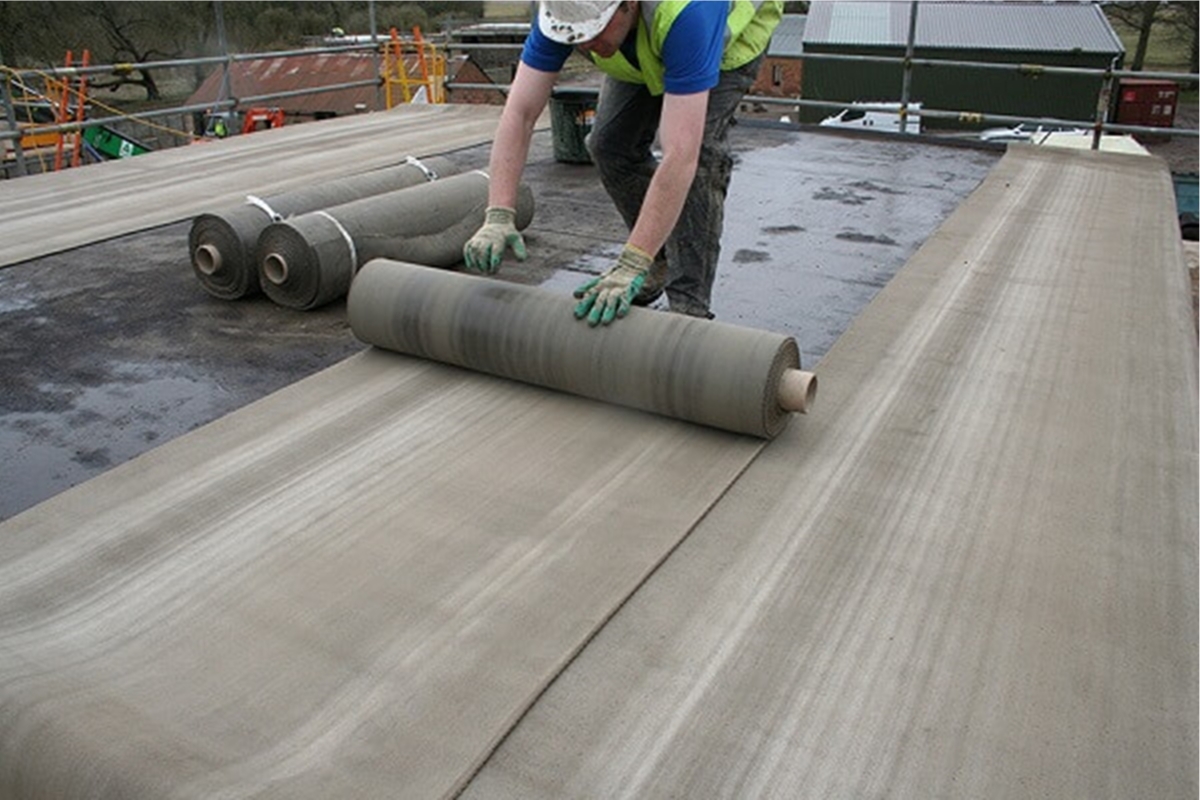
With Compression Resistance Compatible with Thin Coatings and Textile Reinforcement Against Tearing, the Concrete Blanket Delivers Performance for Protection and Containment, Maintaining the Applied Shape Under Sun, Rain, and Thermal Variation
In civil construction, time and simplicity of execution can mean the difference between a viable project and a failure. It is in this context that concrete fabric in rolls, commercially known as Concrete Canvas, emerges, often described as a kind of “concrete blanket.”
Instead of traditional forms, concrete trucks, and long curing times, the material arrives at the site in flexible rolls, is unrolled over the surface, hydrated with water, and, within a few hours, hardens like conventional concrete.
The proposal is to allow the creation of concrete coverings and structures with minimal installation, requiring little specialized labor and reducing the use of heavy equipment.
-
The lack of welders, electricians, and operators becomes a structural threat in 2025, with the construction industry and manufacturing already suffering from delays, cost pressures, and labor shortages in Brazil.
-
Brazil and Paraguay are just 46 meters away from a historic union on the bioceanic bridge that promises to revolutionize trade between the Atlantic and the Pacific.

-
With 55 km over the sea, a cost of US$ 20 billion, and enough steel to build 60 Eiffel Towers, China’s largest project has connected Hong Kong, Zhuhai, and Macau in a colossal bridge that defies the logic of engineering.

-
A trick with joint compound transforms a Styrofoam ceiling into a plaster-like ceiling: leveled panels, wires and mesh at the joints, sand, paint, and change the environment while spending little today.

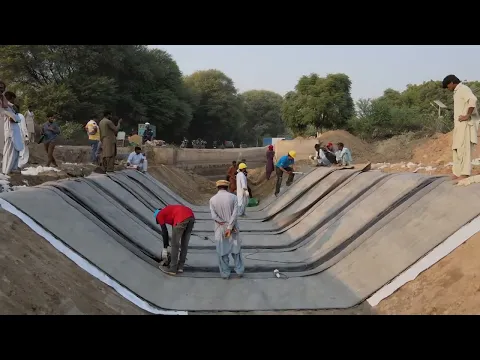
Due to its versatility, the concrete fabric in rolls has been used in infrastructure works, slope and channel protection, service lines, and various engineering applications that require speed and durability.
What Is Concrete Fabric in Rolls?
Concrete fabric in rolls is a composite material in which a layer of fast-drying concrete is incorporated into a reinforced fabric, typically with an external geotextile face and a plastic or waterproof internal face.
This “sandwich” creates a flexible sheet that can be bent, cut, and transported in rolls, but that, when hydrated, hardens into a rigid concrete shell.
The technology is the result of a patented solution, initially developed for military and emergency applications, where there is a need to build structures quickly and with minimal logistics.
As the product matured, its use expanded to civil works, enabling continuous coverings on slopes, dikes, ditches, and erosion-prone areas.

How the Installation Process Works
The principle of operation is relatively simple, which explains the appeal of concrete in fabric.
The material is supplied in rolls of different widths and thicknesses, which are transported to the job site and positioned directly on the prepared ground, existing structures, or desired molds.
After unrolling and adjusting the positioning, the team hydrates the concrete fabric with water, by spraying, hose, or immersion, depending on the application.
In contact with water, the cement contained in the internal layer starts the hydration and hardening process, transforming the flexible fabric into a solid concrete shell, usually within hours.
Once cured, the material forms a surface resistant to abrasion, erosion, and weathering, maintaining the shape in which it was applied.
This combination of quick installation and structural consolidation makes concrete fabric in rolls an interesting alternative for situations where time is critical.
Advantages Over Traditional Concrete
Compared to conventionally poured concrete, concrete fabric in rolls significantly reduces installation time and logistical complexity.
No complex forms need to be assembled, bulky reinforcements installed, or large teams maintained for long periods on site, directly impacting labor costs.
Another advantage is the predictability of material consumption since each roll offers a known coverage area and uniform thickness of the covering.
This facilitates the planning of linear works, such as channels and ditches, and reduces waste, which is often a headache with conventional concretes.
The product also stands out for requiring less heavy equipment, favoring interventions in hard-to-reach locations, steep slopes, or sensitive areas.
In many cases, installation can be done by small teams with the help of light machinery, which broadens the range of scenarios in which the solution is viable.

Typical Applications in Infrastructure and Protection
One of the most common applications of concrete fabric in rolls is the covering of slopes and embankments subject to erosion from rain, wind, or surface runoff.
When applied to the terrain and hydrated, the material creates a protective layer that prevents soil loss, stabilizes the surface, and reduces the risk of surface landslides.
In drainage channels, runoff ditches, and irrigation trenches, the product functions as a continuous covering that reduces erosion of the bed, improves water flow, and decreases maintenance needs.
It is also used in retention basins, dikes, riverbanks, and energy dissipation areas, where the constant action of water tends to wear away conventional materials.
Another relevant front is the protection of pipelines, roadway shoulders, temporary structures, and bases for equipment, especially in emergency contexts or military operations.
In these scenarios, the ability to transport prefabricated rolls and create solutions in a few hours is an important differentiator.
Technical Characteristics and Expected Performance
Concrete fabric in rolls is designed to offer compression resistance comparable to that of low-thickness coating concretes, with performance sufficient for most protection and containment applications.
The combination of a cementitious layer and reinforcement fabric ensures good tensile and tear resistance, preventing localized failures during installation and throughout its service life.
The external geotextile face contributes to adherence to the ground and may allow some interaction with the environment, such as vegetation growth in certain cases.
The internal face, often waterproof, helps control the permeability of the system, protecting slopes and structures against unwanted infiltrations.
Curing time is usually much shorter than that of site-cast concretes, allowing areas to be released quickly for operation or for subsequent stages of the project.
Additionally, durability in outdoor environments is a central point, with resistance to wetting and drying cycles, solar radiation, and temperature variations.
Impact on Sustainability and Construction Logistics
Although concrete fabric in rolls is still a cement-based material, its application method can bring sustainability gains compared to traditional methods.
Waste reduction, more controlled material use, and the lesser need to transport large volumes of concrete and forms to the site help optimize resources.
Simplified logistics reduce the number of truck trips, equipment usage time, and consequently, the emissions associated with transportation and on-site operation.
In remote or hard-to-reach areas, this difference can be even more noticeable, making concrete fabric a practical and environmentally more efficient solution than conventional alternatives.
Furthermore, durability and low maintenance requirements in surface protection applications help reduce future interventions, translating into less material consumption over the life cycle.
This aspect is particularly relevant in infrastructure projects that operate for decades and have significant conservation costs.

Limitations and Challenges of Use
Despite the benefits, concrete fabric in rolls does not replace structural concrete in all situations.
It was primarily conceived as a covering and protection material, not as a primary element of pillars, beams, or slabs in large buildings.
The cost per square meter may be higher than that of traditional solutions in some markets, especially when only considering the price of the material.
Therefore, the economic assessment should take into account the savings in time, labor, equipment, and maintenance to ensure a fair comparison.
Another point is the need to properly prepare the base where the fabric will be applied, ensuring regularity, compaction, and anchoring when necessary.
Without this attention to the preparation phase, even an advanced material may not achieve the expected performance in the field.
The Future of “Blanket Concrete” in Construction
Concrete fabric in rolls fits into a broader trend of materials that simplify processes, speed up construction, and make building more predictable.
Like other innovative materials, it began in specific niches and has gradually expanded its use, particularly in infrastructure projects and linear works.
With the growing pressure to reduce environmental impacts, control costs, and increase the safety of field teams, prefabricated and quick-installation solutions are likely to gain even more relevance.
In this scenario, “blanket concrete” emerges as a robust alternative for coverings, protection, and stabilization of exposed surfaces.
For engineers, construction managers, and public agencies, keeping up with the evolution of this type of material is a way to broaden the repertoire of available solutions.
In many cases, it can make the difference between a complex and costly intervention and a quick, predictable, and technically efficient work aligned with the new demands of civil construction.









-

6 pessoas reagiram a isso.