





 Portuguese
  English
  Spanish
  8 min of reading
  2 comments


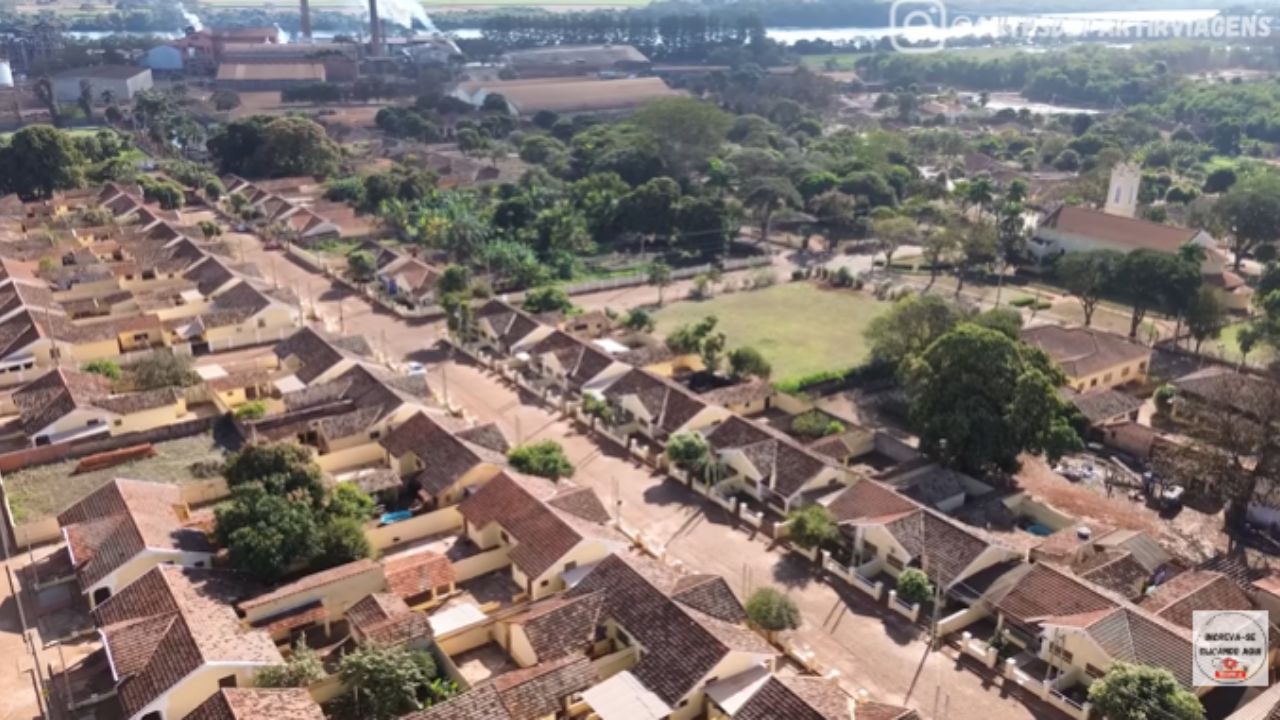


After Nearly Becoming a Ghost Town, the Former Worker Village of the Junqueira Plant Returns with Renovated Houses, Affordable Rent, and Residents Drawn by the Tranquility of the Paulista Countryside
A few kilometers from Igarapava, in the interior of São Paulo, the former worker village of the Junqueira plant is experiencing a rare movement of revival. The place that was created to house sugar workers, which once gathered more than a thousand people and nearly faded away with time, now shows off renovated houses, well-kept streets, and a quiet daily life that contrasts with its past of intense activity. Amid freshly painted walls and raw concrete washbasins, the village tries to balance memory, preservation, and a new phase where anyone can rent a house and live there.
“Don’t even compare, my son, with today. Back then, this place was too good,” summarizes a long-time resident, reminiscing about the time when the former worker village had a cinema, dances, a busy club, and a carnival that filled the halls.
If on one hand time took away much of the old population and transformed the village into almost a ghost town, on the other, the recent renovations, more affordable rents, and a sense of safety have once again attracted families from outside who are looking for exactly what remains: tranquility, history, and a simple countryside life.
-
These are the drivers who may stop paying tolls on highways in a project that promises to reduce costs for those who live from transportation in Brazil.

-
(Video): Italian pilot lands plane on moving train at 120 km/h and achieves unprecedented feat in aviation, even with a narrow runway and without direct visual contact.
-
It seems to have come out of a science fiction movie: A Brazilian city where it rains almost every day, recording over 4,000 mm per year, driven by climatic factors — a direct result of its strategic location in the Amazon.
-
The water crisis that could change everything this year has already begun; it’s not just about the climate, it affects technology, raises product prices, and can halt entire companies without warning.


How the Former Worker Village of the Junqueira Plant Was Born
The former worker village emerged in the early 20th century when Colonel Maximiliano Quito, a significant coffee producer in the region, decided to concentrate land, set up a sugar plant, and build a colony for the employees to live close to work.
The plant was built in the 1910s, right on the border between São Paulo and Minas Gerais, and the first houses arrived a few years later, forming a planned community, complete with a square, church, store, and recreational areas.
The project had a clear logic: work, housing, and well-being in the same place. The houses were maintained by the group connected to the plant and the foundation, residents did not pay rent or for water, and even received discounts on electricity.
The village provided the infrastructure for families to live there, raise children, attend school, go to mass, to the club, and to the cinema without leaving the neighborhood. For those who experienced this phase, the memory is of an intense and organized daily life where everyone knew each other by name.
When the Former Worker Village Almost Became a Ghost Town


As the decades went by, the landscape changed. The plant continued to exist, but the management of the former worker village distanced itself from the daily operations of the industry, falling under the responsibility of the Sinhá Junqueira Foundation.
Transformations in the sugar-energy sector, the opening of the market, and the arrival of other companies weakened the previous structure.
Gradually, many old residents left. Children who grew up there moved to larger cities, taking their parents with them, seeking new jobs.
Some houses were left empty for years, others fell into disrepair, and the village came to be seen as a place frozen in time, with closed doors, broken windows, and too much silence where there once was festivity and locomotives passing by.
In 2016, part of the residences had to be demolished due to structural issues, reinforcing the image of abandonment. It was from this intervention that the opposite movement also began: recovery.
Renovated Houses, Affordable Rent, and a New Phase for the Village
The recent turnaround of the former worker village began precisely with the renovation of the vacant houses. Today, anyone who enters some of them finds new ceilings, good condition floors, bathrooms with newly installed toilets and sinks, still sealed, and painted walls.
In several cases, the only thing revealing the closed time is the accumulated dust.
The homes maintain original characteristics, such as cement washbasins, wide backyards, and simple outbuildings that, many times, were built by the residents themselves over decades.
Each backyard tells a different story: in one house, there’s an extension that likely housed an adult child; in another, a large tree casts shade over the entire lot.
Today, anyone can rent one of these houses directly from the foundation, without needing to have worked at the plant. Most current residents, according to testimonials, come from outside.
Families from Campinas, people from Santa Catarina, and nearby cities have found an opportunity to live in a more tranquil place. The rental values mentioned range from 500 to 800 reais, varying according to the size and structure of the house.
The money from rentals goes back to the institution, which uses the revenue to maintain the village, pay employees, and finance social projects aimed mainly at underprivileged children.
Rare Tranquility: Unlocked Doors and a Sense of Security
If the phase of greatest movement is in the past, a hallmark of the former worker village remains very much alive: tranquility. Long-time residents insist that there has never been a serious robbery problem there.
The recurring memory is of cars left with the doors unlocked, bicycles on the sidewalks, and motorcycles parked outside, without fear of disappearing.
Even with changes in the surroundings and the departure of many historical residents, the village still preserves a sense of security that has become rare in many corners of the Paulista countryside.
This is precisely what attracts newcomers: those who arrive seek peace, a slower pace of life, and a sense of community.
For families that moved from larger cities, the possibility of letting their child play in the little field, walk to school or church without crossing busy avenues is a significant factor in the decision to stay.
Competing School and Community Life Around the Square

In the heart of the former worker village, the central square and the school remain as meeting points. The square, maintained by the foundation, features a statue of Colonel Quito in the middle, reminding everyone of the founder of it all.
Surrounding it is a lawn parched by the dry winter, but trees, benches, and common areas are cared for by staff who sweep, prune, and tend to the space.
The municipal school, which has existed since the time when the village was still directly connected to the plant, is now managed by the city hall of Igarapava.
Its reputation is for differentiated education. In earlier times, they even used booklets from a well-known private system, bringing the pedagogical standard closer to that of a private school within a public setting.
Therefore, there is a waiting list to study there, and many children come from the city and nearby areas in vans and school buses. For those living in the village, the administration usually does everything possible to secure a spot.
In front of the school, a well-maintained small soccer field shows that community life still thrives. Nearby, a simple old chapel, with a curved ceiling and triangular windows, awaits its turn in the renovation queue.
The main Catholic church continues to hold services on special dates, and an evangelical congregation also gathers worshippers from time to time. These celebrations are more spaced out than in their heyday but keep alive an important part of the local identity.
Memories of a Crowded Club, Cinema, and Locomotive in the Square
For the older residents, the former worker village is not just a place of aligned houses and stone streets. It is a complete backdrop of memories. There was a time when the local club was packed for elegant social dances, featuring famous singers performing in the hall.
The carnival was regarded as impeccable, to the point that relatives living in Brasília became members to spend the holiday there every year.
Besides the club, the village once had a cinema and a recreational center with a pool, gym, and games, set up so that employees and families could enjoy their little free time without having to leave the area.
In terms of work, the plant’s locomotives dominated the landscape until the 1970s, transporting cane, raw materials, and bagged sugar.
One of these locomotives, number five, was preserved, restored, and placed in a prominent position in one of the squares, as a monument and tourist attraction.
Today, while entry into it is not permitted, many people stop there to take photos and remember the time when the train was still the primary means of transporting production.
From the Store and Vouchers to the Silent Present
In the past, life in the former worker village also revolved around the store, a kind of market controlled by the administration.
The families received a paper with the “voucher” given by the boss, did their shopping, and the amount was directly deducted from the workers’ salaries. There was a self-contained economy, in a closed circuit, tying income, consumption, and housing into the same system.
Today, the entrance to the village concentrates the few remaining businesses: a restaurant, a snack bar, a small grocery store, and a bakery. It is there that workers from the still-operating plant stop for lunch, to have a soda, or to take care of small purchases.
The square near these commercial points is the busiest part of the day, but even so, the pace is much calmer than in any ordinary urban neighborhood.
The rest of the village remains silent, with stone streets, few people passing by, and houses that are sometimes occupied, sometimes awaiting new residents.
Former Worker Village Between Memory, Renovations, and an Uncertain Future
The recent rebirth of the former worker village of the Junqueira plant is not a return to the past, but an attempt to preserve what still exists, modernizing the minimum necessary, and giving new use to a heritage that could have been completely lost.
The renovations of the houses, the affordable rents, and the arrival of families from outside show that the place still has appeal, especially for those seeking peace and a simpler life.
At the same time, the memories of “how good it used to be” remain present in the speech of those who saw the village full: packed cinema, dances with orchestras, busy store, trains whistling, and carnivals that became a reference in the region.
Between what has been left behind and what can still be built, the village continues to exist, silent but resilient, supported by a foundation that attempts to balance conservation, social use, and history.
In light of all this, knowing that the former worker village today offers renovated houses, cheaper rent, and a tranquility that has almost disappeared from cities, would you have the courage to swap city life for a simpler routine in a place like this, or do you think you wouldn’t adapt to that pace?





Eu moraria sim nesse lugar até vou fazer uma visita na vila para conhecer e quem sabe até morar porque assisti o vídeo e fiquei apaixonada pelo lugar se o aluguel é enconta eu vou é tudo que procuro ❤️🙏🙏🙏🪷🌸
Trocaria sim , com certeza