





 Portuguese
  English
  Spanish
  4 min of reading
  2 comments


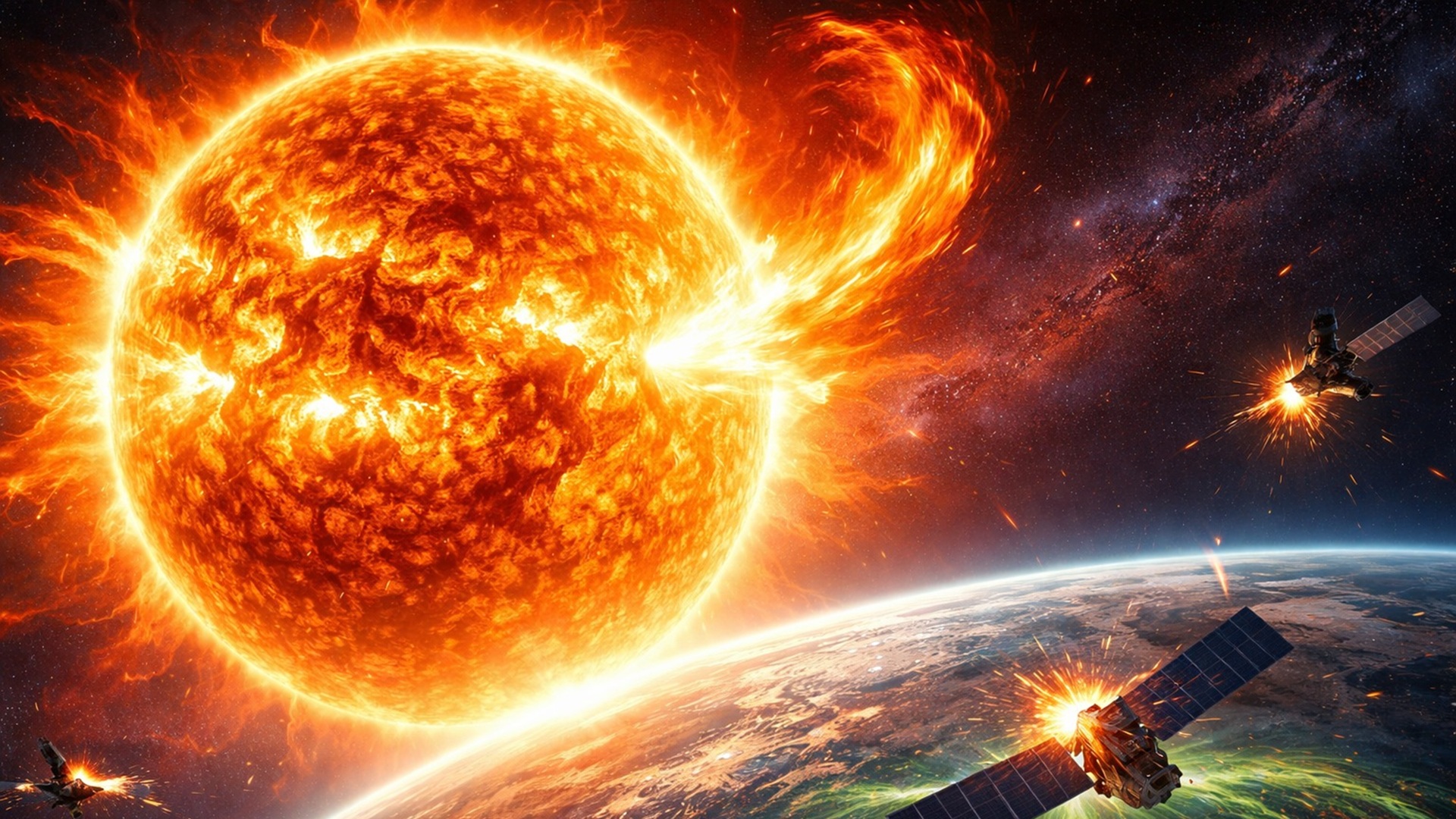


The Nearly Continuous Monitoring of Solar Region NOAA 13664 for 94 Days, Between April and July 2024, Combined Data from Two Spacecraft and Allowed Observation, Over Three Solar Rotations, of the Evolution of Complex Magnetic Fields Associated with the Most Intense Geomagnetic Storms Since 2003 and Technological Impacts on Earth
The nearly continuous monitoring of NOAA 13664 for 94 days allowed scientists to observe how a superactive solar region evolved over three solar rotations, resulting in the most intense geomagnetic storms recorded on Earth since 2003, in May 2024.
Unprecedented Monitoring of Solar Region NOAA 13664
The Sun completes a rotation around its axis approximately every 28 days, which normally limits the observation of an active region to about two weeks from Earth. After this period, the area remains hidden for a similar time on the opposite side of the star.
The Solar Orbiter mission, launched by the European Space Agency in 2020, expanded this field of observation by orbiting the Sun every six months and also visualizing the hidden side.
-
With a cost per shot close to zero, the DragonFire laser could change naval warfare in 2027 and provide British ships with nearly unlimited defense against drones.

-
A British startup creates tires that generate electricity in electric vehicles when passing over potholes, speed bumps, and cracks.

-
Scientists have created robots made with living cells that have their own nervous system, swim on their own, explore the environment, and self-organize without any genetic engineering, and now they want to do the same with human cells.

-
Students create a solar-powered ambulance that operates without a plug, without fuel, and still keeps medical equipment running in remote areas.


Between April and July 2024, the spacecraft monitored NOAA 13664, considered one of the most active solar regions observed in two decades.
When NOAA 13664 became visible in May 2024, it triggered geomagnetic storms classified as the most intense since 2003. The phenomenon was responsible for auroras observed as far south as Switzerland, according to researchers involved in the study.
Combination of Data from Two Spacecraft
To understand how superactive regions form, evolve, and affect the Sun, an international team led by researchers from ETH Zurich gathered observations from two distinct space missions.
Data from the Solar Orbiter, which observed NOAA 13664 on the hidden side, was combined with data from NASA’s Solar Dynamics Observatory, positioned on the Earth-Sun line.
This integration allowed monitoring of the active region with minimal gaps over 94 consecutive days. According to the researchers, this is the longest continuous series of images ever produced for a single active solar region, considered a milestone in modern solar physics.
The group managed to capture the birth of NOAA 13664 on April 16, 2024, still outside Earth’s line of sight, as well as all the transformations undergone by the region until its decline after July 18, 2024.
Magnetic Fields and Extreme Events on the Sun
Active regions of the Sun are shaped by intense and complex magnetic fields, formed when strongly magnetized plasma emerges to the solar surface. These structures can trigger explosive events, such as solar flares and ejections of plasma and high-energy particles into space.
During solar storms, the Sun releases intense electromagnetic radiation and matter from its atmosphere, phenomena capable of producing auroras and affecting technological systems. Researchers observed that NOAA 13664 developed, over three solar rotations, an increasingly intricate magnetic structure.
This process culminated in the release of the most intense solar flare in the last twenty years on the hidden side of the Sun, recorded on May 20, 2024. The gradual evolution of magnetic complexity was closely monitored thanks to the extended observation.
Technological Impacts Associated with NOAA 13664
The solar storms associated with NOAA 13664 had effects beyond auroras. These events can cause electrical blackouts, interference with communication signals, increased exposure to radiation for flight crews, and damage to orbiting satellites.
One example mentioned in the context of the study occurred in February 2022, when 38 of the 49 Starlink satellites launched by SpaceX were lost within two days after a solar storm. Similar phenomena help illustrate the risks associated with intense solar activity.
In May 2024, the effects of the solar typhoon linked to NOAA 13664 also impacted digital agriculture. Signals from satellites, drones, and agricultural sensors were disrupted, causing loss of workdays and resulting in crop failures with significant economic losses.
Advances in Space Weather Forecasting
The detailed tracking of NOAA 13664 allowed, for the first time, to observe three complete solar rotations of the same superactive region. Researchers monitored how the magnetic field developed through multiple episodes, providing unprecedented data for understanding solar storms.
These observations are expected to contribute to improving space weather forecasts, aiming to protect sensitive technologies used on Earth. Currently, although it is possible to identify regions with extremely complex magnetic fields, it is still not feasible to predict accurately the magnitude, number, or exact timing of solar eruptions.
As a next step, the European Space Agency is developing the Vigil mission, dedicated exclusively to studying space weather. The launch of the new spacecraft is scheduled for 2031 and should enhance monitoring capacity and understanding of solar impacts on the terrestrial environment.
The study detailing the monitoring of NOAA 13664 was published on December 5, 2025, in the journal Astronomy & Astrophysics, documenting one of the longest and most comprehensive records ever obtained from a single active solar region.








Hahaha quanta mentira
sério mesmo eu não acredito
Deus tem o controle de tudo,foi ELE quem criou todas as estrelas,o Sol,o universo,com suas galáxias, e todos os planetas na via láctea, tudo está nas mãos de Deus