





 Portuguese
  English
  Spanish
  4 min of reading
  1 comment


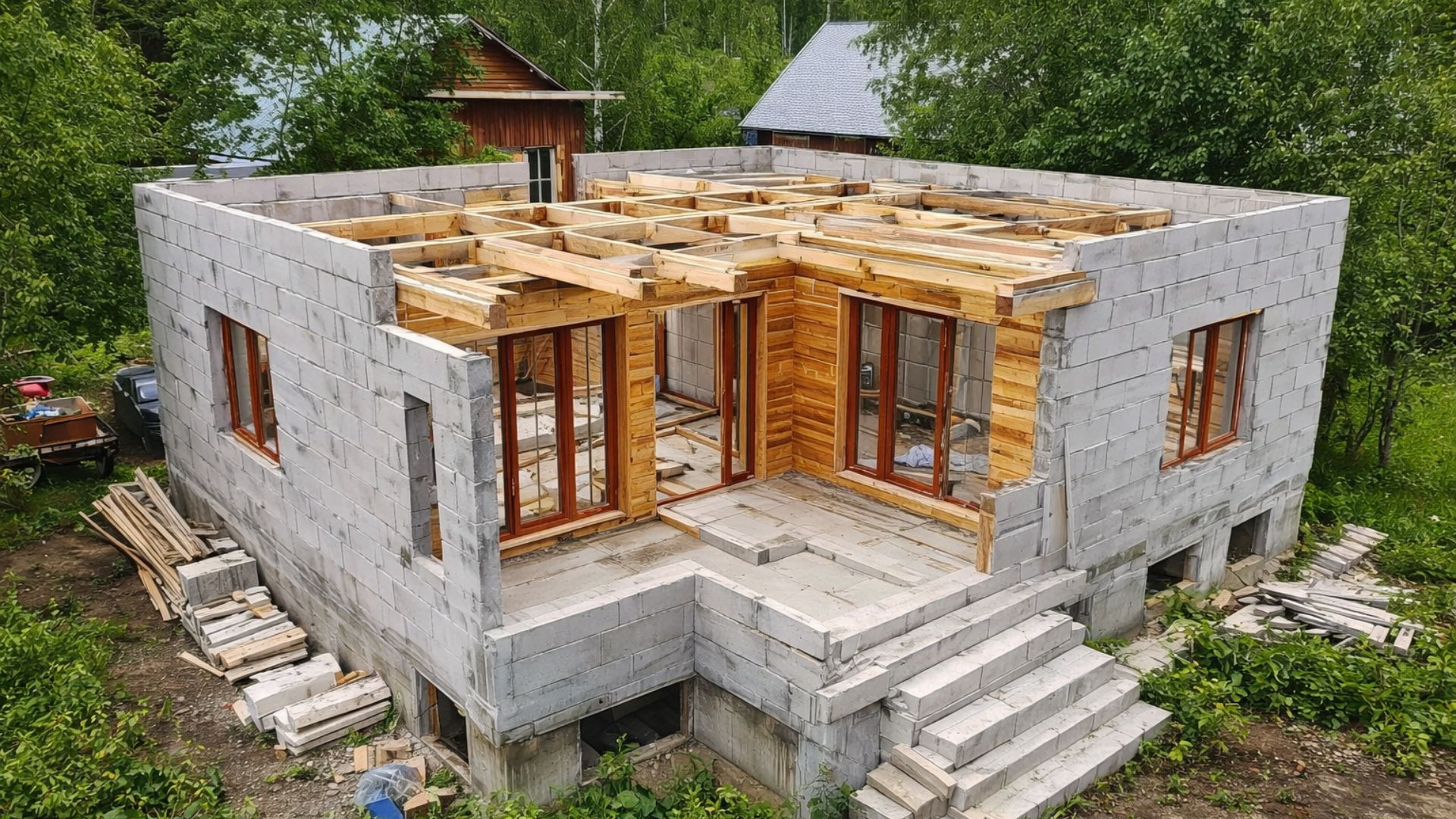


When Treating The Work As A Long-Term Engineering Project, The Builder Rejected Improvisations, Invested In Structural Performance, And Created A House Designed To Withstand Time, Weather, And Daily Wear And Tear
Building an entire house alone is often seen as impractical, but Dmitry Lukin decided to take on exactly that challenge. Over the course of 500 consecutive days of work, he transformed an empty lot into a complete residence, treating each decision as a life investment. Instead of rushing deadlines or irresponsibly cutting costs, the focus was entirely on quality, performance, and durability, resulting in a project that completely deviates from the common standards of modern construction.
The information was released by the Quantum Tech HD channel, which showcased the project in a video published with over 18 million views, showing all stages of the construction led by Dmitry on the profile @DmitryLukinDIY. Throughout the content, it’s clear that this is not just about building walls, but about applying logic, engineering, and discipline in every detail of the work.
Unlike what happens in a large part of current residential constructions, planning came before any action on site. And it is this mindset that explains why the project achieved such a high level of precision and efficiency.
-
The lack of welders, electricians, and operators becomes a structural threat in 2025, with the construction industry and manufacturing already suffering from delays, cost pressures, and labor shortages in Brazil.
-
Brazil and Paraguay are just 46 meters away from a historic union on the bioceanic bridge that promises to revolutionize trade between the Atlantic and the Pacific.
-
With 55 km over the sea, a cost of US$ 20 billion, and enough steel to build 60 Eiffel Towers, China’s largest project has connected Hong Kong, Zhuhai, and Macau in a colossal bridge that defies the logic of engineering.

-
A trick with joint compound transforms a Styrofoam ceiling into a plaster-like ceiling: leveled panels, wires and mesh at the joints, sand, paint, and change the environment while spending little today.

How Planning Transformed A Solitary Work Into An Engineering Project

From day one, Dmitry approached the construction as an integrated system, rather than a series of improvised tasks. Before laying the first block, he defined the exact order of execution, considering foundation, structure, sealing, insulation, and finishing as interdependent parts of a single technical project.
In addition, the choice of materials followed a clear criterion: performance over the decades, rather than immediate savings. Instead of what is referred to as “foolish economy,” which reduces costs in the short term and generates high maintenance expenses, he prioritized high-quality components, even knowing that the initial investment would be greater.
This approach avoided waste, rework, and future structural corrections. Each measurement was calculated so that the brick did not need to be cut, each layer had a specific function, and no stage compromised the next one. As a result, the work pace remained steady throughout the 500 days, without loss of quality or fatigue caused by repeated mistakes.
This level of organization also allowed the builder to work alone without compromising safety or execution accuracy, something rare in projects of this scale.
The Structural Logic That Prioritizes Thermal Performance And Absolute Stability
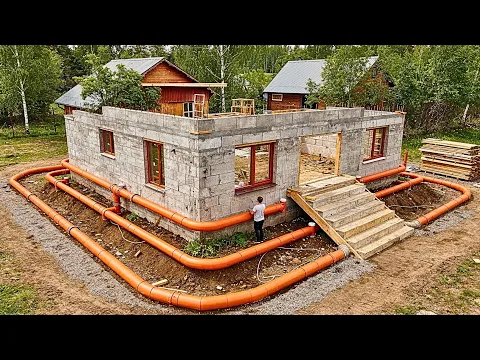

The walls of the house were not only designed to enclose the internal space, but to function as a complete thermal and structural system. Each layer — block, insulation, and facade — serves a specific purpose, ensuring mechanical resistance and internal comfort in any season of the year.
While the market standard typically prioritizes fast aesthetics for sale, Dmitry adopted an opposite philosophy: performance engineering. The walls act as a true thermal bottle, reducing heat exchange with the external environment and drastically decreasing the need for artificial heating or cooling.
This decision directly impacts energy consumption and the longevity of the construction. According to the comparison presented in the project, the applied method costs about 20% more during the construction phase, but generates an approximate savings of 50% in energy and reduces maintenance costs by up to 90% over the house’s lifespan.
Additionally, the structure was intentionally oversized, a concept known as over-engineered. This means that the house was designed to support loads and stresses far above the minimum required, ensuring stability for up to 100 years without the need for structural interventions.
Why Following The Correct Building Sequence Prevents Serious Failures
One of the central points of the project’s success was the absolute respect for the logical order of construction. Foundation, structure, sealing, insulation, and finishing were executed without shortcuts or inversions of steps, which is common in accelerated projects.
This discipline eliminated recurring problems in the market, such as leaks, cracks, and thermal bridges, which typically arise in less than five years in conventional constructions. By avoiding improvisations on-site, Dmitry ensured that each system worked in harmony with the others.
Moreover, the logic of the house’s daily use guided every choice. The work was not designed to visually impress in a quick visit, but to operate efficiently in the long term, providing real comfort to those living in the space.
This mentality allowed for a high standard of execution to be maintained throughout the entire process, even being a solitary and physically demanding job.
A Legacy Built With Patience, Precision, And A Vision For The Future
At the end of the 500 days, the result was more than just a completed house. Dmitry built a personal legacy, where each wall carries the mark of discipline, patience, and total control over the quality of execution.
Among the points that define this project are the absolute control of the work, solutions designed for real life, strategic use of premium materials, and the creation of a dwelling with its own identity. The finished house, illuminated at dusk, symbolizes not only comfort but the materialization of a project made to last across generations.
The example shows that building a house alone is not just a physical challenge, but an exercise in long-term vision. More than just raising walls, Dmitry proved that it is possible to build one’s own future with solidity, efficiency, and purpose.








No Brasil não se pode fazer isto senão a fiscalização manda suspender e destruir tudo. Isto porque a construção não de acordo com as normas da ABNT. Somos muito fiscalizadores, e queremos que a popuplação se sinta segura… bonito discurso!