





 Portuguese
  English
  Spanish
  5 min of reading
  0 comments


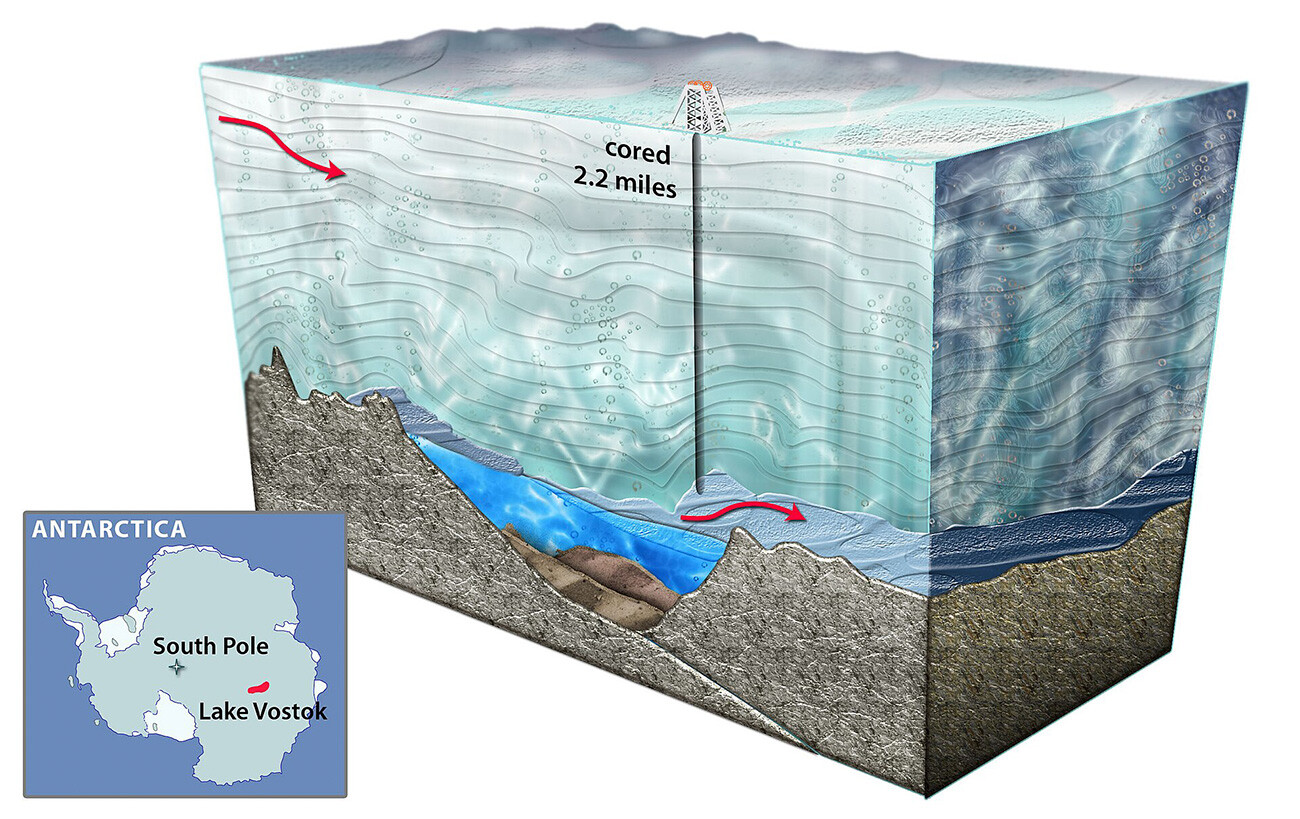
Subglacial Lake With 5.4 Trillion m³ Of Freshwater Remains Isolated Beneath Almost 4 Km Of Ice For Up To 25 Million Years And May Reveal Extreme Limits Of Life On Earth.
Behind this geological enigma is Lake Vostok, one of the most impressive findings of modern science. Hidden beneath the East Antarctic ice sheet, it holds numbers that defy any intuition: approximately 5.4 trillion cubic meters of fresh water, about 250 kilometers long, up to 50 kilometers wide, and almost 4 kilometers of ice above its liquid surface. Even more extraordinary is the time: the lake has remained isolated from the atmosphere for something between 15 and 25 million years, long before any human presence.
This combination of colossal volume, extreme isolation, and deep geological age — has transformed Vostok into a unique natural laboratory, capable of answering questions ranging from the evolution of life in extreme environments to the search for organisms beyond Earth.
A Freshwater Ocean Buried Under Ice
Lake Vostok is not a shallow pocket. Estimates suggest a mean depth of around 400 meters, with variations along its length. The total volume, in the range of 5,400 km³, places the lake among the largest freshwater reservoirs on the planet, larger than many famous surface lakes, though completely invisible.
-
He started running at 66 years old, broke records at 82, and is now a subject of study for having a metabolic age comparable to that of a 20-year-old, in a case that is intriguing scientists and inspiring the world.

-
Oldest tree on the planet reappears after 130 years of searches: Wattieza, 385 million years old, was 10 meters tall and had no leaves or seeds; Gilboa fossils in New York solved the mystery in 2007.
-
A 48-square-meter house assembled in hours with 4,000 bricks made of recycled plastic that does not absorb moisture, has natural thermal insulation, and costs less than 90,000 reais in a complete kit.

-
Luciano Hang revealed that Havan’s air fleet has already accumulated more than 20,000 landings, 10,000 flight hours, and 6 million kilometers traveled, and he says that without the planes, the company would never have grown so quickly.



For comparison, this volume would be enough to supply megacities for thousands of years, if it were accessible. But accessibility has never been the point. What makes Vostok unique is the fact that it exists without any contact with modern rivers, rains, or oceans, kept liquid by extreme pressure and geothermal heat rising from the Earth’s interior.
How Water Remains Liquid At −3 °C
At first glance, it seems impossible for a lake to remain liquid at such low temperatures. In Vostok, the explanation lies in physics. The pressure exerted by almost 4,000 meters of ice lowers the freezing point of water. At the same time, the geothermal flow from the ground provides enough heat to prevent total freezing.
The result is a stable, dark, and silent environment where water circulates slowly, with no waves, no wind, and no sunlight. A closed system that has been functioning for millions of years.
An Isolation That Challenges Known Biology
The most intriguing factor of Lake Vostok is not just its size, but its absolute isolation. For millions of years, there has been no direct exchange of water with the surface.
This means that any form of life existing there would have evolved without external influence, under conditions of extreme pressure, total absence of light, and minimal availability of nutrients.
For biology, this represents a rare scenario. Isolated environments for such a long time tend to develop unique lineages, adapted to conditions that would be lethal for common organisms. The mere possibility of living microorganisms in Vostok is enough to justify decades of research.
The Extreme Care Not To Contaminate The Past
Drilling through the ice to study the lake has always been an ethical and scientific challenge. Introducing modern microorganisms could contaminate an ecosystem intact for millions of years, destroying precisely what is intended to be studied.
Therefore, drilling projects have adopted extremely cautious methods, stopping excavations before reaching the liquid water and analyzing ice samples formed from indirect contact with the lake.
Even so, these samples have already indicated intriguing chemical and biological signatures, compatible with microbial activity.
A Climatic Archive Of The Ancient Planet
Beyond biology, Lake Vostok serves as a natural climatic record. The chemical composition of the water, the sediments at the bottom, and the ice above the lake hold information about periods when Antarctica had a climate very different from the current one.
Studying this system helps to understand:
- how polar continents responded to profound climate changes
- how water behaves in environments isolated for geological eras
- which physical limits allow the existence of liquid water on the planet
This data is valuable not only for reconstructing the past but for projecting future scenarios.
A Direct Analog For Extraterrestrial Worlds
Perhaps the broadest impact of Lake Vostok lies beyond Earth. Similar environments are expected on icy moons of the Solar System, such as Europa, a moon of Jupiter, and Enceladus, of Saturn. On these moons, it is believed that liquid oceans exist beneath thick ice layers, isolated from the surface for millions of years.
Vostok provides a real model for testing hypotheses: if life can exist there, it may also exist in extraterrestrial oceans. Every piece of data obtained from the Antarctic lake directly feeds into space missions and strategies for searching for life beyond our planet.
An Invisible Giant That Changes The Scale Of The Planet
The idea that 5.4 trillion cubic meters of fresh water can remain hidden beneath ice for millions of years changes how we understand the Earth’s natural resources. The planet does not just hold visible rivers and oceans; it hides entire systems beyond direct human reach.
This also redefines the concept of “scarcity” and “abundance.” In many cases, the greatest resources are not absent; they are inaccessible.
Why Lake Vostok Is Not A Water Solution
Despite the colossal volume, Lake Vostok is not a usable reservoir. Extracting it would mean destroying an irreplaceable scientific heritage and compromising a unique ecosystem. Its value lies in knowledge, not practical use.
It exists to answer fundamental questions: how does water behave in extreme isolation? What are the limits of life? What clues does the planet’s deep past still hold?
A Reminder Of How Much We Still Don’t Know
Even in the 21st century, with satellites and advanced sensors, one of the largest lakes on the planet remains hidden, untouched, and mysterious. Lake Vostok is a powerful reminder that Earth still holds secrets on a continental scale and that some of them are literally buried beneath our feet.
As the Antarctic ice silently covers this ancestral reservoir, science advances with caution, knowing that any misstep could erase millions of years of history.
In a world obsessed with quick answers, Vostok imposes another logic: that of deep time, where each discovery must respect the slowness with which nature itself built this invisible giant.








-

-

-

5 pessoas reagiram a isso.