





 Portuguese
  English
  Spanish
  7 min of reading
  6 comments


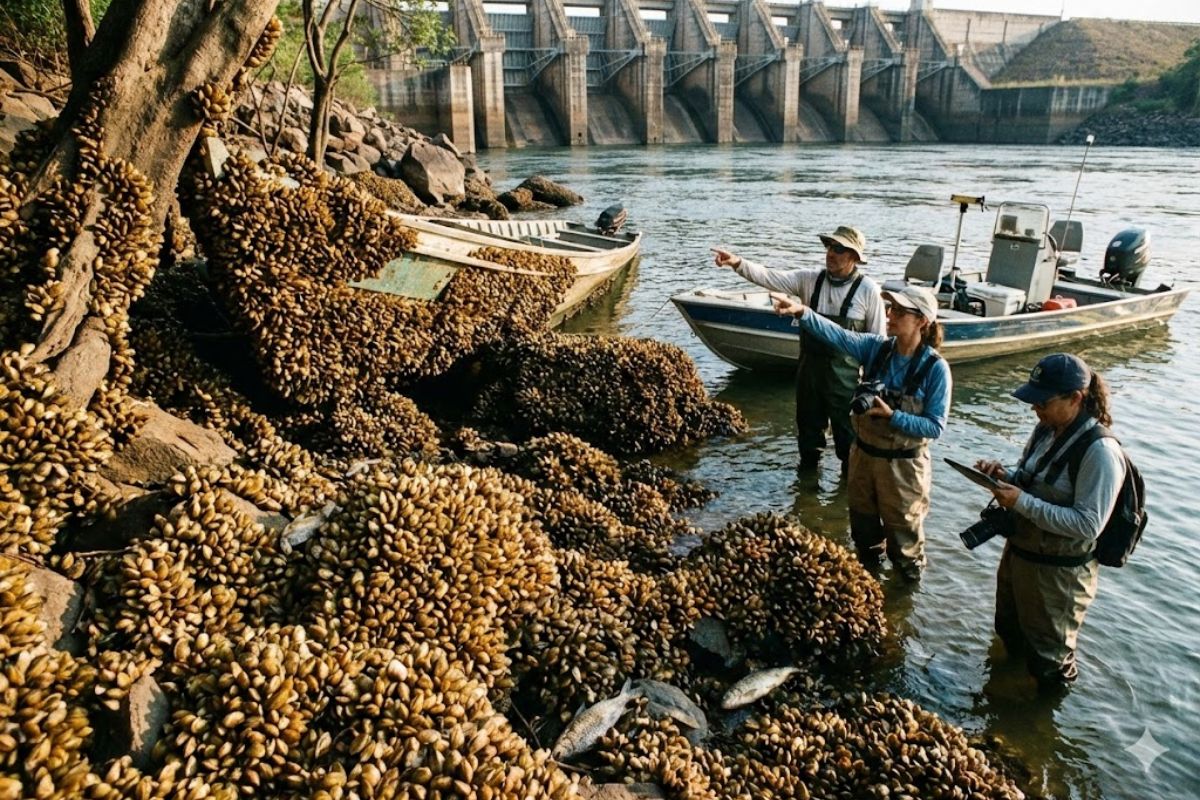


Collections in October 2024 at Pedral do Lourenço, between Marabá and Tucuruí, found the invasive mollusk Limnoperna fortunei measuring 2 to 22 mm and an average density of 11,940 individuals/m², compared to 88 in 2023, indicating adaptation and a completed reproductive cycle sooner than expected in the Amazon, posing risks to fishing and power plants
In the Tocantins River in Pará, the presence of the invasive mollusk golden mussel has ceased to be an isolated record and has begun showing typical signs of an established population, with a large number of individuals, size variation, and evidence of reproduction in the area of Pedral do Lourenço, between Marabá and Tucuruí.
The concerns described involve the aquatic life of the Amazon and immediate socioeconomic effects in Brazil, with reports of damage to fishing, impacts on aquaculture structures, and risks of fouling and obstruction in hydraulic compartments, a scenario that tends to increase maintenance costs in built systems, including power plants and water supply.
Where It Happened and Why the Tocantins River Came on the Radar

The occurrence of the golden mussel was recorded in the Tocantins River and directly connected to the Amazon region based on population data collected in Pará, focusing on Pedral do Lourenço, a rocky formation located between Marabá and Tucuruí. In this stretch, the collections indicated a rapid advance of the invasive mollusk Limnoperna fortunei, commonly known as the golden mussel.
-
With a cost per shot close to zero, the DragonFire laser could change naval warfare in 2027 and provide British ships with nearly unlimited defense against drones.

-
A British startup creates tires that generate electricity in electric vehicles when passing over potholes, speed bumps, and cracks.

-
Scientists have created robots made with living cells that have their own nervous system, swim on their own, explore the environment, and self-organize without any genetic engineering, and now they want to do the same with human cells.

-
Students create a solar-powered ambulance that operates without a plug, without fuel, and still keeps medical equipment running in remote areas.

The first record in the Tocantins River was in 2023, and since then, the species has raised concerns among researchers, environmental agencies, and riverside communities. The reason is clear: when a bioinvasion establishes itself in a river with significant regional connectivity, the potential for dispersion and colonization of new surfaces increases, especially in areas with artificial structures and intense human activity.
Why the Arrival in the Amazon Surprised Projections

The alarm grows stronger when compared to models that indicated a high risk of invasion of the Amazon basin starting only in the 2030s, consolidating around the 2050s. The finding of the invasive mollusk in the Tocantins River as early as 2023 shifts the timeline to the present, suggesting a proliferation that is occurring more rapidly than expected.
This discrepancy between projection and reality alters the type of response that is possible. Instead of a long-term preparation scenario, there is now an emergent management framework, especially since the species already shows signs of local adaptation and size diversity, which typically indicates reproduction and population continuity.
How Collections Were Made at Pedral do Lourenço

The samplings that supported the analyses took place in October 2024 at three points of Pedral do Lourenço. The described collection procedure was scraping of colonized surfaces, followed by conservation of the samples for laboratory stages focused on morphological identification and genetic analysis.
In addition to confirming the species, there was measurement of the individuals and estimates of population density, a central indicator for defining whether the invasion is in its early stage or has already advanced to an established stage. Density is an operational data, as it translates into numbers the pressure that the organism can exert on natural environments and built structures.
The Density Jump Between 2023 and 2024 That Raised the Level of Risk

The most notable result is the sharp increase in density over a short period. The average density reported in October 2024 was 11,940 individuals per square meter, compared to 88 individuals per square meter in 2023.
This difference suggests a change in level: one thing is to detect presence, another is to observe a massive occupation of surface. When the density spikes, it increases the chances of fouling in artificial areas, raises the volume of biological waste released into the environment, and intensifies competition for space and food with native species, especially in freshwater environments where the ecological balance can be sensitive to rapid changes.
Sizes Ranging from 2 to 22 mm and the Sign of a Completed Reproductive Cycle
The population found displayed individuals measuring between 2 and 22 millimeters. The presence of different size classes was interpreted as a sign that the golden mussel has already adapted to the local environment and possibly has reproduced at least once, as size variation suggests different growth stages coexisting in the same area.
This point is crucial for the risk narrative: it is not just about transported and still unstable organisms, but rather an invasive mollusk with evidence of a reproductive cycle and continuity. When reproduction is confirmed or strongly suggested by size structure, control becomes much more difficult, and the tendency is for occupation to expand over time.
Riverside Reports, Aquaculture, and Reinforcement That the Invasion Was Already Circulating
The presence of the golden mussel in the Tocantins River has also been confirmed by reports from riverside communities and records in aquaculture structures. In 2024, fish farmers in the state of Tocantins reported the invasive mollusk in net pens, reinforcing the hypothesis that the species had entered the region before the first official record.
In the same year, in September, residents of Marabá, Itupiranga, and Tucuruí reported to the Public Ministry of Pará the emergence of mussel beds at Pedral do Lourenço. This communication led to the activation of a task force involving the Evandro Chagas Institute (IEC), indicating that the problem had already exceeded the field of sporadic observation and reached the level of institutional mobilization.
What the Golden Mussel Alters in Water and Habitat
The environmental effects of the golden mussel are described as documented and related to well-known mechanisms of filter-feeding species. The species can alter the water transparency due to its high filtration capacity, change habitat quality by releasing a large volume of pseudofeces, and accumulate metals and toxins.
Additionally, the invasive mollusk can reduce the presence of bottom-dwelling animals, compete with native species for food and space, and trigger imbalances in aquatic life, including fish. In freshwater environments, such changes can reverberate in a chain, affecting biodiversity, food availability, and essential natural processes for the functioning of the ecosystem.
Impacts on Fishing, Material Losses, and Rising Costs
The socioeconomic component appears with direct examples. There are reports of fishermen losing nets, of fish farmers recording losses due to the accumulation of the mollusk in tank structures, and of obstruction of pipes due to an excess of individuals in hydraulic compartments.
This point tends to be decisive for the escalation of response, as the damage ceases to be merely ecological and also becomes financial and operational. When pipes and structures begin to obstruct, maintenance costs rise, technical shutdowns become more frequent, and the productive routine of communities and enterprises begins to be continuously impacted.
Why Control is Limited and Why “Eradicating” in the River is Nearly Impossible
The elimination of the golden mussel in natural environments is described as practically impossible. Control, when it occurs, tends to be restricted to artificial structures, such as hydroelectric plants and water supply systems, through combinations of physical, mechanical, chemical, and, to a lesser extent, biological methods.
The recommended approach is based on integrated protocols, combining different methods to keep structures free of fouling. This sets a realistic line: eradication in the environment is not promised, but rather damage reduction and operational maintenance of built systems, with constant monitoring and management.
Who Led the Analyses and How the Research Was Structured
The cited study was published in Acta Limnologica Brasiliensia with the title “Golden but not precious: first quali-quantitative data on golden mussels bioinvasion in the Amazon,” presenting the first quali-quantitative data and population analyses of the species in the region.
The main author mentioned is fishing engineer Rafael Anaisce das Chagas, a post-doctoral researcher at the Federal University of Pará and a researcher at CEPNOR/ICMBio. The cited funding involved the Evandro Chagas Institute (IEC) and the Ministry of Health (MS), with support from Cepnor/ICMBio, reinforcing that the survey had institutional structure and a focus on measurable data of density and establishment.
What the Data from Tocantins Indicates for the Amazon and Brazil
With a record in 2023, a density jump in 2024, size variation from 2 to 22 mm, and indications of reproductive cycle, the case of the Tocantins River points to an invasive mollusk already in an advanced phase of establishment in the Amazon. This raises the risk of combined impacts: ecological alteration in aquatic life and economic pressure on fishing, aquaculture, and infrastructure.
The practical reading is that the problem tends to be persistent and of ongoing management. When the species settles and reproduces, the cost falls on monitoring, control in structures, and damage mitigation, while the natural environment remains under pressure.
Do you believe that Brazil should treat the invasive mollusk in the Tocantins River as a national emergency, or is it still possible to contain the advance with only local actions?







Já deviam ter feito alguma coisa para evitar a proliferação e não ficar estudando. O Brasil sempre foi lento na tomada de decisões importantes.
Só faltou falarem se é comestível…..
Pelas fotos parece ser sururu,aqui no ES tem de água salgada e e uma delícia hehehe muito bom mesmo
Essa praga veio da Ásia é?? Até imagino de onde….