





 Portuguese
  English
  Spanish
  3 min of reading
  0 comments


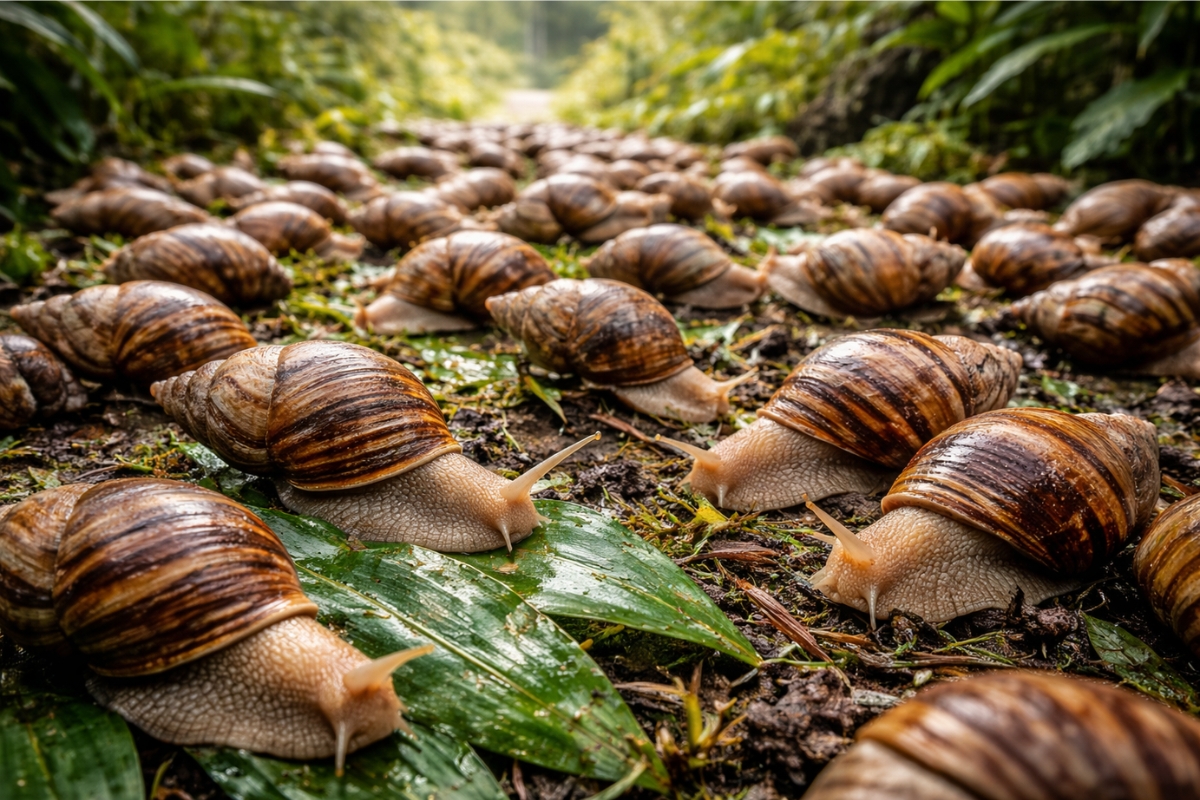
A Simple Introduction In 1936 Triggered Environmental Damage, Health Risk, and Extreme Pressure On Native Snails In One Of The Most Fragile Ecosystems On The Planet
The arrival of the African Giant Snail in Hawaii in 1936 began as a seemingly low-risk human act and ended as one of the most emblematic cases of biological invasion in the world.
In no time, the animal spread, affected gardens and crops, increased control costs, and contributed to creating a scenario of environmental and biological crisis in the archipelago.
The most severe chapter came afterward: an attempt to contain the invader made way for another predator, with a direct impact on native fauna and ecological balance.
-
A Brazilian millionaire couple restores a farm over 150 years old in the interior of São Paulo and transforms the historic property with Portuguese tiles, antique furniture, and new spaces into a refuge that blends tradition, comfort, and sophistication.
-
Submerged city in a lake in Minas reveals intact streets, preserved vehicles, and houses after more than 60 years, impressing divers.

-
Yellowstone has started to rise again in an area of the caldera, and the movement rekindles fears surrounding the U.S. supervolcano, as scientists monitor the deformation and try to understand what is happening underground.
-
Woman arrested after receiving $1.2 million due to banking error and not returning the amount.


What Happened And Why It Got Attention
The African Giant Snail established itself in Hawaii starting in 1936, with entries related to luggage and also mail delivery, going unnoticed.
Formal detection only occurred in 1938, when the species had already multiplied and formed sufficient populations to hinder a quick response.
On islands, this delay weighs heavily. The combination of favorable climate and low ecological resistance usually accelerates the expansion of invaders.
How The Snail Managed To Spread So Easily

The invader has a high-risk profile due to being a generalist consumer, capable of exploiting many types of food and environments.
Feeding is one of the central points: it can consume more than 500 types of plants, increasing its chance of survival in urban and rural areas.
Another factor is dispersal through human action. Soil, loads, and transported materials help carry eggs and individuals to new areas without being noticed.
Why This Became An Environmental And Economic Problem
The presence of the African Giant Snail brings direct damage to vegetation and crops, affecting gardens, plantations, and green areas.
There is also an impact on structures, as the animal can scrape surfaces in search of minerals, affecting materials used in coatings.
The result is a constant pressure for monitoring and control, with recurring costs and greater difficulty in humid regions with available shelter.
The Biological Control In 1955 That Turned Into A New Nightmare

To reduce the invader, the introduction of the Rosy Wolf Snail in 1955, a carnivorous terrestrial mollusk and voracious predator of other snails and slugs, was carried out by the Hawaii Department of Agriculture.
The plan seemed logical but brought a severe side effect: the predator also preys on native snails, with high potential impact on endemic species.
The problem worsens because the predator remains active in different environments, including forested areas where rare and vulnerable species live.
Native Biodiversity Was Already Fragile And Lost Space Quickly
Hawaii had an exceptional diversity of land snails, with more than 750 described species, a biological heritage shaped by the isolation of the islands.
The loss of this group is noted as massive, reaching 60% to 90% in some families, indicating a long-term collapse scenario.
When a generalist predator enters such a system, the risk increases because many species have no evolutionary defenses against this type of threat.
The Risk To Public Health That Enters Alert Along With The Invader
The crisis is not limited to the environment. The USDA and APHIS describe the snail as a relevant intermediate vector of the nematode Angiostrongylus cantonensis.
This parasite is associated with eosinophilic meningoencephalitis, making the issue also a matter of surveillance and prevention.
Care involves avoiding contact and accidental consumption, as well as reinforcing control actions in areas where the snail circulates close to residences and gardens.
The story of the African Giant Snail in Hawaii shows how an introduction in 1936 can escalate into an environmental and biological crisis when detection is late and control fails.
The impact goes beyond damage to plants. It involves loss of biodiversity, health risk, and the cascading effect of a decision made in 1955 that increased pressure on native species.




-

-

-

-

-

7 pessoas reagiram a isso.