





 Portuguese
  English
  Spanish
  5 min of reading
  0 comments


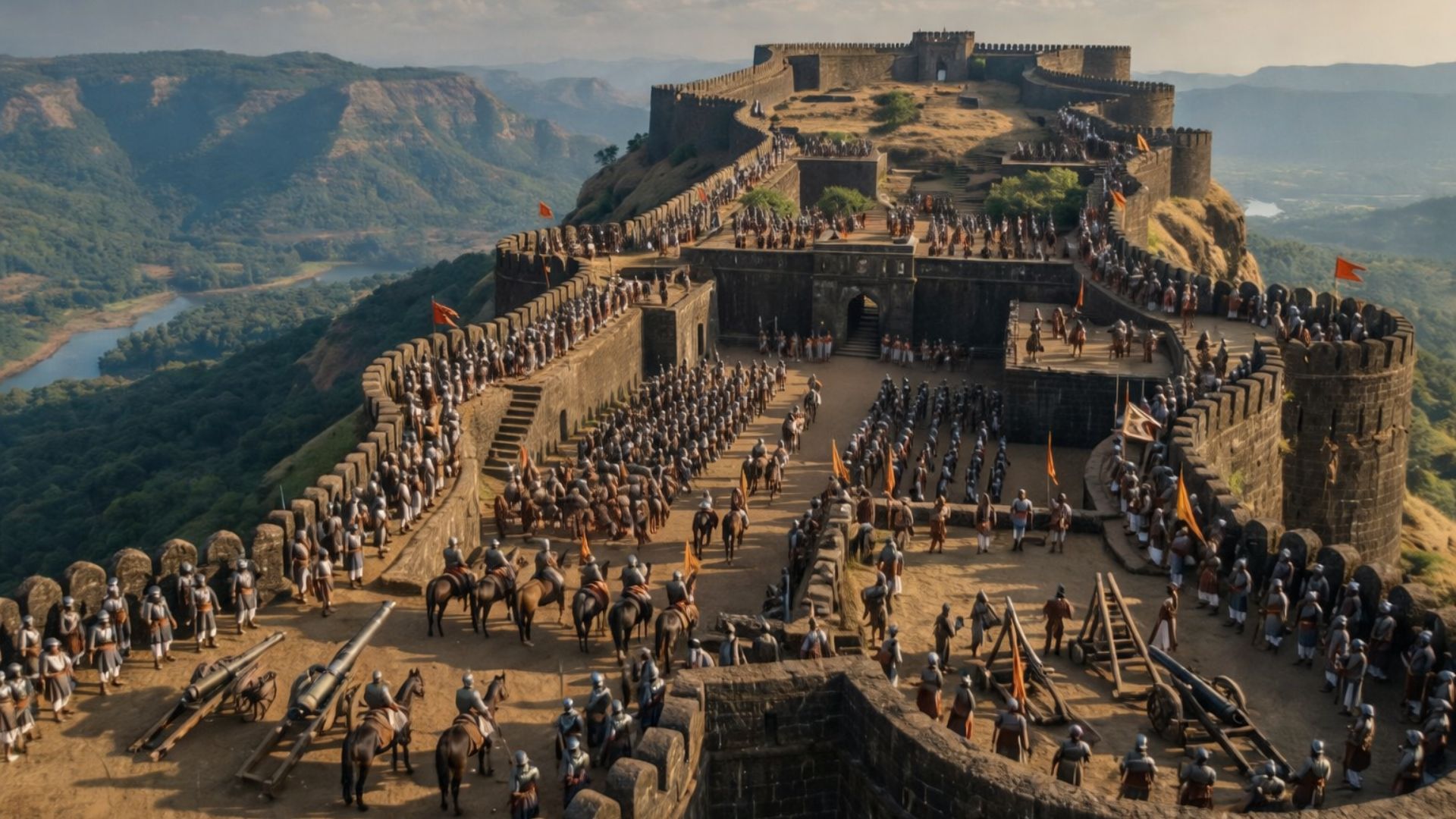
Hidden Strategies, Living Architecture and Territorial Intelligence Transformed Raigad Fort Into One of the Most Advanced Defensive Systems of Pre-Modern India
Built in the heart of the Sahyadri mountain range, in the current state of Maharashtra, the Raigad Fort was not just a fortress built on a mountain. It was, above all, the mountain itself converted into a weapon. The choice of terrain, the use of natural formations as vantage points, and the integration of architecture, geography and military strategy reveal a level of planning that continues to impress historians, engineers and defense specialists today.
This information has been disclosed through local historical accounts, cultural guides from the region, and records preserved by Indian researchers, along with traditional narratives passed down through generations. According to these sources, Raigad was considered a “gift from the Sahyadri” to Chhatrapati Shivaji Maharaj, who made the site the capital of his empire in the 17th century.
Right at the beginning of the ascent to the fort, the visitor realizes that nothing there is casual. The journey begins at the lower gate, known as Chit Darwaja, from where a long trail with approximately 2,000 steps extends over 3.5 kilometers, requiring an average of two hours of climbing. This route, besides being physical, already served as a first defensive filter, tiring potential invaders even before any confrontation.
-
Architects are burying plastic pipes 2 meters deep and using ducts up to 30 meters long to cool homes without electricity, with low-consumption fans and natural heat exchange that drastically cuts the electricity bill.

-
Under São Paulo, Line 6-Orange reaches 15.3 km and 15 stations, promising 23 minutes from Brasilândia to the Center and 633,000 passengers per day; with autonomous trains, it will open a partial section in October 2026.

-
Created by George Lucas with over $1 billion, a futuristic museum in the shape of a spaceship with 1,500 curved panels is about to open in Los Angeles and will house one of the largest private collections of narrative art in the world.

-
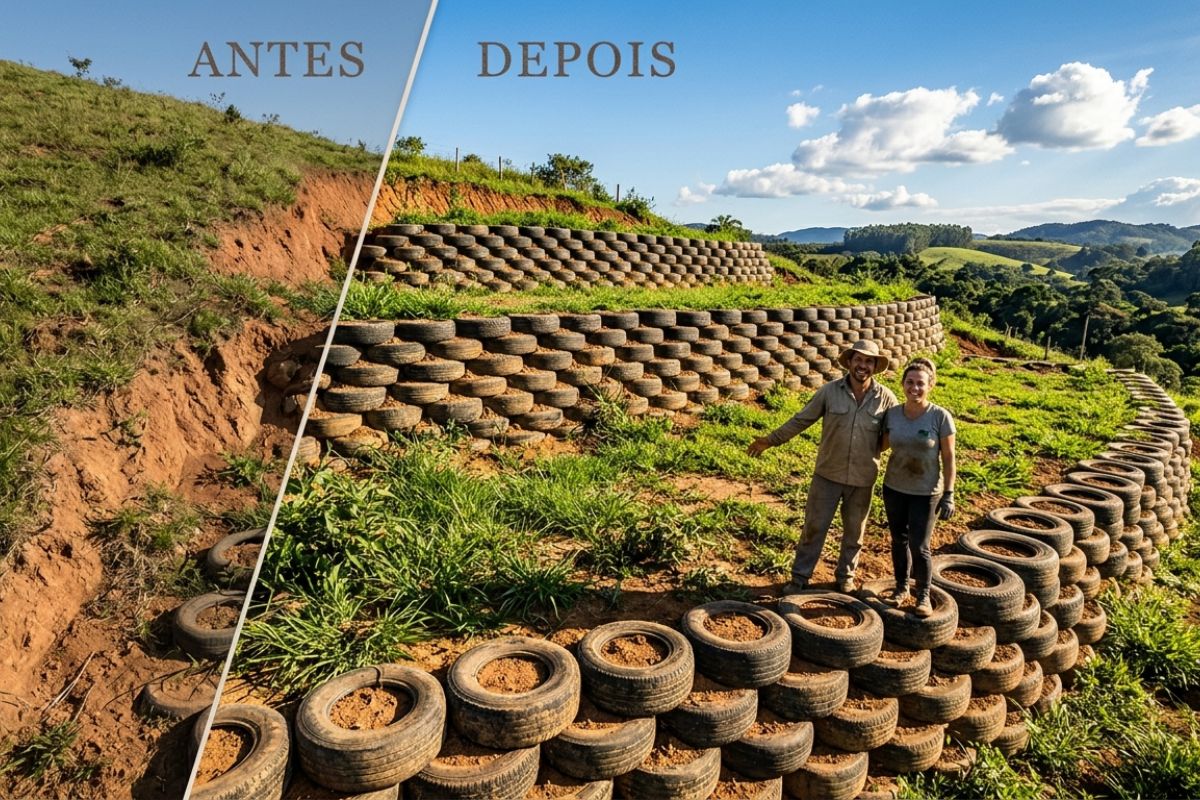
Couple shows how they built a retaining wall on their property using 400 old tires: sloped land turned into plateaus, tires are aligned, filled, and compacted with layers of soil, with grass helping in support and at almost zero cost.

Secret Watchpoints, Zigzag Doors, and Psychological Defense Integrated with the Terrain

As the ascent progresses, elements emerge that explain why Raigad was considered almost impregnable. One of the most impressive is the so-called Vagbil, a Marathi term that can be translated as “tiger’s eye.” It is a completely natural observation point, formed by fissures in the rock, allowing surveillance of the western side of the fort without sentinels being seen from outside.
From this location, two soldiers were sufficient to monitor the approach of enemies, especially at the front of the complex. Those observing from afar did not see people, only the rock itself, creating a defensive invisibility effect. Furthermore, the field of vision resembled the movement of a predator observing its prey, which reinforced the strategic advantage.
Another crucial element was the door system. Before reaching the main gate, the visitor had to pass through the Nane Darwaja, the “small gate.” Unlike straight and obvious entries, this access was designed in a winding shape, similar to a snake’s movement. In practice, this meant that projectiles fired from the outside—such as cannon fire—would collide with side walls, without hitting the interior of the fort.
Only after climbing more than a thousand additional steps did visitors arrive at the Mahadarwaja, the main gate, strategically located and protected from multiple attack angles. This combination of hidden doors, winding corridors, and elevation changes turned any attempt at invasion into a slow, confusing, and extremely risky process.
Ancestral Engineering, Natural Materials, and the Military Use of Local Vegetation


The sophistication of Raigad Fort was not limited to stone. One of the most advanced aspects of its construction was the use of ancestral mortar, produced without modern cement. The process utilized lime, jaggery, specific fruits, and water, mixed by oxen in large circular mills for up to a week.
This material, according to specialists, offered high durability and flexibility, resisting better to climate variations than many modern solutions. Interestingly, even today, staircases restored by the local government follow the same original formula, avoiding concrete and industrial cement.
In addition to engineering, local vegetation actively contributed to the defensive system. Certain plants were used as improvised weapons: fruits that caused intense itching and irritation were thrown at enemies during battles, incapacitating soldiers for hours. Other species served as natural antiseptics, quick healers, and even insect repellents, crucial in long military campaigns.
Aromatic plants were also used both in food and in treating wounds. Some leaves, when crushed and applied to cuts, almost instantly stopped bleeding, functioning as a type of “natural first aid kit” available on the very terrain.
The Story of Hirakani, the Vulnerable Point, and Shivaji Maharaj’s Strategic Response
Among all the stories linked to Raigad, none is as symbolic as that of Hirakani, a milk seller who became trapped inside the fort after the gates closed at dusk. Driven by the cries of her small child, who was outside, she managed to descend a nearly vertical section of the mountain during the full moon night, using only branches, roots, and fissures in the rock.
When this feat came to the attention of Shivaji Maharaj, the reaction was revealing. Instead of punishment, there was strategic reflection. If a common woman could descend that point, a trained enemy might attempt the same. The response was immediate: the construction of a watchtower and blockade at the site, which became known as Hirakani Point, in honor of the woman’s courage.
This episode also reinforces an aspect often highlighted in historical accounts: Shivaji Maharaj was known for his respect for women, prohibiting any form of abuse in his domains and ensuring dignified treatment even in times of war.
A Military System That Still Challenges Modern Concepts of Defense
When analyzing Raigad Fort from a contemporary perspective, it becomes clear that its effectiveness did not rely on high walls or large armies, but on territorial intelligence, integration with the environment, and maximum use of available natural resources. Every curve, every step, and every rock had a specific function within a coherent defensive system.
More than a historical monument, Raigad remains as a living manual of ancestral military engineering, demonstrating that, centuries before satellites and electronic sensors, there were already invisible surveillance systems, psychological defense, and strategic architecture capable of transforming a simple mountain into a practically impenetrable fortress.








-

-

-

-

-

9 pessoas reagiram a isso.