





 Portuguese
  English
  Spanish
  2 min of reading
  0 comments


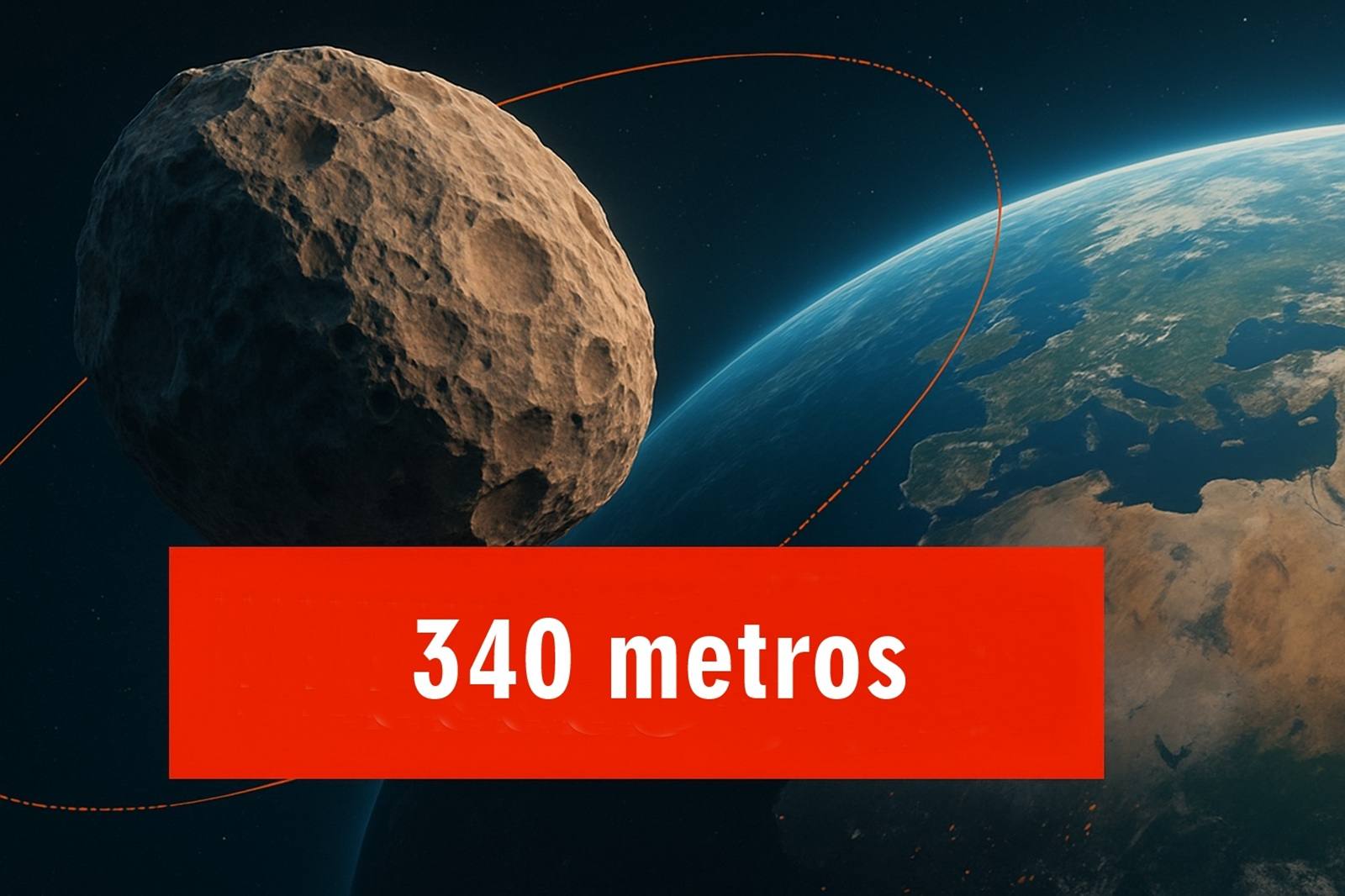
In April 2029, the Asteroid Apophis Will Make a Rare Approach to Earth, Visible to Billions, and Will Offer Unique Opportunities for Scientific Research.
The Asteroid Apophis, named after the Egyptian deity of chaos and darkness, is on a trajectory toward Earth. With a diameter of 340 meters, the celestial body will pass within 5.9 Earth radii on April 13, 2029.
Initially, scientists considered Apophis a real threat. However, after more than 20 years of astrometric and radar analysis, they dismissed any chance of collision. Still, the phenomenon generates enormous interest because an approach of this magnitude occurs, on average, once every 7,500 years.
Unprecedented Scientific Opportunity
The proximity of the asteroid will open new doors for planetary science and for Earth’s defense. The flyby will allow researchers to observe how the gravitational field and the magnetosphere influence Apophis’s trajectory and characteristics. According to Space.com, measuring these properties is essential for developing effective defense strategies against possible future threats.
-
Motorola launched the Signature with a gold seal from DxOMark, tying with the iPhone 17 Pro in camera performance, Snapdragon 8 Gen 5 that surpassed 3 million in benchmarks, and a zoom that impresses even at night.

-
Satellites reveal beneath the Sahara a giant river buried for thousands of kilometers: study shows that the largest hot desert on the planet was once traversed by a river system comparable to the largest on Earth.

-
Scientists have captured something never seen in space: newly born stars are creating gigantic rings of light a thousand times larger than the distance between the Earth and the Sun, and this changes everything we knew about stellar birth.

-
Geologists find traces of a continent that disappeared 155 million years ago after separating from Australia and reveal that it did not sink, but broke into fragments scattered across Southeast Asia.

Additionally, the event will bring together different space missions. The European Space Agency is preparing the RAMSES mission, while Japan’s DESTINY+ is also expected to approach the asteroid. NASA, for its part, has already confirmed OSIRIS-APEX, designed to closely study the effects of the flyby.
A Spectacle Visible to Billions
As probes and agencies plan their part, Earth will also have a special role. Apophis will be visible to the naked eye for about two billion people, especially in regions of Africa and Western Europe.
This moment is expected to mark modern astronomy. After all, it is not common for an object of this size to pass so close without posing a risk, while still offering a rare opportunity for collective observation and learning.







-

Uma pessoa reagiu a isso.