Portuguese
  Spanish


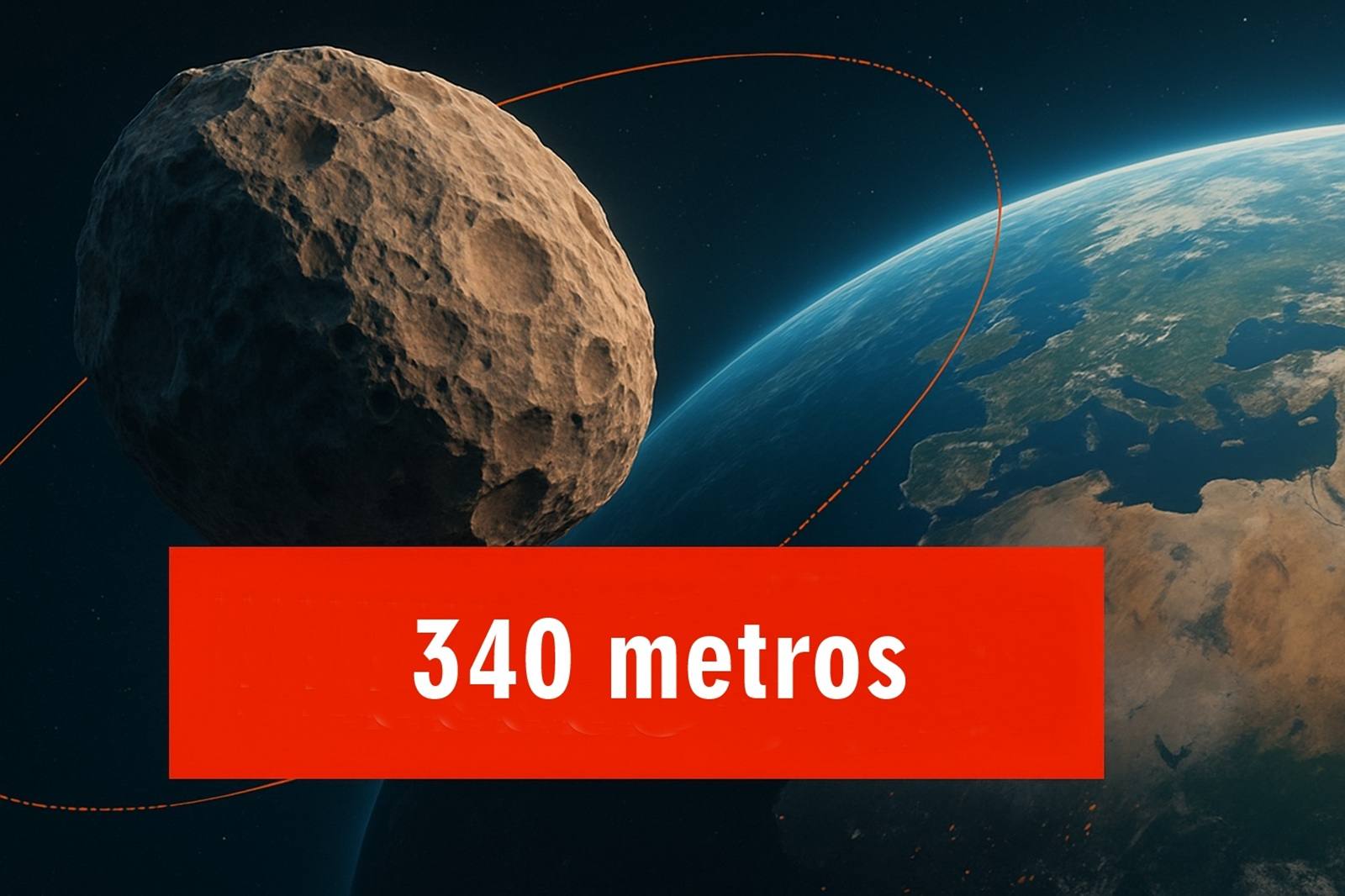


In April 2029, the Asteroid Apophis Will Make a Rare Approach to Earth, Visible to Billions, and Will Offer Unique Opportunities for Scientific Research.
The Asteroid Apophis, named after the Egyptian deity of chaos and darkness, is on a trajectory toward Earth. With a diameter of 340 meters, the celestial body will pass within 5.9 Earth radii on April 13, 2029.
Initially, scientists considered Apophis a real threat. However, after more than 20 years of astrometric and radar analysis, they dismissed any chance of collision. Still, the phenomenon generates enormous interest because an approach of this magnitude occurs, on average, once every 7,500 years.
Unprecedented Scientific Opportunity
The proximity of the asteroid will open new doors for planetary science and for Earth’s defense. The flyby will allow researchers to observe how the gravitational field and the magnetosphere influence Apophis’s trajectory and characteristics. According to Space.com, measuring these properties is essential for developing effective defense strategies against possible future threats.
-
Scientists Convert Food Waste into Aviation Fuel, Successfully Test 50% Blend with Conventional Kerosene to Cut Emissions and Promote Sustainable Flights

-
OnePlus N6 Smartphone to Launch in India with 8,000mAh Battery and 45W SuperVOOC Charging, Lasting Up to Three Days
-
Scientists Plan to Release Air Bubbles Underwater to Protect Antarctica’s “Doomsday Glacier” from Melting

-
Chinese R6000 Drone Combines Airplane and Helicopter Features, Carries Up to 12 People for Multiple Missions




Additionally, the event will bring together different space missions. The European Space Agency is preparing the RAMSES mission, while Japan’s DESTINY+ is also expected to approach the asteroid. NASA, for its part, has already confirmed OSIRIS-APEX, designed to closely study the effects of the flyby.
A Spectacle Visible to Billions
As probes and agencies plan their part, Earth will also have a special role. Apophis will be visible to the naked eye for about two billion people, especially in regions of Africa and Western Europe.
This moment is expected to mark modern astronomy. After all, it is not common for an object of this size to pass so close without posing a risk, while still offering a rare opportunity for collective observation and learning.