





 Portuguese
  English
  Spanish
  5 min of reading
  2 comments


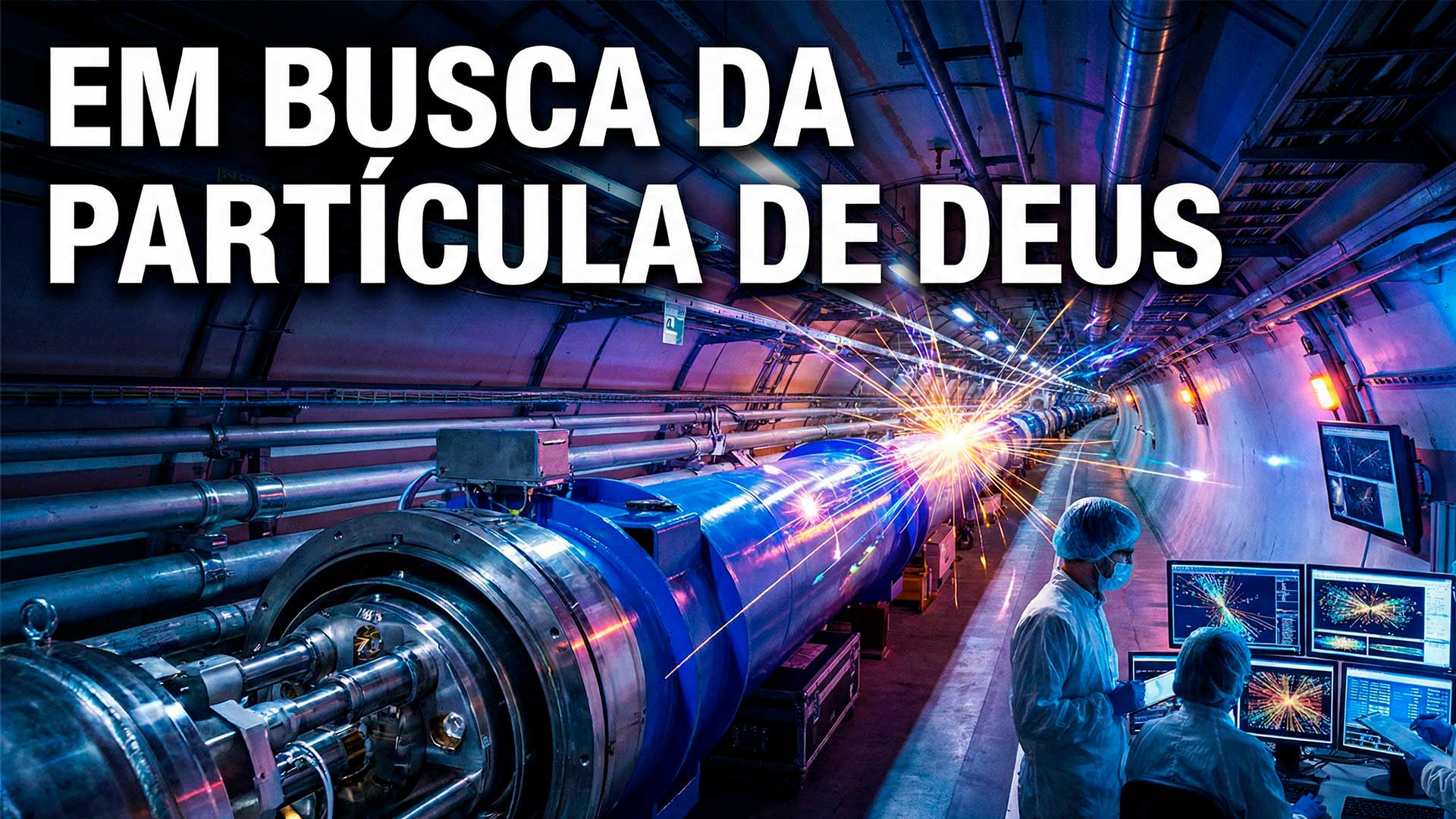


A Subterranean 27 Km Ring on the France-Switzerland Border Accelerates Protons Near The Speed Of Light To Investigate The Birth Of The Universe. At CERN, The Large Hadron Collider (LHC) Confirmed The Higgs Boson And Now Seeks Signs Of Dark Matter And New Physics
Under the green fields on the France-Switzerland border operates a 27-kilometer machine that attempts to recreate the first moments of the Universe. It is the Large Hadron Collider (LHC), installed at the European laboratory CERN, currently the largest particle accelerator in the world.
The LHC is a kind of subatomic racetrack, where particles receive small successive pushes until they reach extreme energies. Currently, the accelerator operates with energies on the order of 6.5 to 6.8 TeV per beam, producing collisions of up to 13.6 TeV.
When two beams collide head-on, the energy of the impact transforms into new particles, as predicted by the famous equation E=mc². For unimaginably small fractions of a second, the LHC recreates conditions reminiscent of the Universe just after the Big Bang.
-
With over 14 million baskets of earth moved, an ancient North American metropolis built a monumental pyramid of 30 meters and established a city with 20,000 inhabitants nearly a thousand years ago.

-
A 1,900-year-old treasure emerges from a Roman house destroyed by fire and sealed since antiquity in Romania, with coins and metals fused among the ashes.

-
The Brazilian colonial city that stopped in time and shares territory with a rocket launch base.

-
79-year-old woman challenges limits, visits 193 countries in the world after 56 years of planning and reveals the behind-the-scenes of a global journey that few have managed to accomplish.

The project involves over 10,000 scientists and engineers from dozens of countries, including teams from Brazil in all major LHC experiments. These teams analyze data, build detectors, and operate computing centers that connect the country to the frontier of particle physics.
LHC Is A 27 Km Ring That Recreates The First Instances Of The Big Bang
The Large Hadron Collider occupies a circular tunnel of 27 kilometers, buried up to 175 meters under the Geneva region. Along the ring, 1,232 dipole magnets and hundreds of superconducting quadrupoles keep the proton beams guided and focused.
The protons start as common hydrogen, pass through smaller accelerators, and arrive at the LHC already at high energy and well organized in packs. Radio-frequency cavities give small electrical pulses with each lap, until the particles travel a few meters per second below the speed of light.
At four points around the ring, the beams are crossed inside giant detectors like ATLAS and CMS, some larger than multi-story buildings. Millions of sensors register the passage of particles, and from these traces, software reconstructs each collision as if it were a 3D puzzle.
From The Higgs Field Theory To The Discovery Of The “God Particle”
The Higgs boson is the particle associated with an invisible quantum field that permeates all space and gives mass to many fundamental particles. Without the so-called Higgs field, electrons, quarks, and other particles would behave as if they had no mass, which does not match the reality we observe.
The idea of the Higgs field was proposed in 1964, but for nearly 50 years, the boson remained only a theoretical prediction. Producing it required very energetic and plentiful collisions, something that the LHC finally made possible with its unprecedented energies and event rates.
On July 4, 2012, the ATLAS and CMS collaborations announced the observation of a new particle with about 125 GeV, consistent with the Higgs boson, with a significance of 5 sigma. The discovery, celebrated worldwide and which led to the 2013 Nobel Prize, closed a central piece of the Standard Model but also opened new questions about the cosmos.
Extreme Engineering: Colder Than Space And Planetary Scale Data
For the magnets to function as superconductors, the LHC operates at about 1.9 Kelvin, around -271 degrees Celsius, colder than space. This extreme temperature is maintained by a cryogenic system that uses about 120 tons of liquid helium circulating through thousands of connections.
The main magnets produce fields of up to 8.3 Tesla, guiding the beams with currents of nearly 12,000 amperes in niobium-titanium cables. If something goes wrong and the material loses superconductivity, a quench occurs, forcing a shutdown and re-cooling of part of the ring.
Keeping all this running consumes around 120 megawatts, comparable to a significant fraction of the consumption of the Geneva region. Much of this energy powers the cryogenics, turning the LHC into one of the largest cryostats ever built.
Each day of operation generates hundreds of terabytes of data, which would not fit in a single computing center. This led to the creation of the Worldwide LHC Computing Grid, a global network that connects dozens of countries, including Brazil, to jointly process the most interesting events.
In the country, centers like SPRACE in São Paulo analyze data from the CMS experiment and participate in the development of electronics and software for the detectors. This effort trains specialized personnel and generates technology that later appears in areas such as medical imaging, telecommunications, and big data systems.
From The High-Luminosity LHC To Future Colliders And Dark Matter
The next step of the project is the High-Luminosity LHC (HL-LHC), an upgrade that should multiply the number of recorded collisions by up to 10. According to the most recent schedule, the new phase should begin around 2030, after an extended technical stop starting in 2026.
With much more data, physicists want to study the Higgs in detail and search for signs of dark matter, investigating, for example, invisible decays of the boson. Recent results from ATLAS and CMS already limit the probability of the Higgs decaying into invisible particles to about 15%, ruling out several theoretical models.
For after 2040, there is discussion about building the Future Circular Collider (FCC), a ring of up to 100 kilometers that would serve as a new Higgs factory and an even more energetic collider. Recent documents show that the Brazilian community is already organizing to participate in these projects, reinforcing the country’s presence in the next generation of colliders.
In your opinion, do the LHC and future colliders bring enough return in knowledge, technology, and training of people to justify this global effort, or is the pursuit of the so-called “God particle” a scientific luxury? Let us know in the comments what you think about this dispute between cosmic curiosity and urgent needs here on Earth.







Investigação científica é para o bem da humanidade, se houvesse menos investimento em guerras e ganância a humanidade resolveria seus problemas em pouco tempo.
A ciência é o universo, partindo do principal, a matéria é limitada e se fragmenta, como somos matéria tudo ao nosso redor é também limitado, por isso nunca vamos conhecer o desconhecido infinito a partir da matéria, podemos chamar de mundo espiritual esse argumento está na base espiritual, um mundo invisível inteligente, é impressionante a imaginação humana.😱