





 Portuguese
  English
  Spanish
  6 min of reading
  0 comments


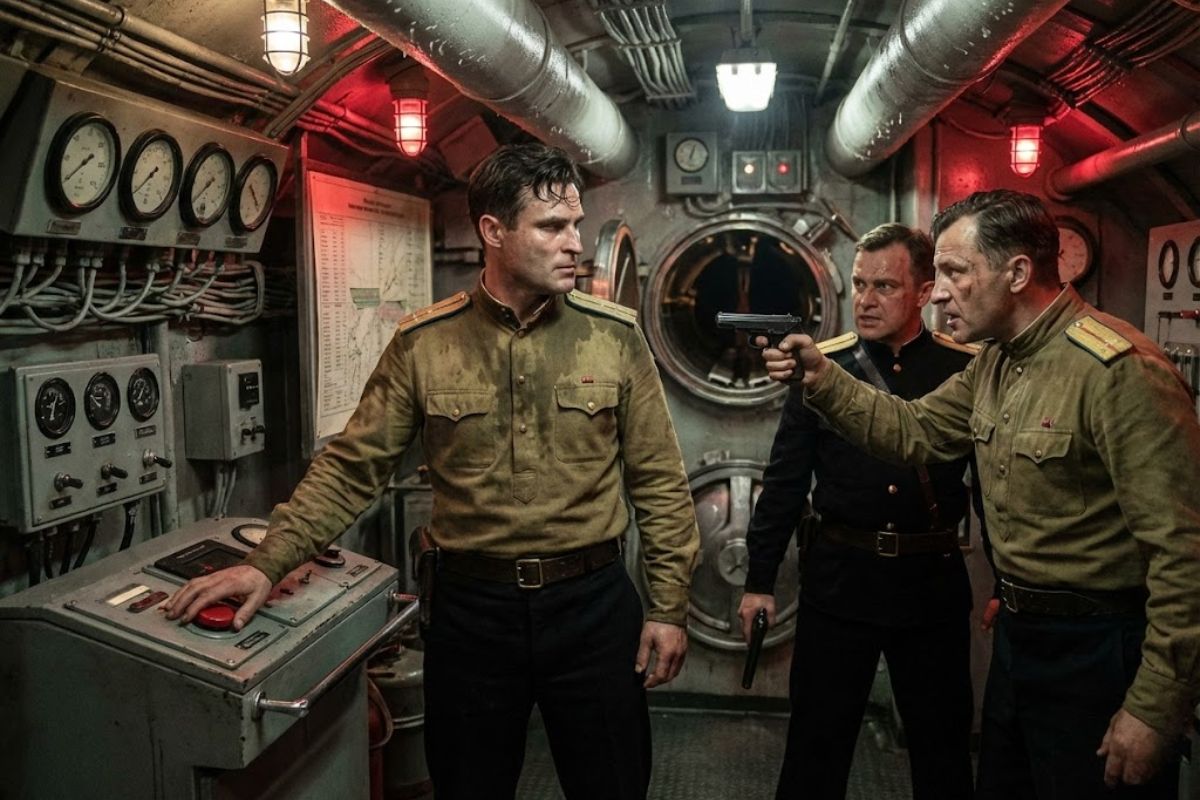
On October 27, 1962, the man Arkhipov was isolated in the Soviet submarine B-59, without communication with command, under apprehension and misinformation. With three officers required to authorize the launch, he refused the nuclear torpedo, faced internal pressure, and helped contain the Cuban missile crisis.
At the height of the Cuban missile crisis, a man of 36 years, Vasili Arkhipov, lived through one of the narrowest and tensest scenarios of the Cold War: locked in the Soviet submarine B-59, without communication with central command, surrounded by apprehension, misinformation, and internal pressure for an irreversible decision.
The story focuses on a specific and operational point: the proposal to launch a nuclear torpedo within the B-59. While colleagues considered the launch as a possible response, Arkhipov, one of the three senior officers required to authorize the launch, said no and blocked the authorization at a moment when minutes and distorted perceptions could have escalated the crisis.
Where It Happened and Why October 27, 1962 Was Different

The episode occurred inside the soviet submarine B-59 during the Cuban missile crisis on October 27, 1962, a time when the world faced the imminent risk of nuclear war. The larger context was the Cold War, with the United States and the Soviet Union positioning strategic missiles and responding to each move with high sensitivity.
-
He started running at 66 years old, broke records at 82, and is now a subject of study for having a metabolic age comparable to that of a 20-year-old, in a case that is intriguing scientists and inspiring the world.

-
Oldest tree on the planet reappears after 130 years of searches: Wattieza, 385 million years old, was 10 meters tall and had no leaves or seeds; Gilboa fossils in New York solved the mystery in 2007.

-
A 48-square-meter house assembled in hours with 4,000 bricks made of recycled plastic that does not absorb moisture, has natural thermal insulation, and costs less than 90,000 reais in a complete kit.

-
Luciano Hang revealed that Havan’s air fleet has already accumulated more than 20,000 landings, 10,000 flight hours, and 6 million kilometers traveled, and he says that without the planes, the company would never have grown so quickly.


This framing is essential because, on that day, the contest was not only in speeches and maps. It was compressed into a closed environment, with a broken chain of command and people trying to decide based on incomplete information. The place was the B-59, and the time was a moment of continuous pressure, when the margin for error seemed minimal.
The Cuban Missile Crisis and the Trigger for Naval “Quarantine”

The Cuban missile crisis, also known as the October Crisis, reached a critical point when, in October 1962, U.S. President John F. Kennedy revealed the installation of Soviet missiles in Cuba, about 200 km from American territory. This proximity heightened the perception of immediate threat and pushed the crisis to a state of readiness.
Kennedy’s response was to impose a naval “quarantine,” a measure that opened a tense period of thirteen days and mobilized the world. During this phase, every decision was interpreted through the filter of the worst-case scenario. The practical effect was a global environment of frayed nerves, where gestures, movements, and silences gained strategic readings.
Isolation in the B-59 and Misinformation as a Risk Factor

Inside the submarine B-59, Arkhipov was isolated with the crew. The described condition is straightforward: without communication with central command, the situation was exacerbated by apprehension and misinformation. This means that, at the moment when external tension was rising, the internal environment of the submarine was accumulating uncertainty, doubts, and interpretations.
This detail is central to understanding why the decision cannot be treated as an abstract debate. The B-59 was a closed, isolated space, and the absence of contact with central command meant that the crew had to decide based on a set of fragmented perceptions. When information disappears, pressure fills the space, and the Cold War was precisely a period when decisions were made under constant suspicion.
The Nuclear Torpedo Proposal and the Rule of Three Officers

The most important operational point is clearly outlined: there was a proposal to launch a nuclear torpedo. It is not a distant rumor, but an initiative put on the table within the B-59. Arkhipov’s colleagues considered the attack, evaluating the possibility of launching in the climate of fear.
But the authorization procedure in this episode required three senior officers to approve the launch. Arkhipov was one of the three. This transforms the story into an equation of consent: without his agreement, the launch was not authorized. His decision was not just an opinion; it was an effective blockage of the act.
The “No” from the Man Arkhipov and the Confrontation Within the Submarine
The described decision boils down to a verb that, in that context, weighs as a mechanism of containment: to refuse. Arkhipov refused to approve the launch of the nuclear torpedo. And the refusal occurred under intense pressure, with reports indicating that he faced armed colleagues and maintained his position in absolute silence.
This combination of elements gives dimension to the moment: a man trapped in a submarine, without external contact, surrounded by internal tension, pressured by peers who were ready to act. The refusal was the line that separated the execution of a escalation from a return to control. The strength of this decision lies in the fact that it was made in the place where the launch could take place, and not in a negotiation room.
How the Individual Decision Fit into the Logic of the Cold War
The Cold War was marked by the idea that the global system depended on deterrence, readiness, and signaling. In this environment, individual decisions could serve as the last barrier before actions that would shift the level of confrontation.
The B-59 episode reinforces this characteristic: an individual decision, within a military system and under the pressure of an international crisis, was treated as crucial. Arkhipov is described as having played an essential role in avoiding a confrontation of catastrophic proportions, precisely by denying authorization for the nuclear torpedo at the moment of highest tension.
The Political Outcome: Kennedy, Khrushchev, and the Removal of Missiles
The resolution of the crisis came through intense negotiations between Kennedy and Soviet leader Nikita Khrushchev. The agreement included the removal of missiles from both territories: the Soviets would withdraw their weapons from Cuba, while the Americans would deactivate their missiles in Turkey. Kennedy also publicly committed not to invade Cuba.
These points show that, on the diplomatic front, an exit route was being constructed. However, on the immediate and operational front, the B-59 faced the risk of decisions made by people without communication with central command. Diplomacy needed time; the submarine operated under minutes and interpretations. Arkhipov’s refusal was the brake at a moment when time seemed too short.
Recognition Years Later and the Mark of 2002
The recognition of Arkhipov’s role is described as late. He played an essential role, but his contribution was acknowledged only years after the events, when documents and military accounts revealed his critical influence.
In 2002, figures like Thomas Blanton emphasized the importance of the decision. This milestone reinforces a recurring aspect in high-tension episodes: the real impact of a decision is not always evident at the same moment it occurs. What remained hidden inside the B-59 submarine came to be remembered as a key piece in preventing a nuclear war.
Why the Story Remains Present in the Memory of the Cuban Missile Crisis
Arkhipov is remembered today as a key figure in preventing a nuclear war, exemplifying the power of discernment in moments of high tension. The strongest detail is the combination of factors: the man was isolated, without communication with central command, in a specific submarine, on the most dangerous day of a crisis known to have mobilized the world.
The narrative does not rely on exaggeration to be strong. It depends on the sequence: Cuban missile crisis, naval quarantine, thirteen days of tension, a Soviet submarine without communication, a nuclear torpedo proposal, the three authorization rule, and a “no” that prevented the launch. It is a sequence of facts that shows how individual decisions can serve as the last barrier.
Do you think another man, in the same conditions of isolation and misinformation inside a submarine, could hold a nuclear torpedo and say no?









-

-

-

6 pessoas reagiram a isso.