





 Portuguese
  English
  Spanish
 5 min of reading
  3 comments


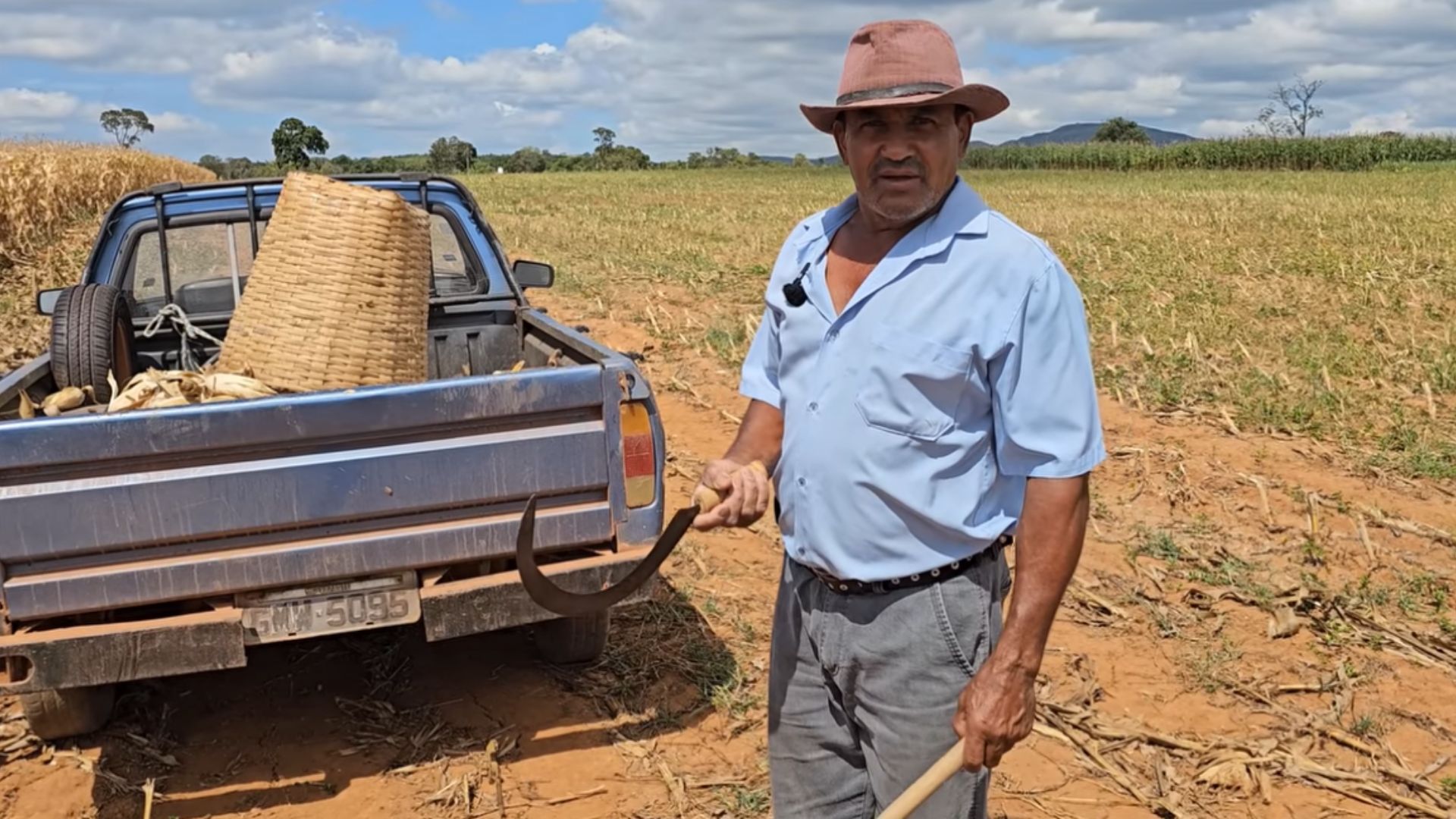


Zé Natal’s Routine Reveals How Homegrown Food Production, Simple Techniques, Rural Association Support, and Preservation of Old Knowledge Ensure Food Autonomy, Health, and a Simple Life in the Countryside
At nearly 70 years old, Zé Natal lives an increasingly rare reality in rural Brazil. On his property, located in the countryside, he produces practically all the food he consumes, maintaining a routine based on manual labor, community cooperation, and respect for traditions passed down through generations. While many depend entirely on the market, he plants, harvests, raises, and transforms his own food, ensuring autonomy and food security.
According to the farmer himself, rice, corn, beans, cassava, fruits, pork, rapadura, and animal fat are part of the daily life on the property. Thus, market purchases are minimal. “I hardly buy anything from the market. I get most of it from here,” summarizes Zé Natal, explaining that he does not consume industrialized oil and exclusively uses lard produced on the farm.
The information was shared in a video recorded on-site and published on a channel specialized in rural life and interior traditions, which closely followed the farmer’s routine, showcasing each stage of planting, harvesting, and animal husbandry.
-
He started running at 66 years old, broke records at 82, and is now a subject of study for having a metabolic age comparable to that of a 20-year-old, in a case that is intriguing scientists and inspiring the world.

-
Oldest tree on the planet reappears after 130 years of searches: Wattieza, 385 million years old, was 10 meters tall and had no leaves or seeds; Gilboa fossils in New York solved the mystery in 2007.

-
A 48-square-meter house assembled in hours with 4,000 bricks made of recycled plastic that does not absorb moisture, has natural thermal insulation, and costs less than 90,000 reais in a complete kit.

-
Luciano Hang revealed that Havan’s air fleet has already accumulated more than 20,000 landings, 10,000 flight hours, and 6 million kilometers traveled, and he says that without the planes, the company would never have grown so quickly.


Homegrown Production Ensures Food Autonomy and Health

Currently, Zé Natal cultivates about 9 hectares of land. In this area, he plants corn, rice, and beans every year, in addition to maintaining small complementary crops such as pumpkin, cassava, and sugarcane. Part of the corn is also used for silage, ensuring food for the animals during the dry season.
As for rice, the farmer reports that last year, the crop yielded about 30 bags, despite being a completely manual production without major technological resources. This year, despite a dry spell — an out-of-season drought — weakening part of the crop, the harvest is still sufficient to feed the family.
Additionally, Zé Natal explains that he uses seeds that are more resistant to pests because, according to him, “it no longer makes sense to plant conventional corn, it attracts too many pests.” This adaptation shows how practical knowledge in the field is essential to maintain production even in the face of climate change.
Local Pigs, Traditional Rearing, and Natural Fat

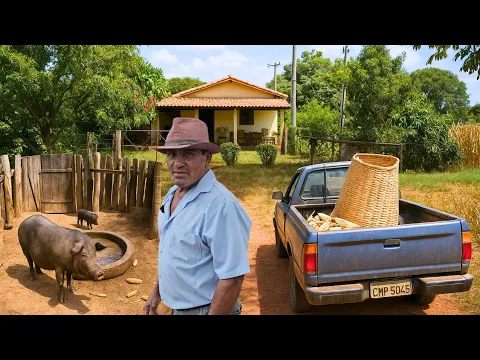
Another highlight of the property is the raising of local pigs, kept in a natural environment with access to damp areas, marshes, and shade from trees like gameleiras, jenipapos, and jatobás. According to Zé Natal, this type of environment is preferred by the animals and contributes to their well-being and the quality of the meat.
Among the animals, there are sows with up to five piglets, as well as breeding males of the local, colher, and piau breeds. The farmer claims not to notice a significant difference in flavor between the breeds but points out that some have skin that is easier to clean, which reduces work during slaughter.
The fat from the pigs is turned into lard, which is used in food preparation. “I don’t eat oil, no. Just lard,” he states. He also mentions that when he lived in the city, he raised pigs on someone else’s land, maintaining the connection to homegrown production even outside the countryside.
Rural Association Reduces Costs and Strengthens Community

One of the factors enabling production is participation in a rural association, which offers tractors and equipment at reduced prices. According to Zé Natal, while silage services charged in the market reach R$ 250, the association performs the same work for about R$ 140, already including the implements.
This model of cooperation allows small producers to keep their crops active, reducing costs and strengthening community ties. Additionally, community workdays for corn harvesting and other tasks bring together neighbors and friends, reinforcing the solidarity typical of rural environments.
Old Tools, Simple Technology, and Efficiency
Among the most symbolic items on the property is a cleaver about 80 years old, inherited from Zé Natal’s grandfather. The tool, used for cutting rice, is treated as a relic. “As long as I’m alive, it’s with me,” says the farmer, highlighting the historical and sentimental value of the object.
Next to the old tools, simple solutions also draw attention. A manual corn sheller, made artisanally, demonstrates that technology doesn’t have to be expensive to be efficient. The equipment quickly and safely separates the grains from the cob, being used for both pig and chicken feed.
Rapadura, Sugarcane, and Neighborly Exchanges
In addition to grains, Zé Natal cultivates sugarcane, used for rapadura production. Without his own mill, he relies on the help of an associate who has the equipment. The system operates on a partnership basis: one cuts the cane, the other grinds it, and the production is shared.
The rapadura, according to visitors, has a creamy texture and intense flavor, with no additives or mixtures. Part of the sugarcane is also used for feeding the cattle, showcasing the full utilization of the production.
Simple Life, Health, and Tradition Maintained at 70 Years
Today, at 69 years old, about to turn 70, Zé Natal maintains an active routine, working daily on the farm. He attributes his energy to consuming natural foods and living away from industrialized products. “I eat very little, but it’s all natural food,” he says.
Father of three children and grandfather of five grandchildren, he recounts that he left the farm for a while for his children to study in the city but never completely abandoned cultivation. After retiring, he returned definitively to the countryside, resuming the life he has known since childhood.
An Example of Self-Sufficiency That Withstands Time
In a region where few still plant rice, Zé Natal persists, preserving practices that span decades. His way of life shows that, even in times of high market dependency, it is possible to live with dignity, autonomy, and balance, utilizing local resources, community cooperation, and traditional knowledge.
More than a personal story, the daily life of the farmer represents a living portrait of family farming, cultural resistance, and the simplicity that ensures quality of life in the countryside.
In an increasingly market and industry-dependent world, could true wealth lie in those who still manage to derive everything from their own land?








Sinceramente, respeitar o vocabulário regional tudo bem, agora colocar um termo errado que o povo usa não dá né! Nunca vi manteiga de porco, ninguém tira leite de porco, o que se faz é banha da gordura do ****
Vou imprimir seu comentário e usar o papel no banheiro
Exato, manteiga é da batida do leite, seria gordura ou banha de porco. Um pequeno pedaço erro do editor. Perdão…
Mas informações importantes, por isso lemos