





 Portuguese
  English
  Spanish
  5 min of reading
  0 comments


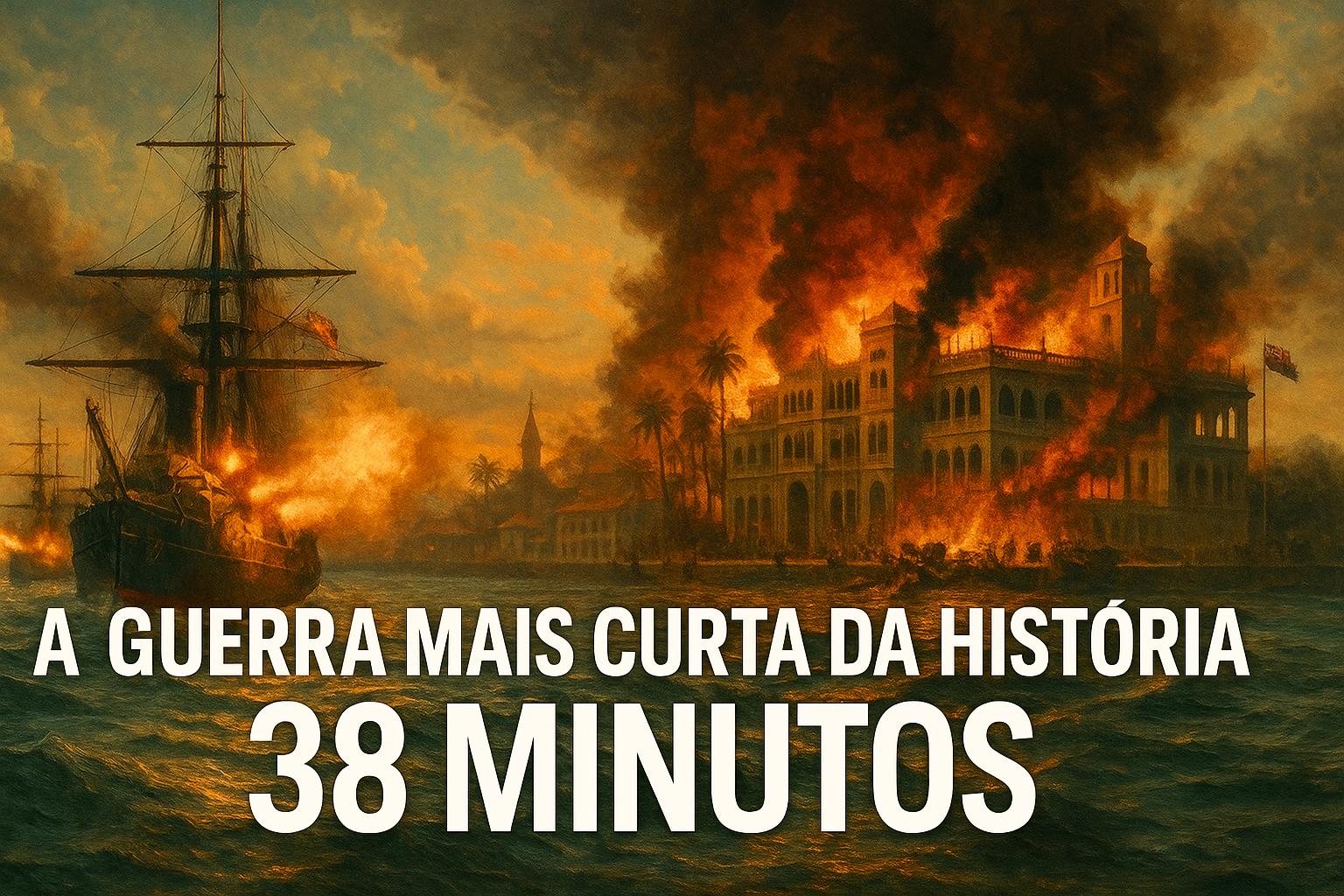
The Anglo-Zanzibar War of 1896 Lasted Only 38 Minutes and Is the Shortest Conflict in History — It Ended with a Palace in Flames and 500 Dead in Less Than an Hour.
On the morning of August 27, 1896, the blue sky of the Zanzibar archipelago, on the eastern coast of Africa, was pierced by the sound of British cannons. In less than an hour, the sultan’s palace was in ruins, hundreds of soldiers lay dead, and the conflict that had just begun was already over. It lasted only 38 minutes, long enough to enter the records of World Military History as the shortest war ever fought between two nations. The episode, known as the Anglo-Zanzibar War, symbolizes the zenith of British imperial dominance and the collapse of the independence of the small African sultanate.
The spark was political, but the outcome was inevitable. Zanzibar was then an important trading post in the Indian Ocean, dominated by an Arab elite that amassed power and wealth through the trade of cloves, ivory, and slaves. The British protectorate closely controlled the region, influencing the succession of sultans to safeguard their strategic interests. When the pro-British sultan Hamad bin Thuwaini suddenly died on August 25, 1896, his cousin Khalid bin Barghash took power without the United Kingdom’s authorization — an act deemed unacceptable by London.
The Ultimatum That Lasted Less Than a Day
Within hours, the new sultan gathered about 3,000 armed men and entrenched himself in the royal palace, backed by guards and light artillery. The British, led by Rear Admiral Harry Rawson, immediately reacted, demanding Khalid resign and leave the palace by 9 a.m. the next day.
-
These living root bridges and ladders are over 700 years old and help indigenous people survive in one of the rainiest regions in the world.

-
From sertanejo star to international investor: Ana Castela invests millions in a mansion in the USA, creates a themed accommodation in Orlando, and shows that the “boiadeira” also wants to grow away from the stage.

-
The 10 most stunning motorhomes in the world: a $3 million trailer with a rooftop nightclub and garage for a Ferrari, “palaces on wheels” with Italian marble, private cinema, and five-star hotel luxury for billionaires.

-
Trump wanted to spend $400 million on the White House, but the courts prohibited the million-dollar construction.




The response did not come. On the contrary, the sultan reinforced the defenses and positioned 7-pound cannons around the building, a symbolic attempt to resist the world’s most powerful naval force.
At 9:02 a.m. on August 27, once the ultimatum had expired, British ships HMS St George, HMS Racoon, HMS Thrush, and HMS Sparrow, anchored in the port of Zanzibar, opened fire. In just 3 minutes, the palace began to collapse under the impact of the shells.
The roof caught fire, the sultan’s artillery was destroyed, and many of his soldiers fled in despair. The crossfire lasted between 38 and 45 minutes, according to official historical records of the British Admiralty.
The Ruined Palace and the End of an Era
The result was devastating. More than 500 defenders of Zanzibar died, while the British reported only one injury. Sultan Khalid bin Barghash managed to escape through a side passage and sought asylum at the German consulate, which temporarily sheltered him before he was exiled to Dar es Salaam, in present-day Tanzania.
Within hours, Zanzibar completely surrendered. The United Kingdom installed Sultan Hamoud bin Mohammed on the throne, considered more cooperative, solidifying British control over the archipelago.
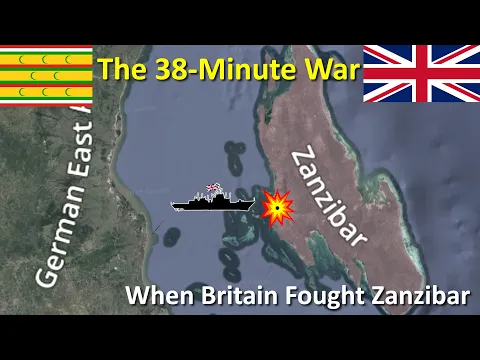
Records from the National Museum of Zanzibar and the Imperial War Museum in London describe the final scene as almost surreal: the palace in flames, smoke covering the harbor, and the warship HMS Thrush hoisting the British flag before a silent city. The conflict that lasted less than an episode of a series marked the final point of Zanzibar’s political independence.
Why Was the War So Short?
The imbalance of forces explains the brevity. The British had modern cruisers, naval guns, and Gatling machine guns, while the sultan’s troops had only black powder weapons and outdated artillery. The technological and tactical superiority was overwhelming, and local resistance dissolved in minutes.
Moreover, the United Kingdom’s objective was purely political — to restore imperial authority and send a message to other colonies. There was no interest in prolonging the confrontation.
As soon as the palace was taken, the British suspended fire and began to install a favorable government. The war officially ended at 9:40, according to the official report of Admiral Rawson sent to the British crown.
The Consequences for Zanzibar and the Empire
The British victory solidified control over the archipelago and led to a new political order. Under the new sultan, Zanzibar became a full British protectorate, and the slave trade — still present in the region — was officially abolished in 1897.
The conflict also served as a symbol of British naval power at the turn of the 19th century, an era when the empire controlled a quarter of the planet and its ships patrolled all oceans.
Zanzibar, which had been a prosperous and independent Arab monarchy, was gradually integrated into the colonial sphere. Not until 1963, nearly seven decades later, did the archipelago regain its political autonomy, joining the following year with the former colony of Tanganyika to form the present-day country of Tanzania.
A Short Episode, But with Historical Echo
The Anglo-Zanzibar War is remembered today not only for its record duration but for representing the imbalanced strength of colonial relations of the 19th century. The conflict, although brief, illustrates how a local political decision could trigger an overwhelming military response from a European power.

Historians such as Stephen Taylor and Thomas Pakenham point out that the episode reveals the peak of the so-called “Age of Empires,” when European powers exerted absolute control over ports and trade routes in Africa and Asia.
Control over Zanzibar, in particular, was strategic for trade with India and for controlling the Indian Ocean.
The War That Fits in a Watch
Today, the episode is studied in military academies and history courses for its symbolism and brevity. The exact time of the war — 38 minutes — is widely accepted and cited in official British records, becoming a worldwide curiosity.
There is even a plaque at the old Beit al-Hukm Palace in Zanzibar, commemorating the event as “the shortest war in human history.”
More than a century later, the memory of this lightning confrontation continues to echo, not for the grandeur of its battles, but for the speed with which an empire imposed its will on a nation. A reminder that, in history, power is not always measured by the duration of the struggle; sometimes, less than an hour is enough to change a country’s destiny.







-

-

-

11 pessoas reagiram a isso.