





 Portuguese
  English
  Spanish
  3 min of reading
  0 comments


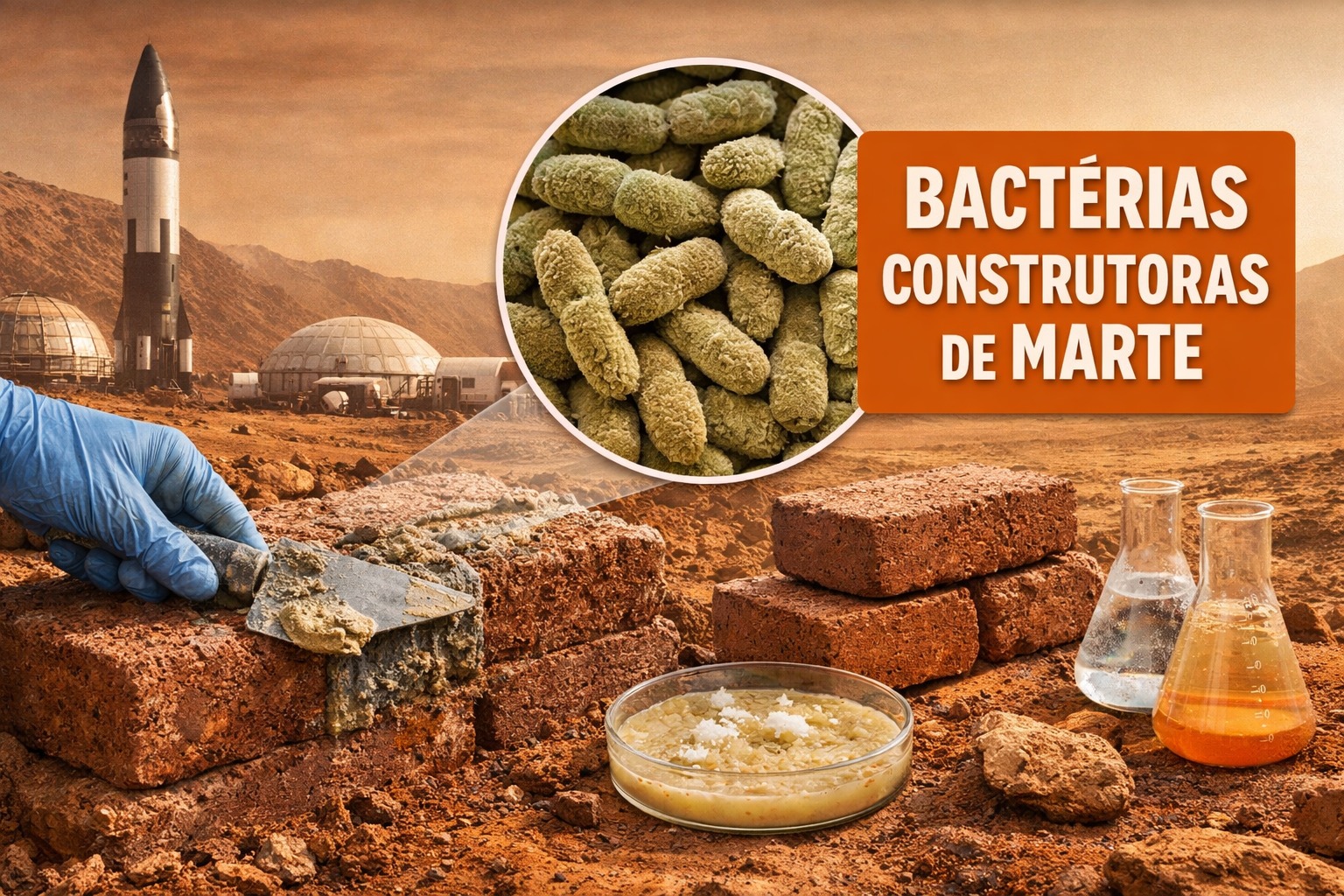
Study Reveals That Perchlorate Strengthens Biological Bricks and Brings Construction of Human Bases on Mars Closer with Material Produced Directly from Martian Soil
A recently published study in the journal PLOS One presents a possibility that seems straight out of science fiction but is beginning to take on concrete forms. Scientists suggest that a toxic compound present in Martian soil may, paradoxically, help bacteria produce brick-like materials. These so-called “biological bricks” could be used to build habitats on the Red Planet, reducing dependence on materials transported from Earth and leveraging locally available resources.
The proposal is based on previous research conducted by scientists at the Indian Institute of Science, who in 2025 demonstrated that the bacterium Sporosarcina pasteurii, naturally found in terrestrial soil, can transform lunar and Martian regolith into a solid material.
The mechanism is relatively simple: the bacterium excretes urea, which reacts with calcium to form calcium carbonate crystals.
-
With a cost per shot close to zero, the DragonFire laser could change naval warfare in 2027 and provide British ships with nearly unlimited defense against drones.

-
A British startup creates tires that generate electricity in electric vehicles when passing over potholes, speed bumps, and cracks.

-
Scientists have created robots made with living cells that have their own nervous system, swim on their own, explore the environment, and self-organize without any genetic engineering, and now they want to do the same with human cells.

-
Students create a solar-powered ambulance that operates without a plug, without fuel, and still keeps medical equipment running in remote areas.


Mixed with guar gum, a natural adhesive derived from the guar bean, these crystals bind the regolith particles together, creating a strong block similar to a brick.
The Idea of Building Using Only What Exists on Mars
The central goal of the research is to enable the construction of structures using only local resources, a step considered essential for prolonged space missions.
“We do not need to transport anything from Earth; we can use the available resources and build the structures in situ,” stated Shubhanshu Shukla, astronaut at the Indian Space Research Organisation (ISRO) and co-author of the study, in a statement.
This approach, besides reducing costs, minimizes logistical risks associated with sending large volumes of material into space.
The possibility of manufacturing bricks directly on Mars could transform how future human bases are planned.
Experiments Use Simulators of Martian Soil
As real samples of Martian regolith are extremely rare, researchers work with simulants, artificial materials developed to mimic the characteristics of Martian soil.
For safety reasons, these simulants typically do not include perchlorate, a toxic chemical compound identified on Mars in 2008 by NASA’s Phoenix probe.
Despite being dangerous, perchlorate is usually avoided mainly due to its high flammability.
In the new study, the team decided to carefully add perchlorate to a specific simulant, the Mars Global Simulant 1, to observe how the presence of this compound would affect the production of the bricks. The result brought a surprise.
The Unexpected Role of Perchlorate
As expected, perchlorate stressed the bacteria, slowing their growth and causing them to clump together.
It also increased the release of proteins and other molecules, forming an extracellular matrix (ECM). Although this structure arises in response to stress, it ultimately reinforced the produced bricks.
Electron microscopy images revealed that the ECM creates small “microbridges” between bacterial cells and calcium chloride crystals, increasing the material’s strength.
“Perchlorate, by itself, is a stress factor for the bacteria, but in the bricks, with the right ingredients, it helps,” explained microbiologist Swati Dubey from the University of Florida.
Next Steps of the Research
Scientists believe that these microbridges also facilitate nutrient circulation, aiding in the recovery of damaged cells and enhancing the bacteria’s ability to bind regolith particles.
This process is known as biocementation and relies on the presence of guar gum and nickel chloride as catalysts.
The next step will be to test biocementation under conditions that simulate the Martian atmosphere, which is rich in carbon dioxide.
“Mars is an alien environment. Understanding how Earth organisms adapt to it is a crucial scientific question,” stated Aloke Kumar, co-author of the study.
In addition to its practical potential, the research also provides clues on how life forms may respond to extreme environments, helping to understand biological limits and paving the way for innovative solutions in extraterrestrial contexts.
With information from Olhar Digital.









Seja o primeiro a reagir!