





 Portuguese
  English
  Spanish
  7 min of reading
  0 comments


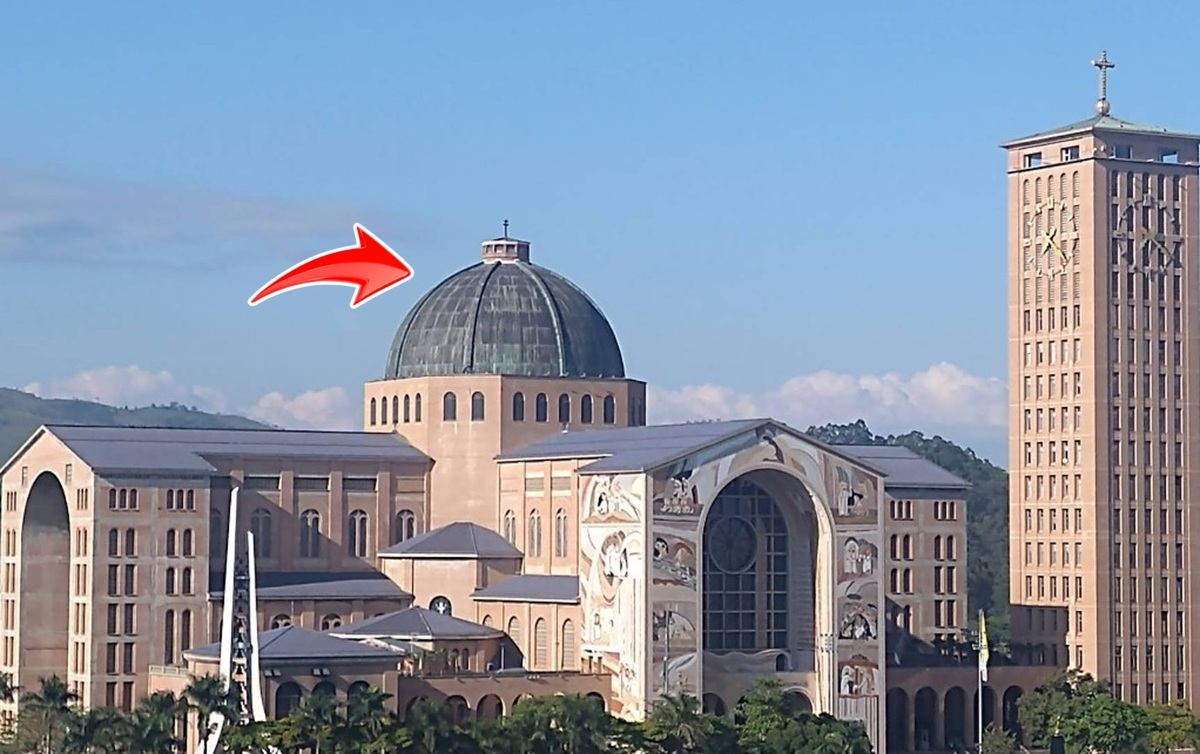
The Ultimate Symbol of the Union Between Faith and Engineering, the Dome of the Basilica of Our Lady of Aparecida Impresses with Its Monumental Dimensions and the Precision of Its Construction. At 70 Meters High, 34 in Diameter, and Coated with 5 Million Colored Tiles, It Represents the Heart of the Largest Marian Shrine in the World and One of the Most Admired Architectural Landmarks in Brazil
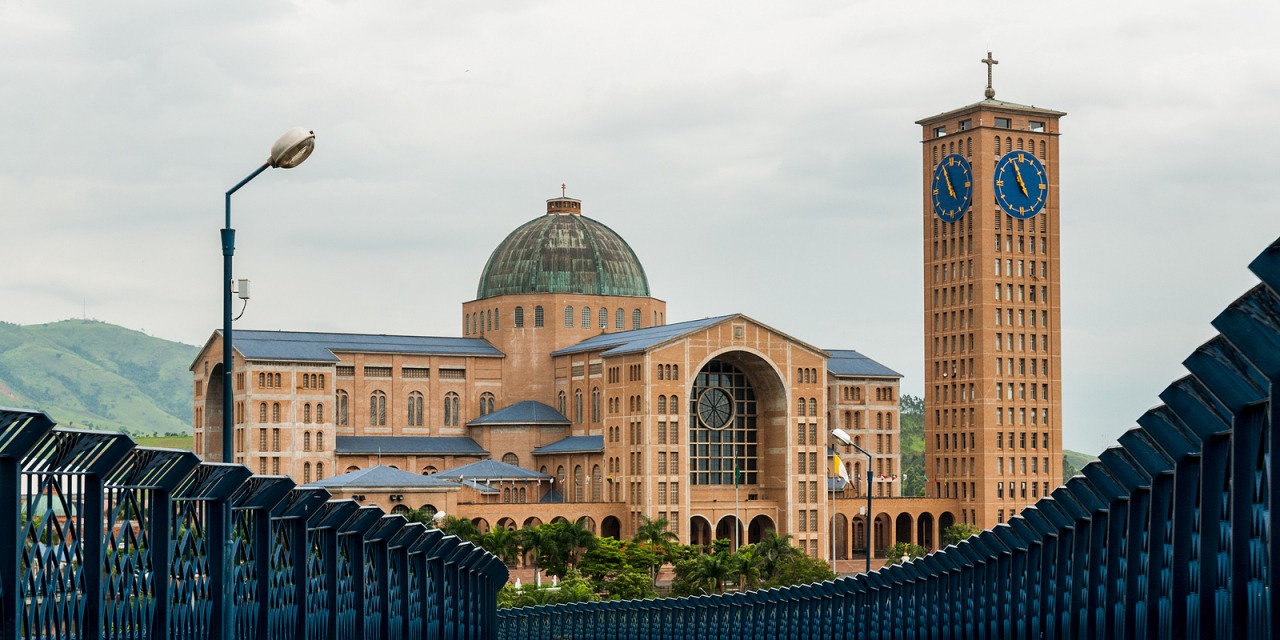
Located at the central point of the Basilica of Our Lady of Aparecida, in the Vale do Paraíba (SP), the dome is one of the most impressive elements of Brazilian religious architecture.
Designed to combine functionality, aesthetics, and symbolism, it stands out for its imposing shape and the technical complexity involved in its construction, becoming a national reference in engineering and sacred art.
The Basilica of Aparecida is visited by millions of people every year.
-
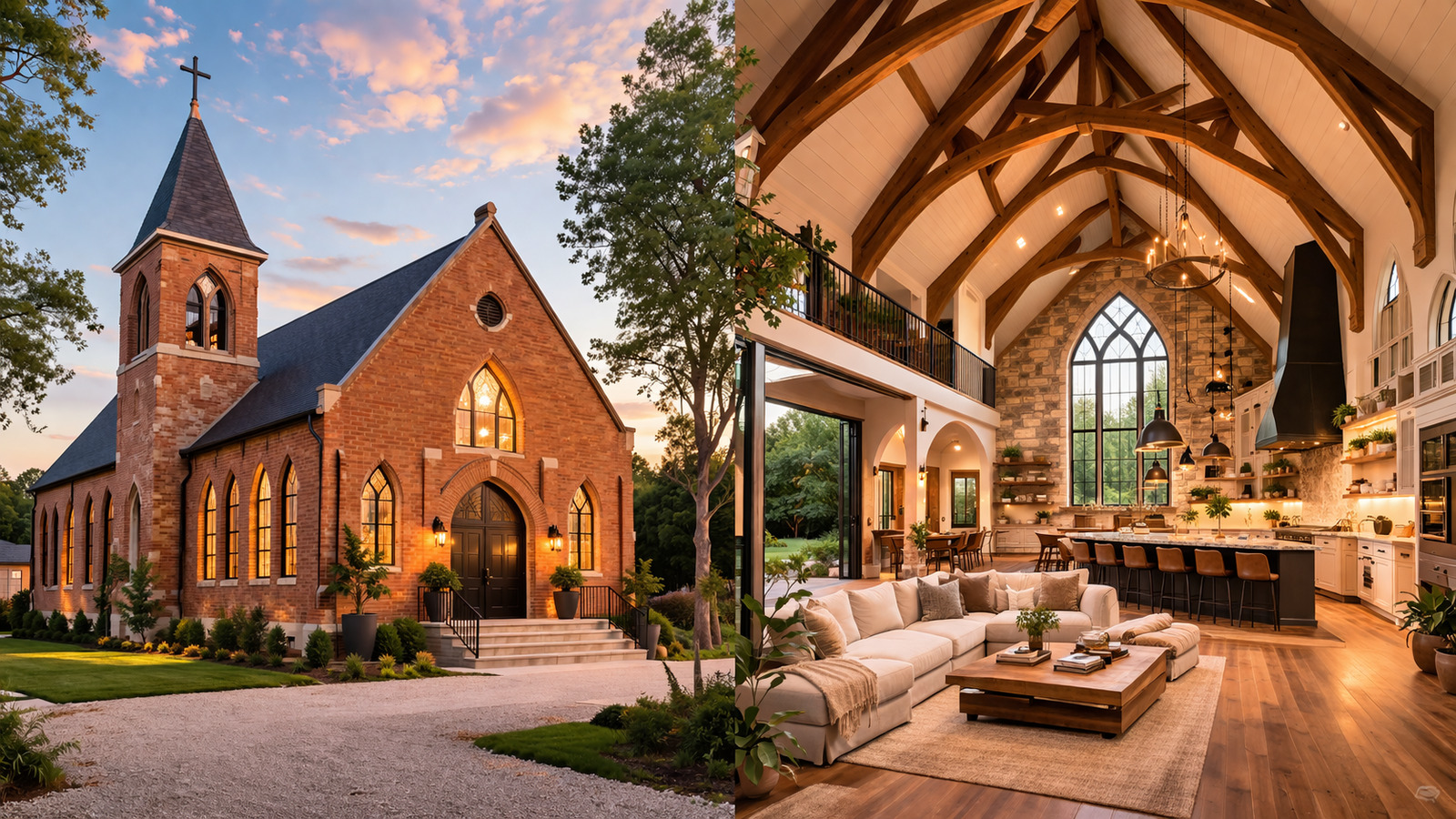
Church from 1888 becomes a mansion of over 330 m² in Canada after a renovation of R$ 3.4 million and is eventually sold for nearly R$ 4.3 million.
-
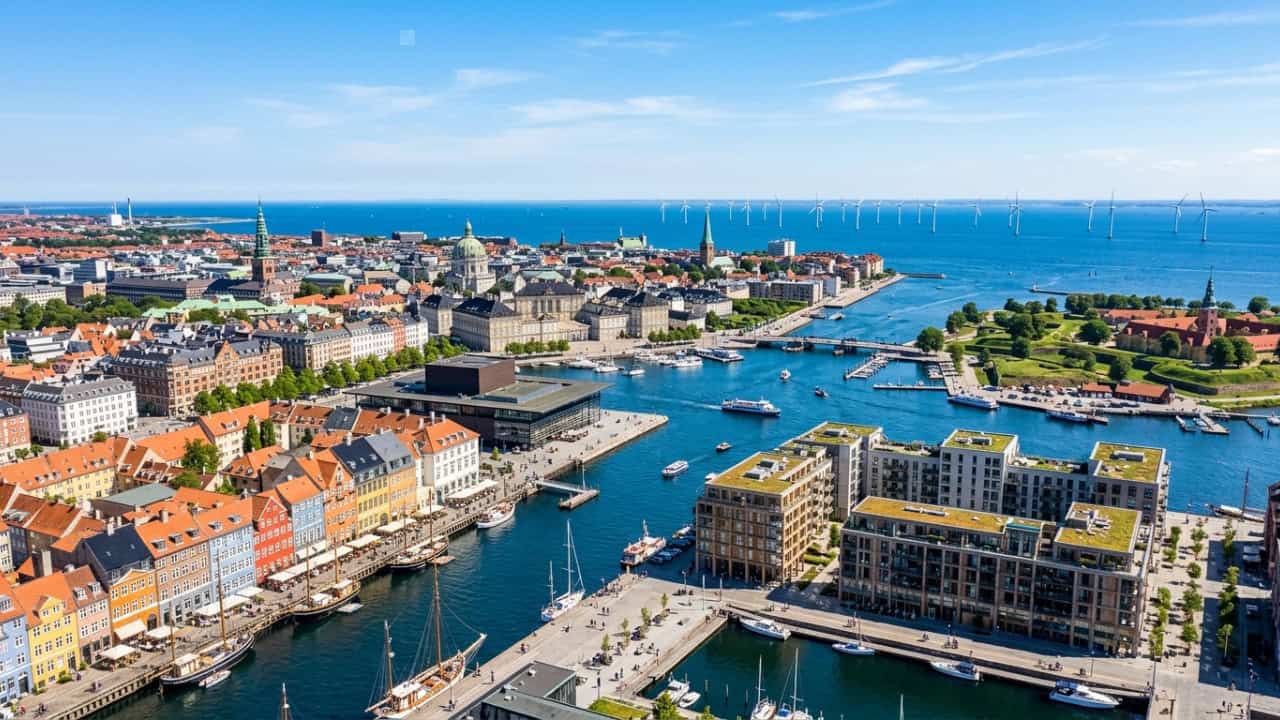
How an innovative city combines high technology, well-being, and sustainability to become the largest reference in clean energy on the planet.
-
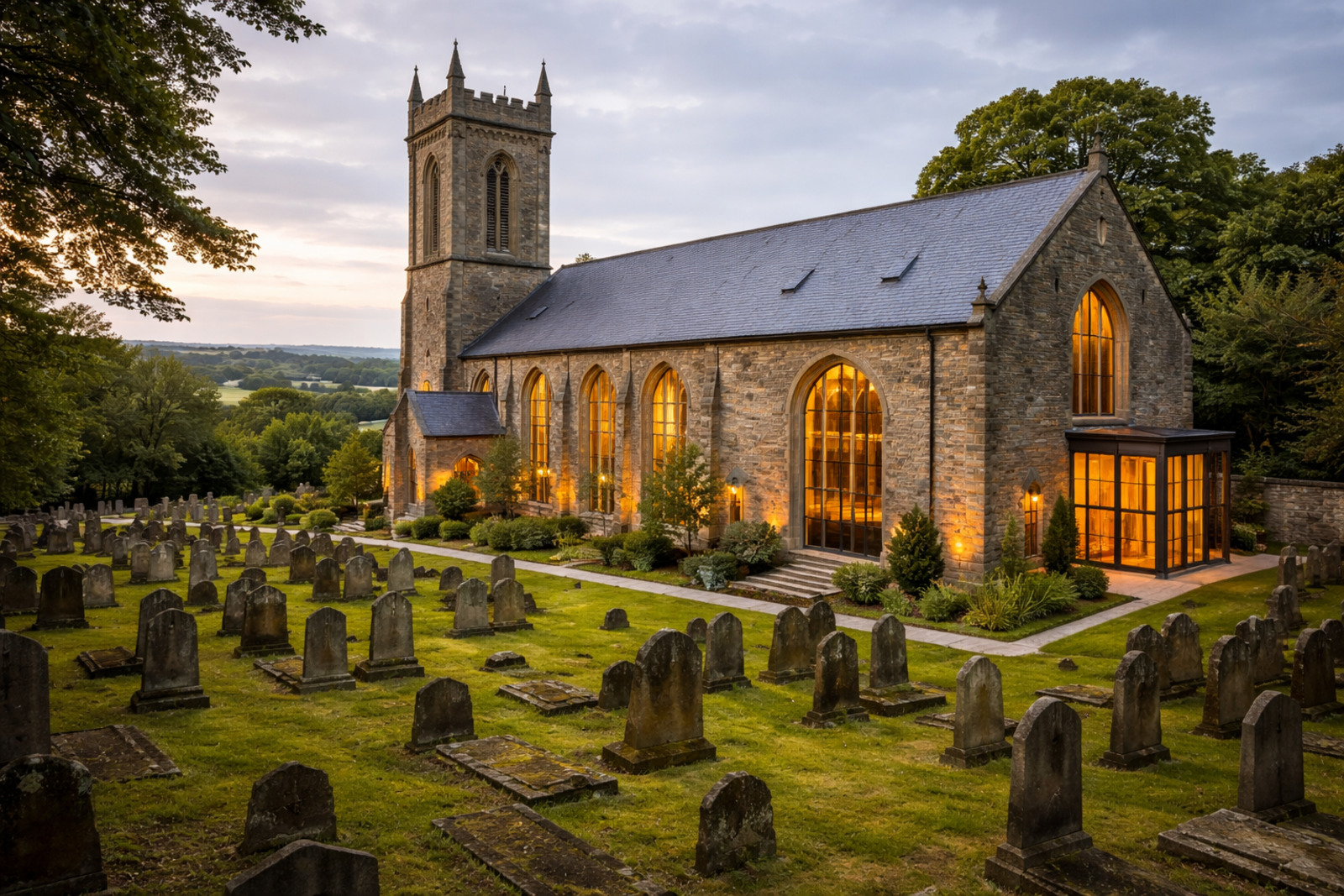
Couple buys 1846 church in ruins for R$ 660,000, invests R$ 3.2 million in renovations, transforms it into a millionaire mansion, and even preserved a historic cemetery with over 300 graves.
-
He started running at 66 years old, broke records at 82, and is now a subject of study for having a metabolic age comparable to that of a 20-year-old, in a case that is intriguing scientists and inspiring the world.


In 2024 alone, the number of visitors exceeded 9 million, reaffirming the shrine as the largest pilgrimage center in Brazil and the second largest Catholic temple in the world, second only to St. Peter’s Basilica in the Vatican.
Its history mixes faith, art, and technology on a monumental scale.
The Origin of the Devotion and the Miracle of the Fishing
The history of the Basilica dates back more than 300 years, to the episode known as the miracle of the fishing, which marked the birth of the devotion to Our Lady of Aparecida.
In 1717, three fishermen — Domingos Garcia, João Alves, and Felipe Pedroso — cast their nets into the Rio Paraíba do Sul after days of scarcity. Instead of fish, they found a small fragment of a clay image, and soon after, the body that completed the piece.
Shortly after the discovery, the nets filled with fish, which was interpreted as a divine sign. The story spread quickly, transforming that image — darkened by the waters — into the patroness of Brazil.
The First Chapel and the Growth of Devotion
With the fame of miracles, the first pilgrimages began. In 1745, the first chapel was built to house the image, with the help of the fishermen’s family.
Among the distinguished faithful was Princess Isabel, who, after promising devotion to the saint, became pregnant and gave birth to her first child, Dom Pedro de Alcântara.
During the period of slavery, the black image of Our Lady of Aparecida became a symbol of hope and liberation for the enslaved, further strengthening the popular and inclusive nature of the devotion.
The Birth of the Largest Religious Project in the Country
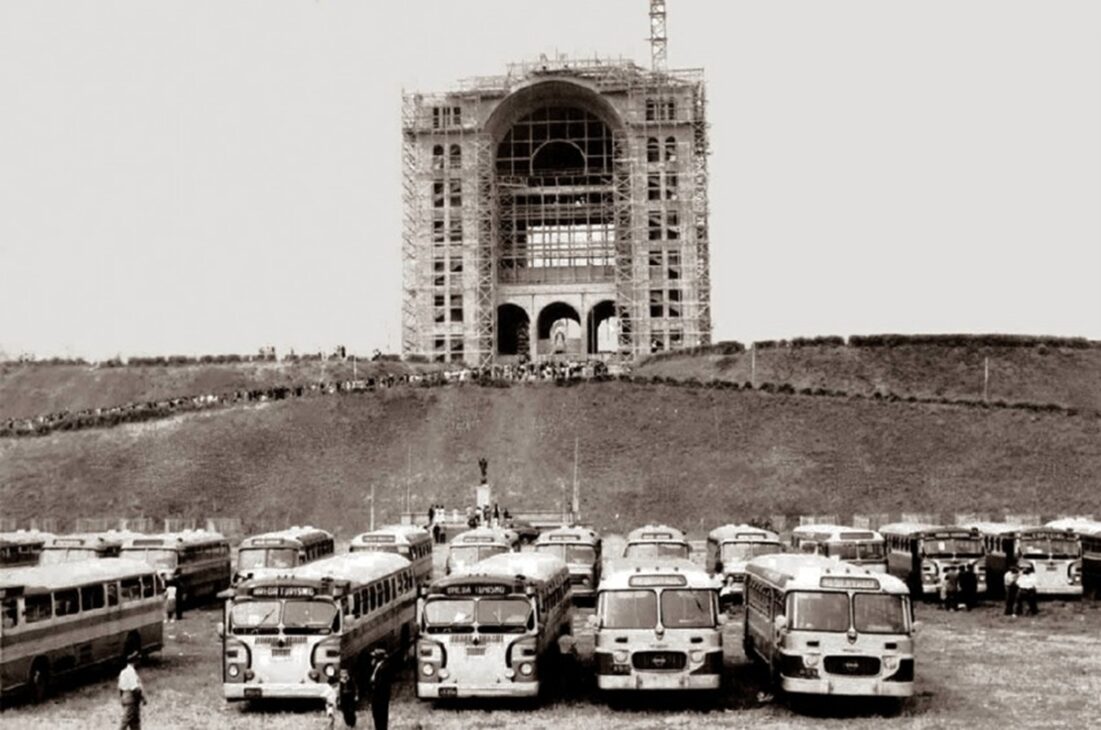
As the decades passed, the small sanctuary could no longer accommodate the growing number of pilgrims. In 1939, plans were initiated to build a new basilica, thousands of times larger than the old one.
The project was the responsibility of architect Benedito Calixto de Jesus Neto, one of the greatest specialists in sacred art in the country.
Calixto studied temples in Italy, Germany, and the United States, adapting modern engineering and acoustics techniques.
The project, approved by the Vatican’s Sacred Art Council, was classified as “incredible and unparalleled” due to its combination of grandeur and harmony.
The Grandiose Construction of the New Basilica
Construction began in 1952, with earthworks, and continued until 1955, when the foundations were laid.
12 thousand cubic meters of concrete and 1,200 tons of steel were used, under the supervision of engineer Paulo Franco Rocha.
Father Noé Sotílio managed the funds obtained through donations. To save costs, he terminated the contract with the construction company and assembled his own Church team, made up of workers and volunteers — a tradition that continues to this day.
The basilica was designed in Neo-Romanesque style, with a Greek cross-shaped floor plan, a wide central nave, and side towers that balance the monumentality of the construction.
The Monumental Dome: Faith and Precision at 52.86 Meters High
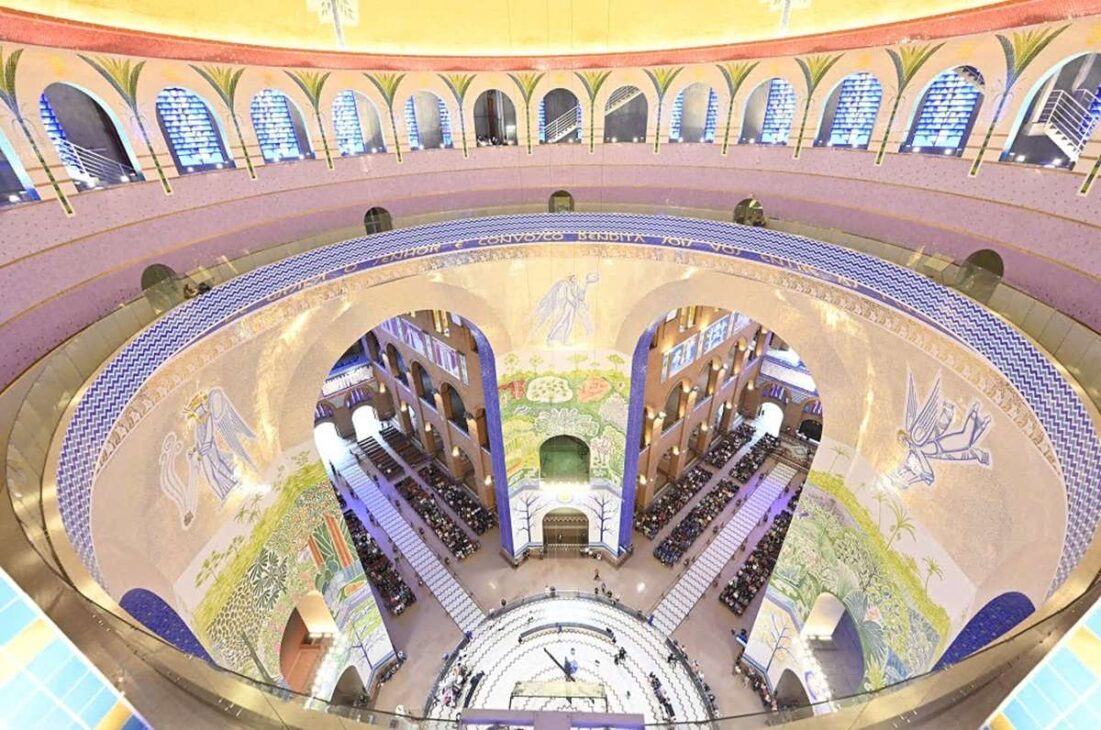
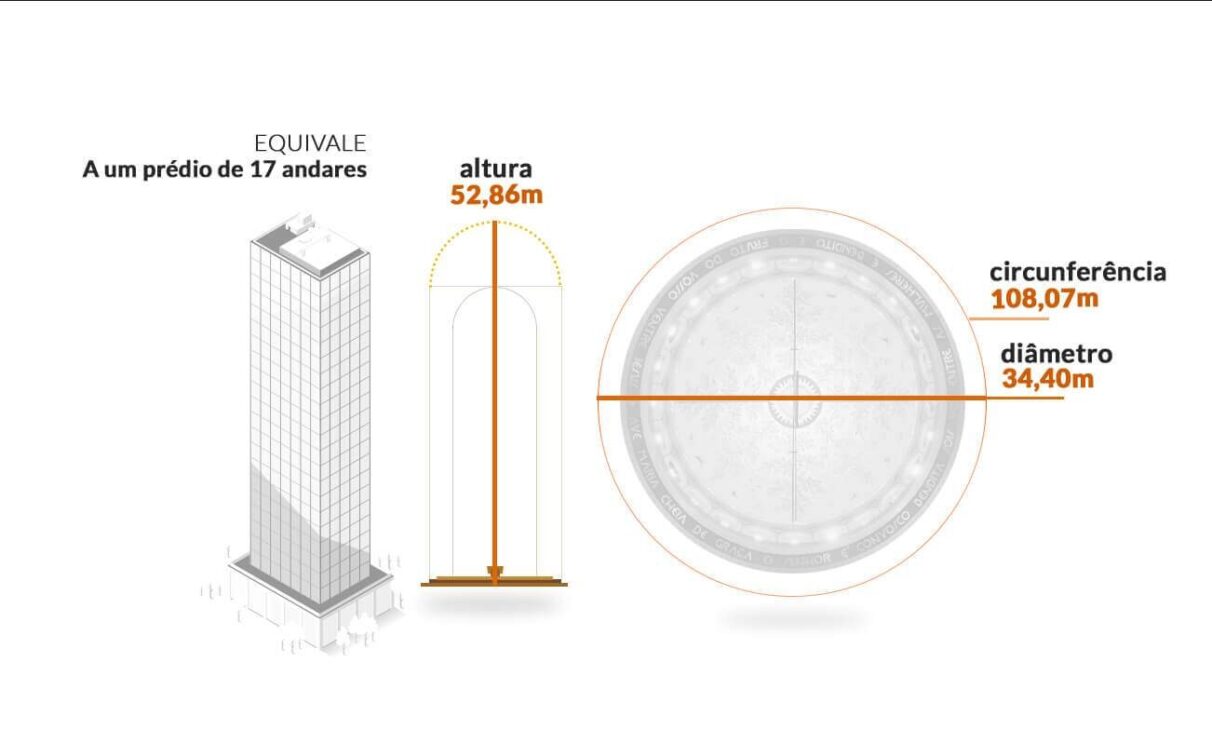
The most symbolic and technical point of the project is the central dome, positioned directly above the main altar. Located at 52.86 meters high, it combines technique, spirituality, and art in a single ensemble.
The height of 52 meters is the maximum height accessible to people. However, if counted from the altar to the highest point, the height reaches 72 meters.
Its inauguration took place on October 11, 2017, during the celebrations of the 300 years of the appearance of the image in the Rio Paraíba do Sul.
The work was designed by sacred artist Cláudio Pastro, who was also responsible for other elements within the sanctuary. His work transformed the dome into a true visual book of the Catholic faith, full of colors, mosaics, and symbolism.
Symbols and Meanings of the Dome
Inspired by the parable of the mustard seed, Pastro created a composition that represents the growth of faith, spreading like a leafy tree where birds find shelter. In the center of the structure, a bird symbolizes the Holy Spirit, radiating light over the altar — a detail that stands out when natural light passes through the stained glass.
Surrounding it are 52 informational panels explaining the meaning of each element. The colors refer to divine creation, the designs represent the diversity of peoples, and the communion among the faithful. The whole interacts with the four pillars of the basilica, also decorated by Pastro, reinforcing the sense of unity between faith and art.
The cap of the dome, the upper and visible part of the structure, has 34 meters in diameter, 109 meters in circumference, and 72 meters in total height from the base. It consists of two overlapping spheres, between which there is a spiral staircase that leads to the lookout.
Engineering and Visiting
Constructing a dome of such proportions required millimeter calculations and high-strength materials.
The balance between visual lightness and structural robustness was achieved using reinforced concrete and steel, in harmony with the rest of the building.
Today, the Sanctuary offers the “Dome Visiting Circuit”, where the public can ascend to the highest accessible point — 52 meters — to view the interior of the temple from a new perspective. The visit is part of the “Circuit 3 – Dome + Facades”, which also includes access to the North, East, and South facades, from where the entire religious complex can be seen.
Juscelino Kubitschek and the Brasília Tower
During a visit to the construction site in 1960, then-President Juscelino Kubitschek was impressed by the project and decided to contribute personally. He financed the construction of the Brasília Tower, a metallic structure of 107 meters tall, equivalent to a 30-story building.
It is one of the only parts of the basilica not made of reinforced concrete. Today, it houses administrative sectors, technical areas, a museum, and a 300 m² lookout with a panoramic view of the Vale do Paraíba.
Architecture, Art, and Faith in Every Detail
The interior of the basilica is a visual spectacle. The dome, with 2 thousand m² of internal area, is covered with about 5 million glass tiles, forming the mosaic of the Tree of Life. The central columns display engravings that represent the cultural and religious diversity of the Brazilian people.
The temple is shaped like a Latin cross, with 72 thousand m² of built area and a capacity for 270 thousand people in a single day.
In addition to its artistic beauty, the complex generates an impressive economic structure: R$ 1.4 billion per year, a value 14 times higher than the annual budget of the municipality of Aparecida.
A Gigantic Infrastructure Complex
The National Shrine is much more than the main church. The Visitor Support Center houses 380 shops, 874 bathrooms, a helipad, and the largest parking lot in Latin America, with space for 6 thousand vehicles.
The complex, spanning 1.3 million m², also has its own water treatment station and systems for energy, security, and ongoing maintenance.
Connecting the Old Basilica to the new structure, the famous Faith Walkway — measuring 392 meters long and 35 meters high — has become one of the main symbols of the devotion of pilgrims who walk the route, many of them barefoot, in gratitude for granted graces.
Costs and Recent Stages of Construction
The total cost of the basilica’s works is estimated to be around R$ 1.5 billion, not including the recent expansions. In 2016, the bell tower was inaugurated, one of the last projects designed by Oscar Niemeyer.
The bell tower has three bells imported from Holland, totaling 97 tons and an approximate cost of R$ 5.6 million. The system is fully automated and allows for the execution of complex melodies, controlled by computer.
International Recognition and Papal Visits
The Basilica of Aparecida is one of the few places in the world to receive three papal visits. In 1980, John Paul II crowned the image of the saint. In 2007, Benedict XVI celebrated Mass at the site during the 5th Conference of the Latin American Episcopate. In 2013, Pope Francis visited the sanctuary just a few months after assuming the papacy, reinforcing the importance of Marian devotion in Brazil.
One of the Largest Religious Works on the Planet
The construction of the Basilica involved 35 thousand m³ of concrete, 40 thousand tons of steel, 25 million bricks, and 250 thousand tiles. Even after 65 years of construction, the temple continues to receive improvements and expansions, without losing its essence.
More than a religious monument, the Basilica of Our Lady of Aparecida is a national symbol, a synthesis of history, art, and spirituality that impresses believers and visitors from around the world.
The monumental dome, with its 52 meters in height and 34 in diameter, crowned by millions of tiles that shine under natural light, remains as the symbolic heart of Brazilian Catholic faith — a fusion of engineering and devotion that translates the power of belief and beauty into a single architectural gesture.





-

-

-

8 pessoas reagiram a isso.