





 Portuguese
  English
  Spanish
  4 min of reading
  0 comments


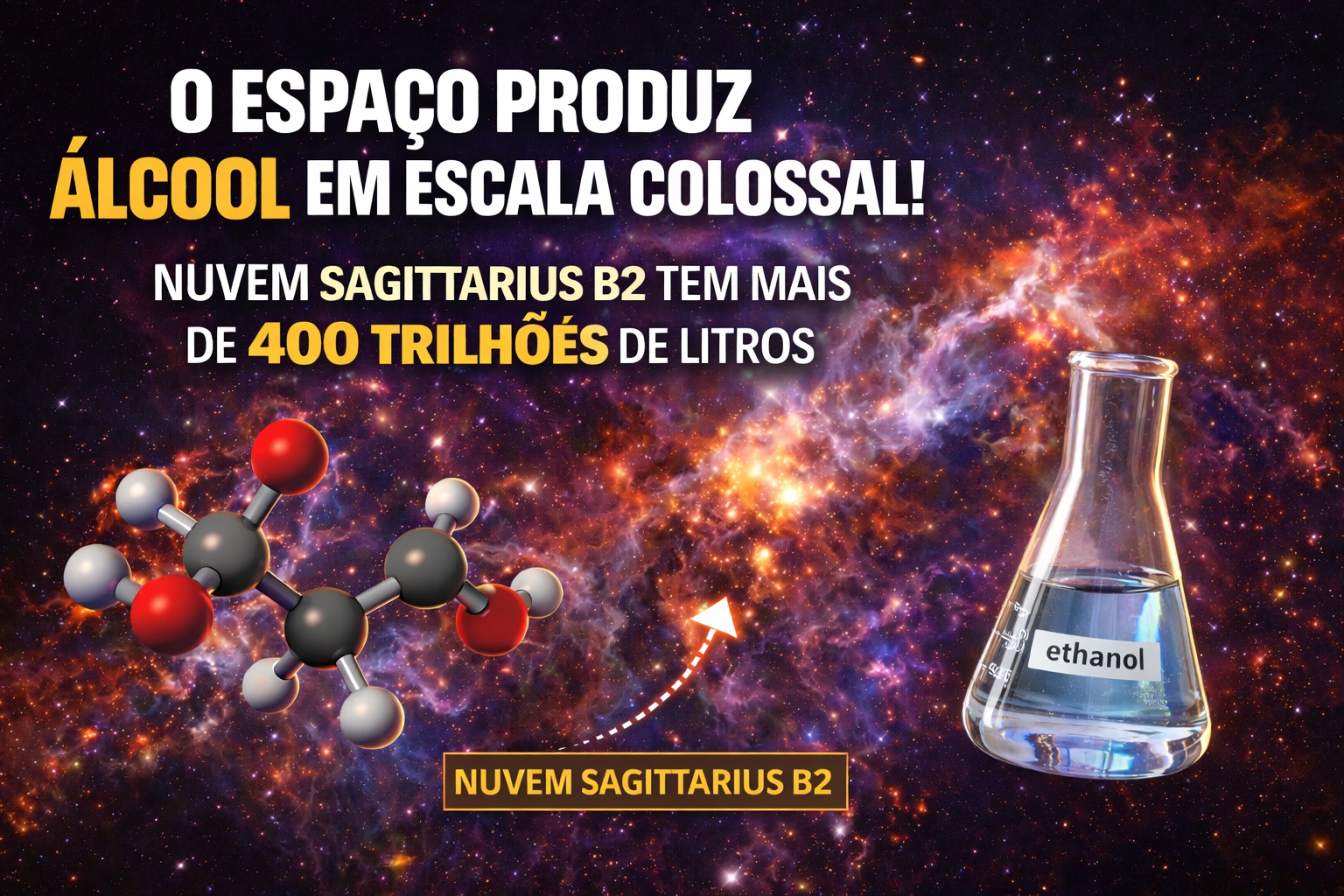
Interstellar Cloud With Light-Years Contains Colossal Amount Of Alcohol And Organic Molecules, Showing That The Ingredients Of Life Appear Before Stars And Planets.
Long before planets formed, oceans emerged, or any type of life appeared, interstellar space already functions as an immense chemical laboratory. One of the most impressive examples of this reality was revealed when astronomers identified a giant molecular cloud containing a practically unimaginable amount of ethyl alcohol (ethanol) dispersed throughout space. This is not about residual traces or spot detection, but about a chemical reservoir so large that it challenges human intuition and changes the way we understand the origin of the ingredients of life.
The protagonist of this discovery is Sagittarius B2, one of the largest and most studied molecular clouds in the galaxy, located about 25,000 light-years from Earth, in the central region of the Milky Way. This cloud alone houses volumes of organic compounds that surpass any known planetary scale.
Sagittarius B2 spans dozens of light-years in length, has extremely low temperatures, around –260 °C, and sufficient density to allow complex chemical reactions even in a hostile environment. It is in this setting that organic molecules form, survive, and accumulate over millions of years.
-
With a cost per shot close to zero, the DragonFire laser could change naval warfare in 2027 and provide British ships with nearly unlimited defense against drones.

-
A British startup creates tires that generate electricity in electric vehicles when passing over potholes, speed bumps, and cracks.

-
Scientists have created robots made with living cells that have their own nervous system, swim on their own, explore the environment, and self-organize without any genetic engineering, and now they want to do the same with human cells.
-
Students create a solar-powered ambulance that operates without a plug, without fuel, and still keeps medical equipment running in remote areas.


The Absurd Amount Of Alcohol Detected In Interstellar Space
Measurements made by radio telescopes showed that the total amount of ethanol present in Sagittarius B2 is around 400 trillion trillion liters.
To grasp the scale, this volume would be sufficient to fill trillions of Earth oceans. Even if only a tiny fraction of this material were incorporated into planetary systems, the chemical impact would still be colossal.

This alcohol is not concentrated as a liquid but dispersed in gaseous form, mixed with hydrogen, carbon monoxide, ammonia, methanol, and a long list of other organic molecules. Detection is made through spectral signatures, when these molecules emit or absorb radio waves at specific frequencies.
These observations were made possible thanks to instruments like the Atacama Large Millimeter/submillimeter Array, which allows for precise identification of the chemical composition of distant regions of space. Each molecule functions as a cosmic fingerprint.
How Organic Molecules Form Before Stars And Planets
Within these giant molecular clouds, the chemical process occurs on microscopic surfaces of interstellar dust grains. These grains, composed of silicate and carbon, act as natural catalysts. Simple atoms deposit onto them, bond, and form increasingly complex molecules.
Ethanol, for example, does not arise in isolation. It is part of a chemical chain that involves:
- hydrogen,
- carbon,
- oxygen,
- ultraviolet radiation,
- and thermal shocks caused by stellar shock waves.
This environment creates a true natural chemical factory, operating continuously for millions of years. When part of the cloud collapses and gives rise to new stars, this chemical material does not disappear. It is incorporated into the protoplanetary disks that will later form planets, moons, comets, and asteroids.
What This Discovery Changes In The Origin Of Water And Life
For decades, the dominant idea was that complex organic compounds arose only after the formation of planets, driven by oceans, volcanism, or biological activity.
The existence of clouds like Sagittarius B2 shows the opposite: the chemistry of life begins even before the birth of stars.
This strongly reinforces the hypothesis that:
- comets,
- asteroids,
- and interstellar dust
acted as chemical vectors, bringing ready-made organic molecules to young planets like primordial Earth. In other words, Earth may not have “invented” its basic ingredients on its own — it may have inherited them from the interstellar medium.
This conclusion connects directly to data obtained from comets studied by space missions, such as Rosetta, which also detected alcohol, amino acids, and complex organic compounds in icy bodies of the Solar System.
A Chemically Active Universe And Far From Sterile
Sagittarius B2 is not an isolated case. Other molecular clouds have already revealed:
- methanol in large quantities,
- formaldehyde,
- formic acid,
- and even precursors of amino acids.
This suggests that the galaxy is filled with chemically rich regions where the fundamental building blocks of biology are produced on a colossal scale, regardless of the existence of life.
From a scientific perspective, this discovery reinforces a powerful idea: organic chemistry is a natural consequence of the physics of the universe, not a rare exception. Where there is dust, hydrogen, and enough time, complex molecules will emerge.







-

Uma pessoa reagiu a isso.