





 Portuguese
  English
  Spanish
  4 min of reading
  0 comments


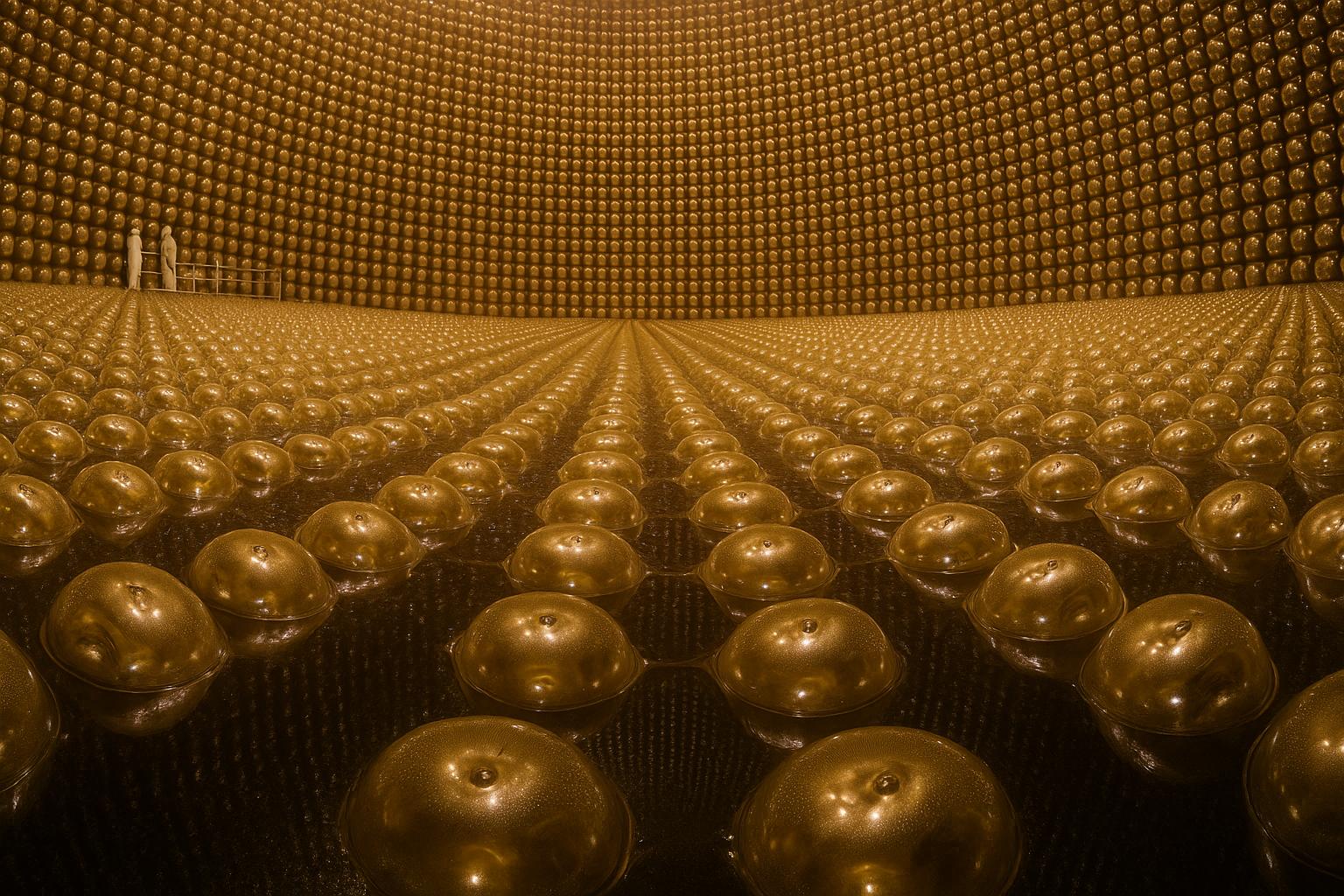
Under A Mountain In Japan, The Super-Kamiokande, The Largest Neutrino Detector In The World, Holds Millions Of Liters Of Water So Pure That It Becomes Corrosive And Reveals Secrets Of Neutrinos And The Cosmos.
Under the Kamioka Mountain, in Gifu Prefecture, Japan, there is one of the most impressive scientific chambers ever constructed by humans. From the outside, it looks like an old abandoned mine, but at a depth of one thousand meters, it reveals a monumental space that seems straight out of science fiction: a gigantic golden cylinder, illuminated by thousands of photomultiplier tubes, holding water so pure that it becomes corrosive, capable of damaging exposed metals over long periods.
It is the Super-Kamiokande, the most famous neutrino detector on the planet and a true “window” to the deepest secrets of the universe.
The Water That Corrodes Because It Is Pure Is In The Largest Neutrino Detector In The World
The first impression is startling: how can water be corrosive? It is not about acidity, but the almost total absence of mineral salts and impurities.
-
How the terraforming of Mars can transform the planet: artificial aerosols can increase the temperature by up to 35°C in 15 years, creating conditions for liquid water.

-
Scientists drilled nearly 8,000 meters into the ocean floor above the fault that caused the 2011 tsunami in Japan and discovered that a layer of clay 130 million years old was responsible for making the wave much worse than any model had predicted.
-
Thousands of years after causing the largest eruption of the Holocene, one of the world’s largest supervolcanoes is rebuilding itself beneath the sea south of Japan, receiving new magma and alarming scientists with its transformation.
-
China has activated a magnet 700,000 times more powerful than the Earth’s magnetic field that operates for over 200 consecutive hours while consuming little energy, and now the world wants to know what Beijing plans to do with this technology in 2026.

The purification process in the Super-Kamiokande is so extreme that the water becomes chemically unstable, “seeking” to dissolve any available ion. This characteristic means that metals, concrete, and even plastic surfaces suffer accelerated wear if kept in direct contact.
This purity is essential to avoid interference with the extremely rare neutrino signals that pass through the detector, coming from the Sun, the atmosphere, or even stellar explosions millions of light-years away.
The Functioning Of The Super-Kamiokande – Largest Neutrino Detector In The World
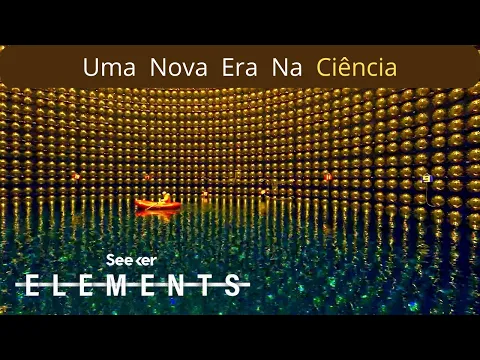

The observatory is a cylinder 40 meters high and 40 meters in diameter, filled with 50 thousand tons of ultra-pure water.
Surrounding it are more than 11 thousand photomultiplier tubes — enormous circular sensors that resemble golden eyes — keeping watch for every flash produced inside the tank. This flash is not visible to the naked eye, but is recorded as a Cherenkov radiation flash, which occurs when a charged particle generated by a neutrino moves faster than light can propagate in water.
Neutrinos are almost ghostly particles, passing through mountains, planets, and even our bodies without leaving traces most of the time.
Therefore, the only way to detect them is to create a gigantic and protected environment where extremely rare signals can be distinguished from the “noise” of other particles.
The depth of 1,000 meters in the mine serves precisely to filter the rain of cosmic rays that hit the Earth’s surface, allowing only the subtlest events to reach the golden chamber.
The Discovery That Earned A Nobel
It was thanks to the Super-Kamiokande that particle physics made one of the biggest leaps of the 20th century. In 1998, analyses conducted at the detector revealed that neutrinos change identity as they travel through space — a phenomenon known as neutrino oscillation.
This discovery meant that they have mass, albeit tiny, contradicting previous predictions.
The achievement was so impactful that it earned Japanese physicist Takaaki Kajita the Nobel Prize in Physics in 2015.
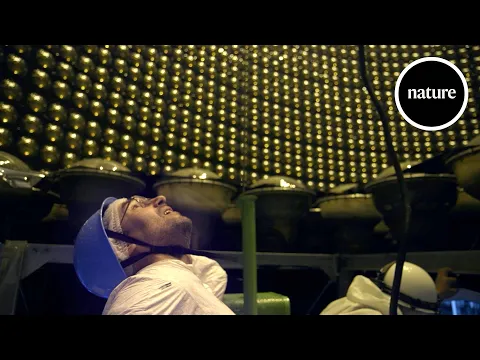
The revelation opened new lines of fundamental research: understanding how matter behaves in the primordial universe, explaining why the cosmos contains more matter than antimatter, and even investigating whether neutrinos hold clues about dimensions beyond the Standard Model of Physics.
The Future: Hyper-Kamiokande
If the Super-Kamiokande is already impressive, Japan is preparing an even more monumental project: the Hyper-Kamiokande, expected to start operations in 2027.
It will be five times larger, with 260 thousand tons of ultra-pure water and more than 40 thousand light sensors, making it the largest neutrino detector in the world.
The Hyper-Kamiokande will seek answers to even deeper questions: can neutrinos explain the asymmetry between matter and antimatter? Will it be able to detect neutrinos coming from distant supernovae, providing real-time information about the birth of black holes? And perhaps help piece together the puzzle of the very origin of the universe.
Between Science And Wonder
In the heart of the Japanese mountains, this “golden cave” does not hold treasures of gold or precious stones, but something infinitely more valuable: data that can reveal the invisible structure of the cosmos.
Each flash captured by the sensors is a whisper from the stars, a fragment of cosmic history silently crossing the Earth.
As the Hyper-Kamiokande progresses, the legacy of the Super-Kamiokande remains a symbol of human ingenuity: transforming the purest water on the planet into a portal to the mysteries of the universe.










-

Uma pessoa reagiu a isso.