





 Portuguese
  English
  Spanish
  5 min of reading
  14 comments


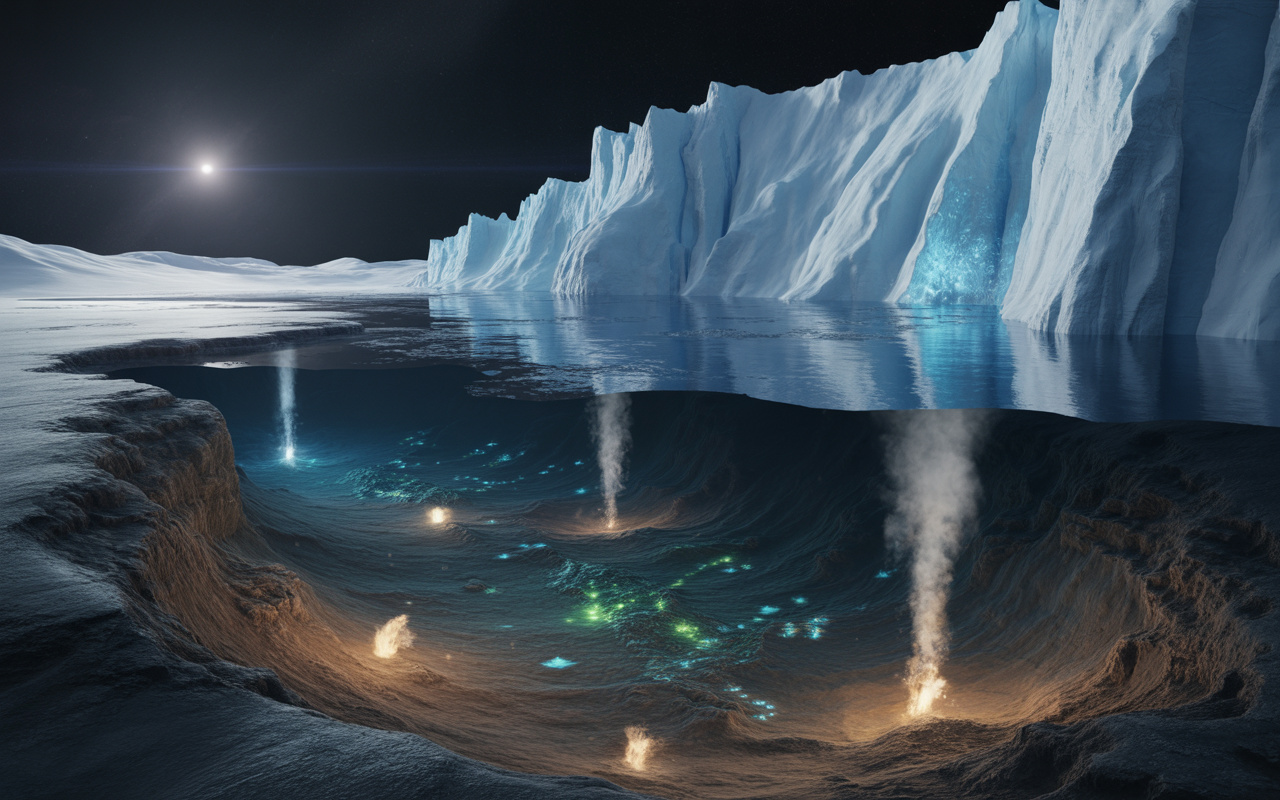


An Ocean Beneath Dozens of Kilometers of Ice May Contain More Water Than All the Earth’s Oceans Combined and Maintain Enough Energy to Sustain Life Outside the Planet.
For decades, the search for life beyond Earth has focused on the surface of planets. But accumulated evidence from space science points to another path: the underground. In particular, an icy world in our Solar System has revealed consistent signs that a global ocean exists beneath a thick crust of ice, containing more liquid water than all of Earth’s oceans combined. This environment, protected from radiation and powered by internal energy, may have remained stable for billion years, enough time for complex chemical processes and perhaps biological ones to develop.
The location in question is Europa, one of Jupiter’s largest moons. What once seemed merely a cracked white sphere has turned out to be one of the most promising environments for life beyond Earth.
What the Data Reveals About the Subsurface Ocean


Gravitational measurements, magnetic field analyses, and spectral observations indicate that Europa harbors a global salty ocean beneath an ice crust that varies in thickness, according to models, between 15 and 30 kilometers. Below this solid layer, the ocean is estimated to have an average depth of 60 to 100 kilometers.
-
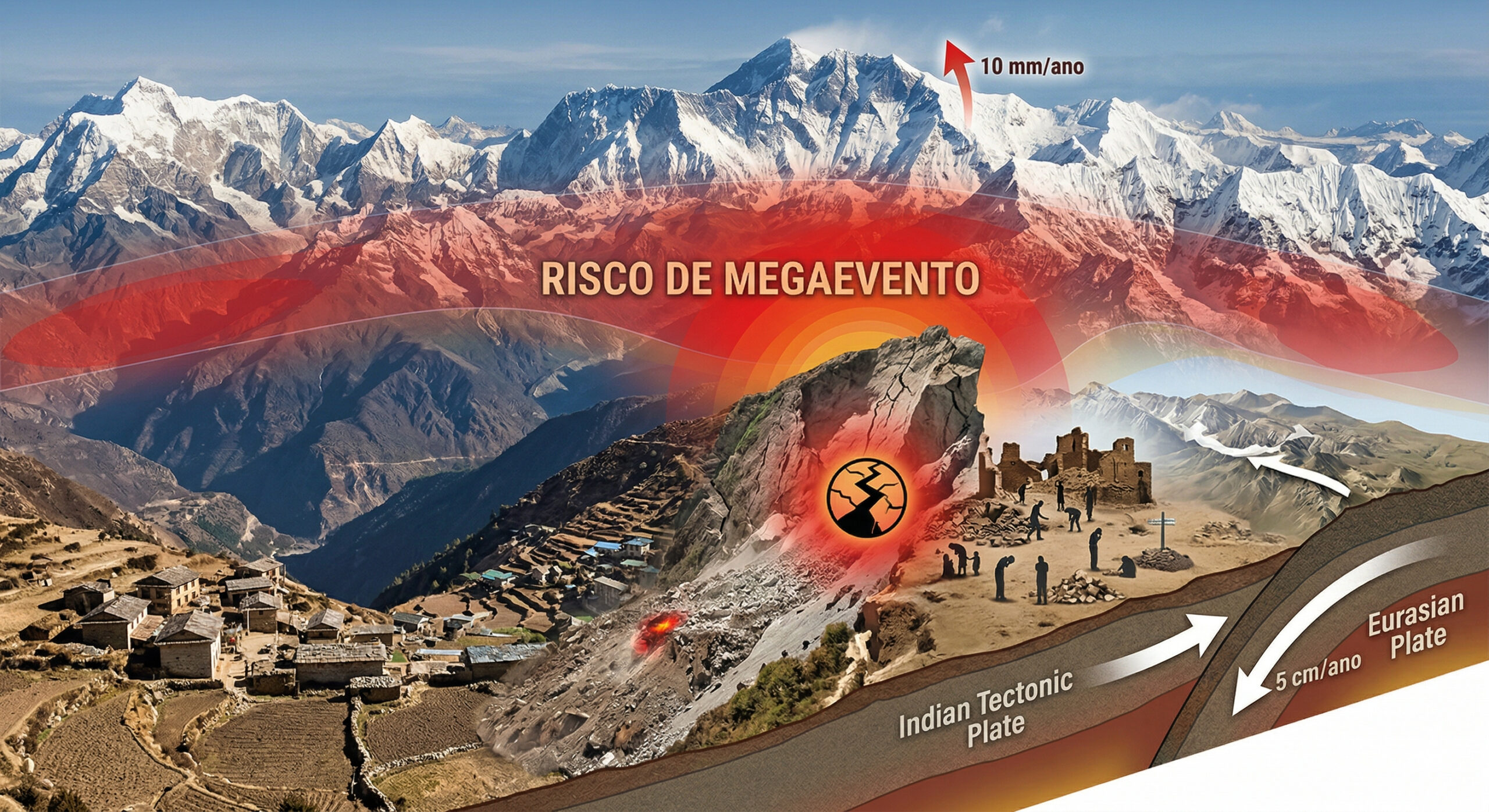
The Himalayas continue to grow to this day, with tectonic plates advancing 5 cm per year, mountains rising up to 10 mm annually, and the 2015 earthquake that killed 9,000 people may have increased the risk of an even larger seismic mega-event.
-
At an altitude of 400 km by astronauts from the International Space Station, Paris transforms at night into a golden mesh so precise that it reveals the outline of the Seine River, avenues, and entire neighborhoods like a luminous map drawn over the Earth.

-
iPhone 17 reaches historic low price with 256 GB, 120 Hz display, and drops to R$ 5,703 on Shopee, featuring A19 chip, dual 48 MP cameras, battery life of up to 30 hours, and advanced AI features.

-
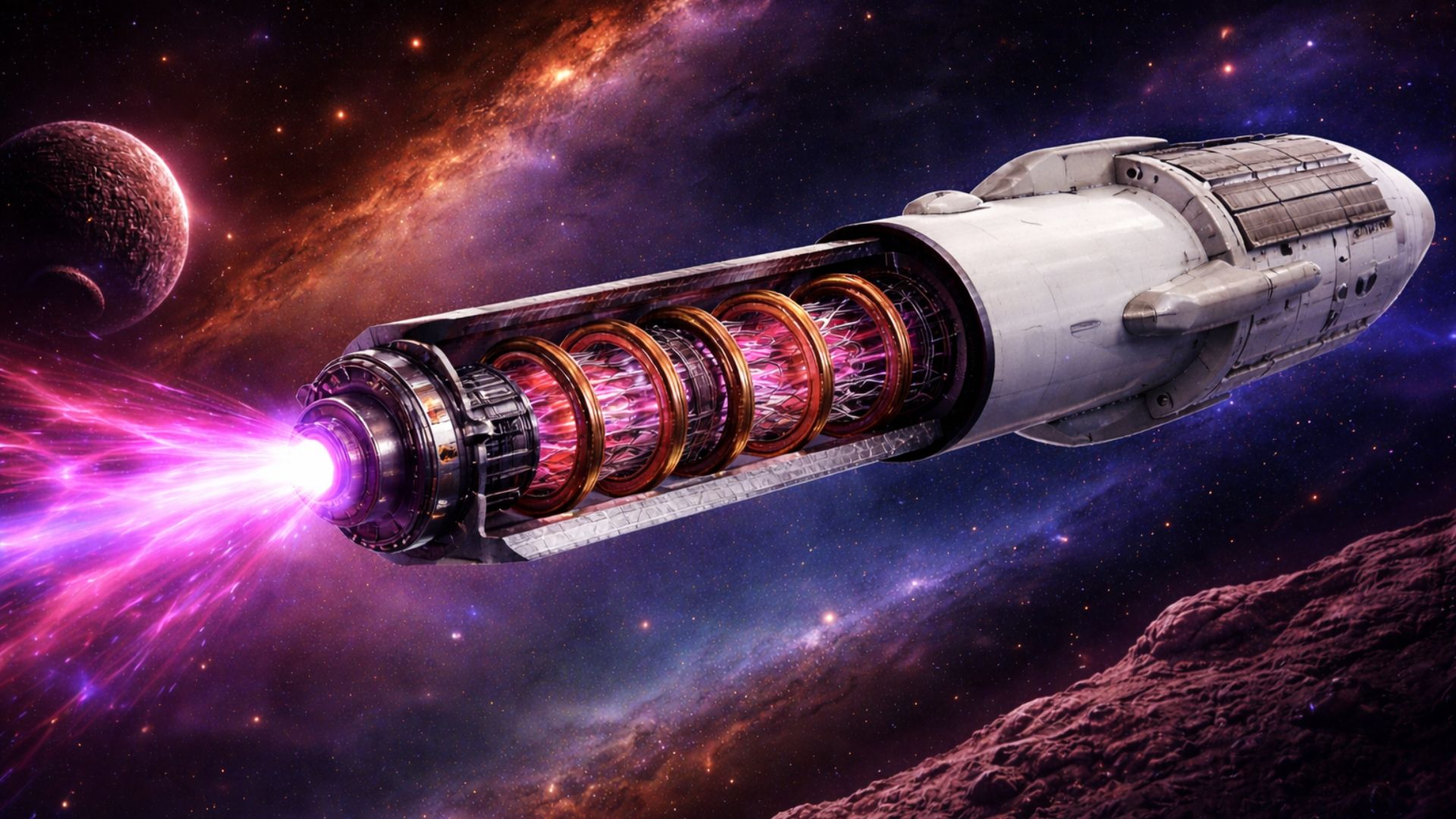
Trip to Mars getting closer: Pulsar Fusion, from the UK, advances with plasma ignition in fusion engine and could drastically reduce space travel time, making crewed missions faster, safer, and economically viable.

In terms of volume, this means something impressive: more liquid water than all the Earth’s oceans combined, even though Europa is smaller than Earth. This finding has completely changed the moon’s status within astrobiology.
Why the Water Does Not Freeze

At the distance of Jupiter, Europa’s surface temperature is extremely low, reaching –160 °C. Still, the ocean remains liquid thanks to a powerful mechanism: gravitational tidal heating.
Jupiter’s intense gravity continuously deforms the moon’s interior as it orbits the giant planet. This process generates enough internal heat to:
- prevent total freezing of the water
- keep the ocean in liquid state for geological periods
- sustain continuous internal activity
It is a stable energy source, independent of sunlight — exactly the kind of condition that allows life to exist in extreme environments on Earth.
A Crust That Moves and Exchanges Matter With the Ocean
High-resolution images show that Europa’s surface is covered by fractures, broken plates, and areas where the ice appears to have been recycled. This suggests that there is interaction between the ocean and the crust, allowing for material exchange.
Scientifically speaking, this is crucial. Life, as we understand it, needs not only water but also:
- nutrients
- chemical energy
- circulation of elements
Models indicate that salts, simple organic compounds, and minerals from the rocky substrate may be transported between the ocean and the ice, creating a dynamic system — not an isolated and dead reservoir.
Evidence of Current Activity: Water Jets into Space
Observations made by space telescopes have detected plumes of water vapor being ejected into space from Europa’s surface. These jets may reach hundreds of kilometers high, piercing the crust and releasing material directly from the ocean or from shallow liquid pockets.
This phenomenon is a game changer: it suggests that ocean samples can be analyzed without drilling, merely by traversing the plumes with space probes. It is a rare and strategic opportunity for astrobiological exploration.
A Possibly Active Ocean Floor
Below Europa’s ocean lies a rocky mantle, and everything indicates that hydrothermal reactions may occur there, similar to the hot springs at the bottom of Earth’s oceans. On Earth, these environments:
- do not depend on sunlight
- are rich in chemical energy
- sustain complete ecosystems
If similar processes exist on Europa, they would provide exactly the kind of energy needed to sustain microbial life for long periods, even in total darkness.
Natural Protection Against Extreme Radiation
Jupiter emits intense levels of radiation that can destroy organic molecules on the surface of its moons. However, Europa’s ocean is shielded by dozens of kilometers of ice, functioning as a natural shield.
This protection creates an environment:
- chemically stable
- isolated from catastrophic external events
- preserved over billions of years
It is the opposite of unstable and hostile surface environments. In terms of habitability, this counts for a lot.
Why Europa Surpasses Mars in Biological Potential
While Mars shows signs of ancient water, Europa offers current liquid water, continuous energy, and prolonged isolation. These three factors together make the moon:
- one of the most promising environments in the Solar System
- a more robust candidate for present life, not just past
Mars may have been habitable in the past. Europa may be habitable now.
Dedicated Missions to Answer the Definitive Question
The scientific importance of Europa is so great that it has motivated specific missions. The most ambitious of these is the Europa Clipper, from NASA, designed to:
- map the crust thickness
- analyze the ice composition
- study the plumes
- identify regions with the most exchange between ocean and surface
These data will help define whether and where a future landing mission could search for direct signs of life.
Everything indicates that Europa’s ocean has existed for billion years, enough time for complex chemical processes to occur. Unlike transient environments, it is a:
- durable
- energetically active
- chemically diverse
On the cosmic timescale, few places beyond Earth offer such persistent conditions.
What Is Really at Stake
The discovery of life on Europa would have profound implications. It would not only confirm life beyond Earth but also prove that life can arise and persist in environments vastly different from our own, in worlds covered by ice, far from the Sun. This would change:
- our understanding of the origin of life
- estimates of life in the Universe
- Earth’s own position as a special case
While Europa’s surface may seem cold and inhospitable, everything suggests that an entire ocean pulses below, dark, warm, and potentially alive. An invisible world, hidden under ice, waiting only for the right tools to reveal its secrets. The question is no longer whether there is water. The question now is: what lives in it?










Pode haver peixes 🐟 🐟 🐟 ou similares lá. Bilhões de anos são muito tempo!
A chance da vida ter surgido da matéria, em qualquer ambiente e espaço de tempo, é de 0,0000000000…1% (10^-121). Tenham fé, pois ainda há possibilidades. Haja fé.
Considerando que estamos falando de um universo com trilhões de galáxias e cada uma com bilhões de estrelas então nasceu vida em milhões de lugares inimagináveis
Não adianta para qualquer lugar do universo q o ser humano for ele destrói tudo com a ganância e a falta de respeito a vida e com Europa não será diferente, eles querem saber se tem materiais valiosos para poder explorar e se tiver vão poluir e matar tudo q tem vida 🧬
O bom é que ninguém nunca pescou lá