





 Portuguese
  English
  Spanish
 5 min of reading
  7 comments


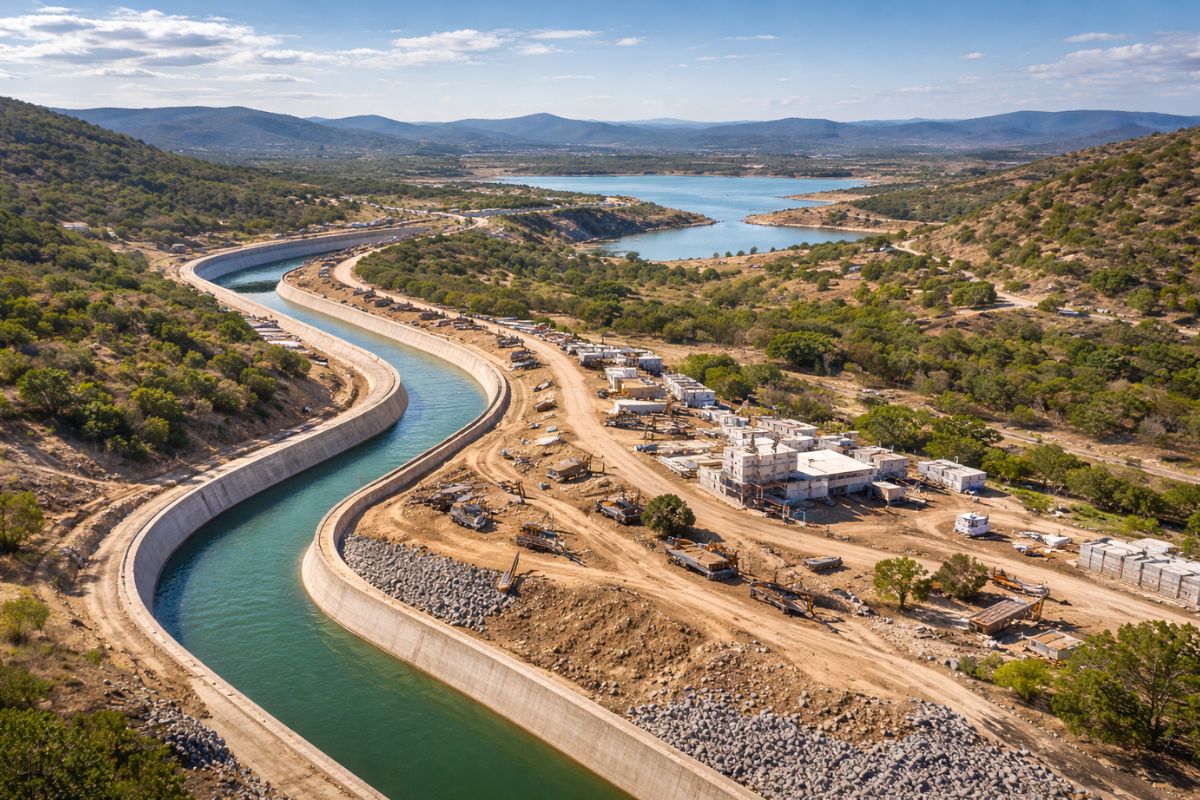


With 145.3 km underway and expected completion in June 2026, the largest state water project in Brazil, the Cinturão das Águas do Ceará, expands water transfer and reinforces water security in the Ceará semi-arid region.
The largest state water project in Brazil, the Cinturão das Águas do Ceará, has reached 91% completion and is advancing as the central axis of water transfer in the state. With ongoing lots in Cariri and delivery targets set for June 2026, the project consolidates a new water route for the Ceará semi-arid region.
What Is the Cinturão das Águas do Ceará and Why Is It the Largest State Water Project in Brazil
The Cinturão das Águas do Ceará, known as CAC, is a system of large-scale water transfer. Water captured at the Jati dam, in the North Axis of the São Francisco River Integration Project, travels 145.3 kilometers through open channels, concrete sections, tunnels, and siphons until it reaches the springs of the Cariús River, in the municipality of Nova Olinda, in the Cariri region.
The central goal is clear: to provide water security for the Ceará semi-arid region, reducing dependency on emergency actions and ensuring alternative supply routes.
-
“No one will make us change the Pix,” says Lula after the US report.

-
Lula responds directly to Trump and says that Pix is from Brazil and will not change under pressure from anyone, after a report from the United States pointed out the Brazilian payment system as an American trade barrier.

-
Amazon has just announced a new fee on all deliveries, and your online purchases will become more expensive starting April 17, including for those buying from the United States here in Brazil.

-
He sold his share for R$ 4 thousand, saw the company become a giant worth R$ 19 trillion, and missed the opportunity of a lifetime.


Instead of treating each reservoir as an isolated system, the project creates an integrated network of basins, where one region can support another in critical moments.
It is this combination of extent, redistribution capacity, and priority for human consumption that makes CAC the largest state water project in Brazil, with a direct impact on the daily lives of millions of people over the coming decades.
Project Status: 91% Completion and Expected Conclusion in 2026
The works of the Cinturão das Águas are divided into five lots. Lots 1, 2, and 5 have already been completed, forming operational sections that provide part of the benefits even before the total completion of the project.
In Lot 3, which connects Barbalha to Crato, passing through Juazeiro do Norte, completion has reached 86%. Lot 4, which runs from Crato to Nova Olinda, is at 70% and is expected to be completed by October 2025. Combined, all sections keep CAC at overall execution around 90%, with final delivery expected in June 2026.
During a recent technical visit to Lot 3 in Barbalha, managers of the Water Resources System emphasized that the progress above plan, with 91% completed before the end of the year, demonstrates the effort to complete the largest state water project in Brazil on schedule.
Operational tests are already being conducted, preparing the infrastructure for full operation.
How the Infrastructure That Redistributes Water in the Ceará Semi-Arid Region Works
The backbone of the project is a series of excavated channels, concrete structures, tunnels, and siphons that carry water by gravity or difference in elevation, with control structures distributed along the route.
These structures regulate flows, allow segmented operation, and enable the sending of water to different internal basins as needed.
Operation will be supported by automation and remote monitoring almost in real-time, allowing precise tracking of volumes, pressures, and flows.
The distribution priority follows clear rules: first human supply and essential public services, then industrial and tourism demands, followed by rural use and livestock watering, and finally, irrigated agriculture projects, always according to availability.
In addition to reinforcing the Cariri region, the largest state water project in Brazil plays a strategic role in the state’s water integration.
Through interconnection with the Eixão das Águas, the Cinturão can contribute to the supply of the Metropolitan Region of Fortaleza, reaching over 5 million inhabitants, especially in situations of severe drought.
Investments, Lots 3 and 4, and Economic Impact in the Interior
The total investment in the Cinturão das Águas is approximately R$ 800 million, considering the contributions shared between state and federal governments.
In Lots 3 and 4, the total amount reaches R$ 1.084 billion, with about R$ 319 million allocated to Lot 3 and R$ 765.9 million to Lot 4.
This injection of resources is not limited to physical infrastructure. The project’s execution stimulates productive chains in engineering, construction materials, transportation, fuels, and local services.
More than 1,500 direct jobs are generated along the route, supported by around 500 machines in operation.
Around the construction sites, the demand for food, lodging, trade, and support services is growing, strengthening the economies of municipalities in the interior.
In the medium term, the expectation is that the completion of the largest state water project in Brazil will reduce emergency expenditures by the government on water trucks and crisis actions, while also opening space for new ventures and expanding irrigated agriculture in areas with greater supply security.
Water Security for Cariri and 24 Directly Served Municipalities
When completed, the Cinturão das Águas will represent a decisive reinforcement in water security in Cariri, the second most populous region in Ceará and of great economic relevance.
The project prioritizes human supply, followed by addressing demands from industry, tourism, livestock watering, and irrigated agriculture.
The direct influence area of the project encompasses 24 municipalities, benefiting approximately 561,000 people.
In practice, this means greater stability in water supply, less risk of prolonged rationing, and reduced dependence on emergency measures during intense drought periods.
By integrating basins and creating reinforcement routes between reservoirs, the largest state water project in Brazil reduces the risk that a critical reservoir could lead an entire city to collapse.
Instead of relying on a single source, the served regions now have an articulated system capable of redirecting water from areas with higher availability to areas under greater pressure.
Long-Term Water Planning and Reference for the Semi-Arid
The model of the Cinturão das Águas do Ceará has been attracting attention from other states in the Semi-Arid for combining large-scale water transfer, basin integration, and prioritizing human consumption in a single structure.
Instead of acting only with emergency measures, the state invests in a permanent work as the basis of its water planning.
With completion expected in June 2026, the system is likely to guide decisions on water use in urban areas, industrial expansion, agricultural projects, and watershed protection.
Thus, the Cinturão becomes a central instrument for coexistence with the semi-arid climate and for organizing regional development, helping to balance economic growth and the availability of natural resources.
At the same time, the largest state water project in Brazil consolidates a shift in perspective: water is no longer treated merely as an emergency but is structured as strategic infrastructure, as important as highways, transmission lines, or major energy projects.
What should be the priority after the conclusion of the Cinturão das Águas do Ceará: to expand irrigated agriculture, further strengthen urban supply, or use this structure to attract new industries to the Ceará semi-arid region?








Finalmente uma obra necessária sendo finalizada, ja deveria ter sido feita há decadas.
Lula não fez nada, durante o governo dele engenheiros começaram a obra, ele desviou muito dinheiro e parou, ele tentou politizar a obra como promessa de campanha. Largou tudo a ação do tempo foi destruindo tudo. Quando Bolsonaro entrou concluiu a obra. Mas quando Lula **** voltou mandou desligar as bombas lula é o maior **** do mundo!
A maior Obra Hídrica
do Brasil so poderia ter sido construída pelo Presidente Lula
Lula não fez nada, durante o governo dele engenheiros começaram a obra, ele desviou muito dinheiro e parou, ele tentou politizar a obra como promessa de campanha. Largou tudo a ação do tempo foi destruindo tudo. Quando Bolsonaro entrou concluiu a obra. Mas quando **** voltou mandou desligar as bombas. **** é o maior **** do mundo!
Muuuuuumuuu
De que planeta voce veio!!!! Acha mesmo que o 9 dedos……. ta de sacanagem