





 Portuguese
  English
  Spanish
  4 min of reading
  9 comments


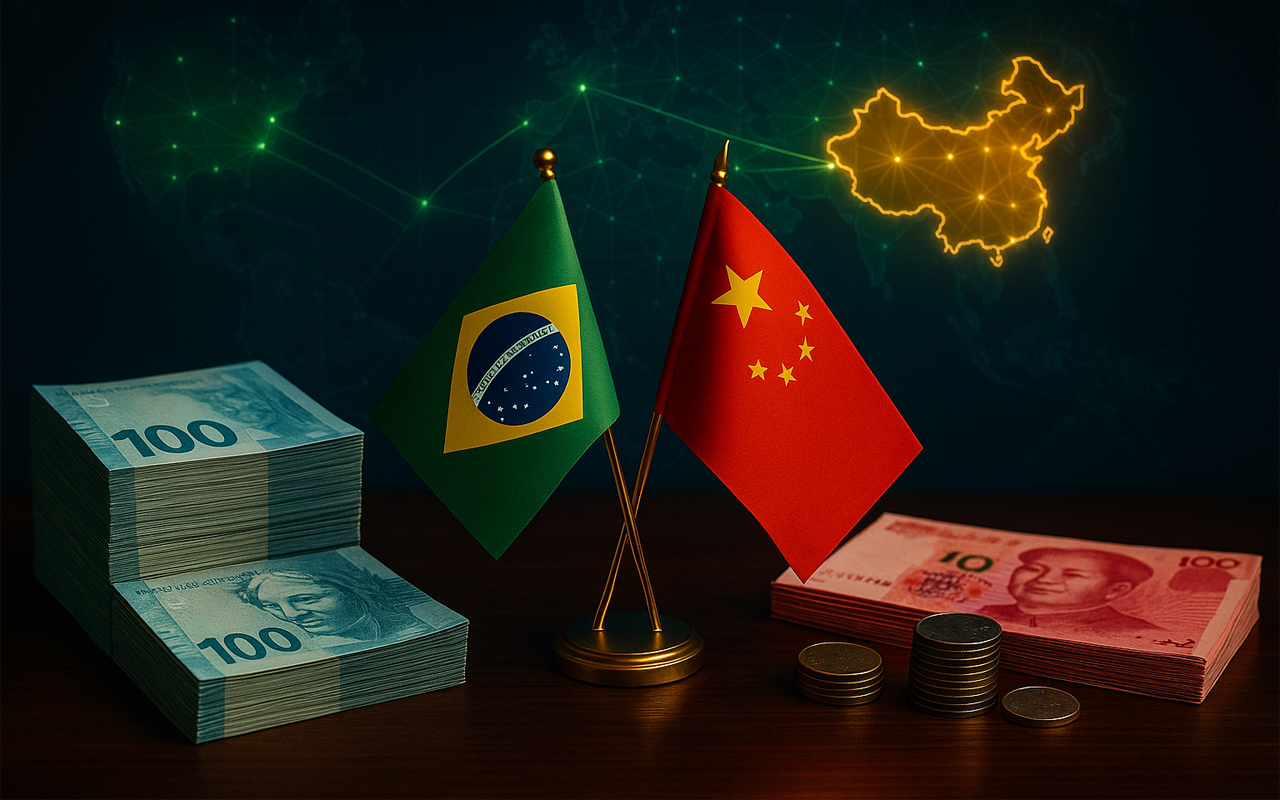


CIPS, China’s Cross-Border Payment System, Grows in Volume and Reach and Already Has Banks in Brazil Connected. Understand How Contracts in RMB (Yuan) Can Cut Costs in Agriculture, Mining, and Energy.
The CIPS (Cross-Border Interbank Payment System) is the infrastructure created by the People’s Bank of China for clearing and settling international payments in renminbi (RMB). In 2024, the system processed RMB 175.49 trillion and maintained 99.999% availability, according to official data, a leap that places it on the radar of exporters selling to China.
In addition to volume, CIPS operates on a “5×24h + 4h” basis, extending the global processing window and reducing operational friction compared to arrangements with multiple correspondent banks. In practice, it means fewer message resends, less reconciliation, and more predictability for those billing in RMB.
This advancement occurs alongside the growing use of yuan outside of China. In July 2025, SWIFT maintained RMB as the 6th currency in global payments by value (2.88%), but showed acceleration in trade finance, where the yuan reached 7.70% market share, signaling that the currency is advancing faster in trade financing than in settling all invoices.
-
Airfare prices may rise with increasing fuel costs, and the government is considering urgent measures to avoid a direct impact on the wallets of Brazilians.

-
Chocolate prices soar nearly 15% and become a luxury item for Easter 2026, with increases surpassing inflation and changes in Brazilian consumption habits.

-
The Federal Revenue issues a good alert for Brazilian taxpayers: 60.9% are already using the pre-filled tax return, automatic refunds via Pix reach millions, and the government plans for a fully automated income tax in the coming years.

-
India announces a plan of $3.06 billion to bring aviation to forgotten regions: 100 new airports, $1.07 billion in subsidies, and regional routes guaranteed for 10 years, from 2026 to 2036, away from the centers.

For Brazil, the largest exporter of soybeans, minerals, and oil to the Chinese market, receiving in RMB via CIPS can reduce costs and lower chain risks. But it is essential to understand how CIPS works, who is already connected here, and what limitations remain.
Understand Better How CIPS Works (the “Chinese Swift”)
The CIPS is the “backbone” for cross-border payments in RMB, with direct and indirect participants worldwide. It is not identical to SWIFT (global messaging network) or CHIPS (dollar settlement in the U.S.). CIPS focuses on RMB and, in many flows, uses SWIFT for messaging, which explains why it does not immediately replace Western networks. Summary: CIPS reduces exposure to the dollar but does not eliminate interdependence with global infrastructure.
In operational terms, the second phase of CIPS expanded the window to 5×24h + 4h, increasing the overlap of times with the Americas, Europe, and Asia. This helps to shorten deadlines and standardize routes for foreign trade payments with China.
Growth is steady: the CIPS website features tally counters of participants (176 direct and 1,531 indirect as of 08/25/2025) and highlights the annual volume for 2024. FXC Intelligence estimates that the number of transactions last year reached 8.2 million (+24% year-on-year), reinforcing the adoption trend.
RMB in Payments and Trade Finance, Most Recent Data from SWIFT
In global payments, RMB maintained 2.88% market share in July 2025 (6th position), according to the RMB Tracker from SWIFT. This is a modest level compared to USD and EUR, but stable in 2025 following fluctuations in the first half of the year.
Where the advancement is most visible is in trade finance. The August 2025 edition of the RMB Tracker shows that, in July, the yuan reached 7.70% market share in documentary instruments (MT 400/700), trailing behind USD and very close to the euro — a leap compared to 2023. For the exporter, this indicates more banks and counterparties willing to finance letters of credit and documentary collection in RMB.
This backdrop connects to movements from global banks entering CIPS as direct participants, such as HSBC Hong Kong — a sign that the ecosystem of liquidity and services in RMB is densing outside of China.
Brazil in CIPS, Clearing Bank and Participants
Brazil already has a local “plumbing” for RMB. In Feb 2023, the People’s Bank of China designated ICBC Brazil as the RMB clearing bank in the country — it is responsible for settling and clearing payments in Chinese currency within national territory, reducing frictions. This is crucial to cut intermediaries and timelines.
On the list of direct participants in CIPS are BOCOM BBM S.A. and Bank of China (Brazil) S.A., along with a reference to ICBC (Brazil) RMB clearing bank. In practical terms, there are active institutions in Brazil capable of processing flows in RMB and offering related trade finance products.
Instances in Brazil are already occurring. In April 2024, CGN secured trade financing in RMB (¥160 million) via ICBC Brazil to import solar modules for a project in Ceará — a concrete example of an energy chain operating in yuan, with reduced exposure to the dollar.
Agriculture, Mining, and Energy: Gains and Limits of Sanctions and Hedge
In agriculture, contracts for soybeans, meat, and sugar can avoid double conversion (RMB→USD→BRL), reducing cost and volatility between order and receipt. Mining (iron ore, nickel) tends to benefit in long-term agreements with Chinese buyers, simplifying the settlement. In energy, trade finance in RMB is already present in the import of solar modules and could expand to oil and hydrogen as the ecosystem matures.
Sanctions: What CIPS Changes (and Does Not Change). CIPS reduces reliance on dollar-linked infrastructures and creates alternative routes — but does not immunize companies against secondary sanctions. Studies from CSIS and European centers remind us that CIPS still relies on SWIFT for a significant part of the messaging and that banks outside China can avoid risks when there is regulatory pressure. Summary: CIPS reduces exposure, but compliance remains mandatory.
Hedging in RMB: exporters can lock in CNH with NDF/forwards or structure swaps aligned with the cash cycle (shipping, delivery, receipt). In general, it makes sense to partially cover flows in RMB and compare the cost of direct protection in CNH versus via USD, taking into account spreads, basis, and terms offered by the bank.









E ótimo para negociar com China, Rússia, cuba e Coreia do Norte, mas e com o resto do mundo? Países que aderem a esse sistema, normalmente é excluído do americano.
Só um **** como o lula 9 dedos e o tachado pra acreditarem na china , qualquer problema na economia chinesa, quebra o brasil.
O LULA TÁ louco pra nós jogar aos pés do comunismo………