





 Portuguese
  English
  Spanish
  5 min of reading
  0 comments


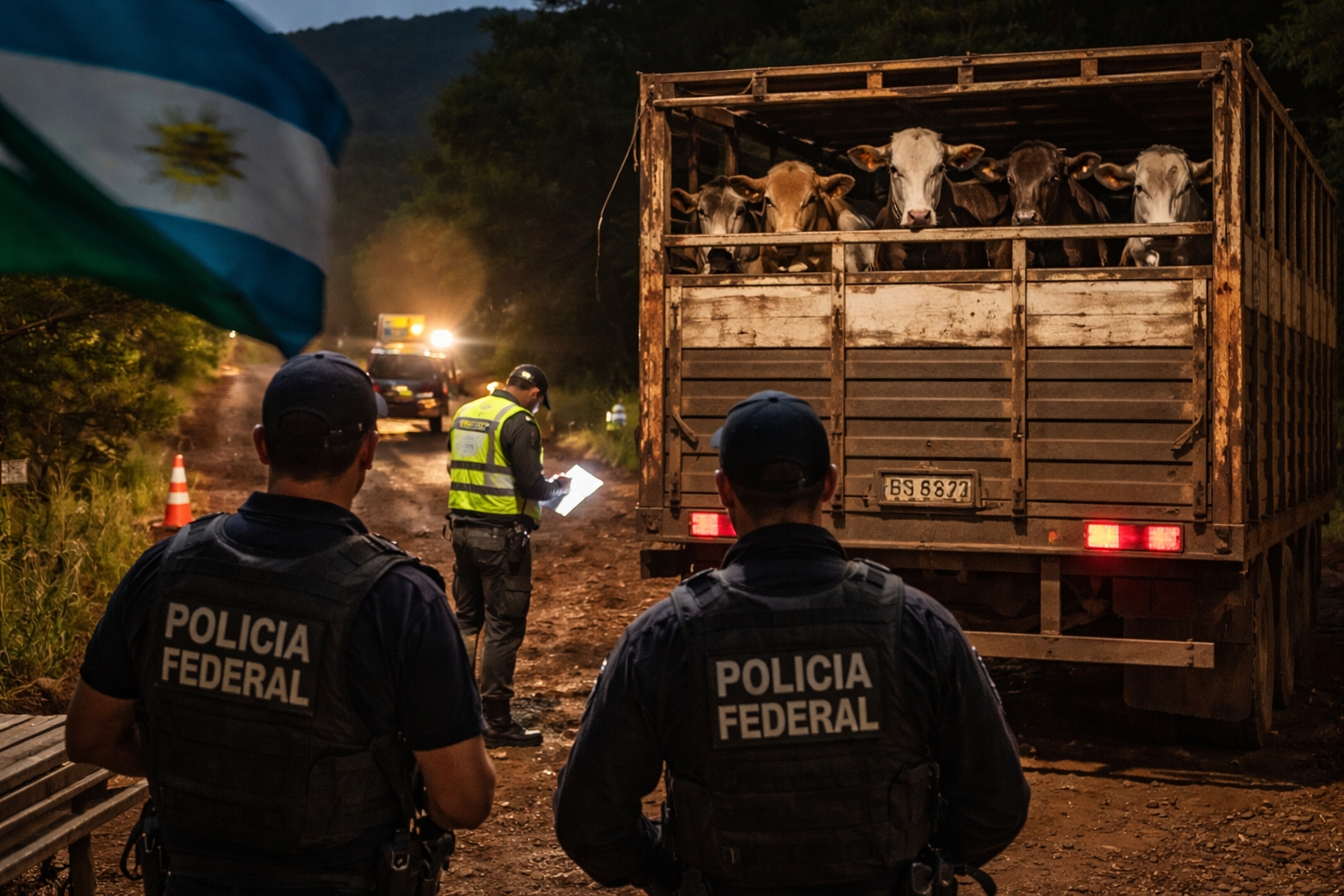
Border Inspection Becomes Focus of Attention With Sanitary Risks for the Protein Chain and Brazilian Beef Exports
If there is one issue that puts the agricultural sector on high alert, it is when illegality comes too close to the farm gate and affects animal health. And that is exactly what is happening: the smuggling of cattle from Argentina to Brazil, crossing the border through improvised routes in Paraná, Santa Catarina, and Rio Grande do Sul, has gained strength again — and it is not just “another fiscalization problem.” The real fear is that the country could see years (and billions) of work going down the drain because of an uncontrolled animal entering without documentation and without sanitary barriers.
Even with the price increase in Argentina following the new economic policy of President Javier Milei, the illegal flow of animals has grown. The movement involves not only price but also the genetic quality of the herd, especially highlighting European breeds.
The increase in these irregular entries raises concerns about animal health and the impact on the Brazilian meat market, with direct repercussions on a sector that generated over US$ 23 billion in foreign sales last year.
-
While Brazil wants to end the 6×1 work shift, the president of Argentina wants 12 hours for his workers, increasing political tension in the country.

-
The village where two rivers run side by side without mixing in Santarém and Alter do Chão reveals some of the most beautiful freshwater beaches on the planet.
-
Mars is accelerating, and scientists have discovered that the planet’s day is getting shorter, revealing surprising signs of internal activity.

-
Artemis 2 is set to launch on April 1 at 7:24 PM to orbit the Moon with four astronauts, but a class X solar flare and coronal mass ejection could interfere with communications and threaten the launch.

The Bigger Problem Is Not Just Crime: It Is Sanitary Safety and Direct Risk to Meat Exports
The entry of cattle without official control increases the risk of sanitary problems and reaches a sensitive point for the Southern Region. The circulation of animals without tracking can compromise the trust in areas that took decades to achieve a valued sanitary status.
Brazil leads global protein exports, and the volume of the sector helps gauge the size of the risk. In the last year, sales totaled over US$ 23 billion, with US$ 9.8 billion from poultry, US$ 2.8 billion from swine, and US$ 10.8 billion from cattle.
When cattle enter without certification of origin and without undergoing customs and sanitary control, the chances of contamination and commercial questioning increase. The impact can reach demanding markets and affect prices, contracts, and authorizations.
Clandestine Routes at the Border and the Use of Easy Crossings
The main route identified involves the region between Santo Antônio do Sudoeste (PR) and Dionísio Cerqueira (SC), locations adjacent to the border with Argentina. There are sections where crossing can be done on foot, facilitating clandestine movement.
Smugglers take advantage of the lack or inadequacy of inspection at advanced sanitary control posts. Trucks loaded with animals mostly travel at night, reducing the chance of interception.
After entering, the herd usually follows local or rural roads to farms or slaughterhouses nearby, in areas that are not always far from the border line. In some sections, there are properties side by side between the two countries, which complicates control.
Certification of Foot-and-Mouth Disease-Free Area and the Risk of Setback in Meat Exports
The most sensitive point is the status of area free from foot-and-mouth disease without vaccination. Paraná and Rio Grande do Sul received certification and recognition from the World Organization for Animal Health in 2021. Santa Catarina has held the certificate since 2007.
This condition is crucial for opening, reopening, or maintaining markets that require a high sanitary standard. There are buyers who do not accept proteins originating from regions with vaccination against the disease, making this status an economic asset.
The entry of animals from places that still use immunization, as occurs in Argentina, can lead to a loss of trust and a rollback in sanitary status. This risk directly impacts the competitiveness of the sector and the stability of exports.
Why Paraná, Santa Catarina, and Rio Grande do Sul Speak of Billion-Dollar Losses
The potential impact is not limited to cattle farming. Paraná, Santa Catarina, and Rio Grande do Sul account for almost the entirety of Brazilian pork exports, with over 1.1 million tons out of a total of 1.2 million exported in 2023.
The three states also concentrate 60% of Brazilian commercial poultry farming, increasing the exposure of the protein chain. The sanitary risk can reach production, the economy, and the regional market, with potential losses in the scale of billion.
There is also an indication of increased smuggling of other items, such as meats, pesticides, garlic, onions, and food in general. This scenario amplifies concerns as it involves pathologies typical of other crops and pressures inspections on several fronts.
How Measures Work to Prevent Fake Documents and “Hot” Cattle
To make it harder for animals to enter irregularly and then circulate with falsified documentation, the Paraná Agricultural Defense Agency (Adapar) has adopted special mechanisms for issuing Animal Transit Guides (GTAs) in high-risk areas, such as borders and borders between states with different statuses.
One of the requirements is the sealing of loads, a measure used to prevent a shipment from entering uncontrolled and later being presented as having local origins. The in-transit load must be sealed by the official veterinary service of origin, and the numbers of the seals need to be recorded in the remarks field of the GTA.
There has also been identification of forgery related to filling out documents required for transportation. In a operation carried out just over a year ago, it was pointed out that declarations were used to indicate the birth of the herd on the Brazilian side, despite the animals having come from the neighboring country.
One example involves the declaration of birth for 50 animals, all males. There was no record on the farm, in nearly half a decade, of the birth of a single female, even with half the herd being of that gender.
What the Law Allows, Which States Can Buy, and What May Occur Now
Those involved in these crimes can face charges of smuggling, criminal association, ideological falsehood, and violation of preventive sanitary measures, with sentences that can add up to 18 years in prison. When an irregular shipment is seized, the animals go to slaughter, with destruction and disposal.
The rules for transit and acquisition are also strict: states can only buy animals from locations with the same sanitary status and required certification. For the Southern states, free from foot-and-mouth without vaccination, purchases can only occur from units with the same status, including Rondônia and Acre.
Brazil has the second largest cattle herd in the world, with 234.4 million animals, behind India, which has around 300 million heads. Even so, sanitary status weighs more than the size of the herd when the focus is on market access and maintaining certifications.
There are markets like Japan and South Korea that do not buy pork from Paraná due to issues related to the historical sanitary status. Such restrictions show how any risk at the border can resonate throughout the entire chain.
Do you think border inspection is at the level that the size of the risk demands? Leave your comment below and share this post with someone in agriculture who needs to stay alert on this issue.







-

-

-

-

-

10 pessoas reagiram a isso.