





 Portuguese
  English
  Spanish
  2 min of reading
  5 comments


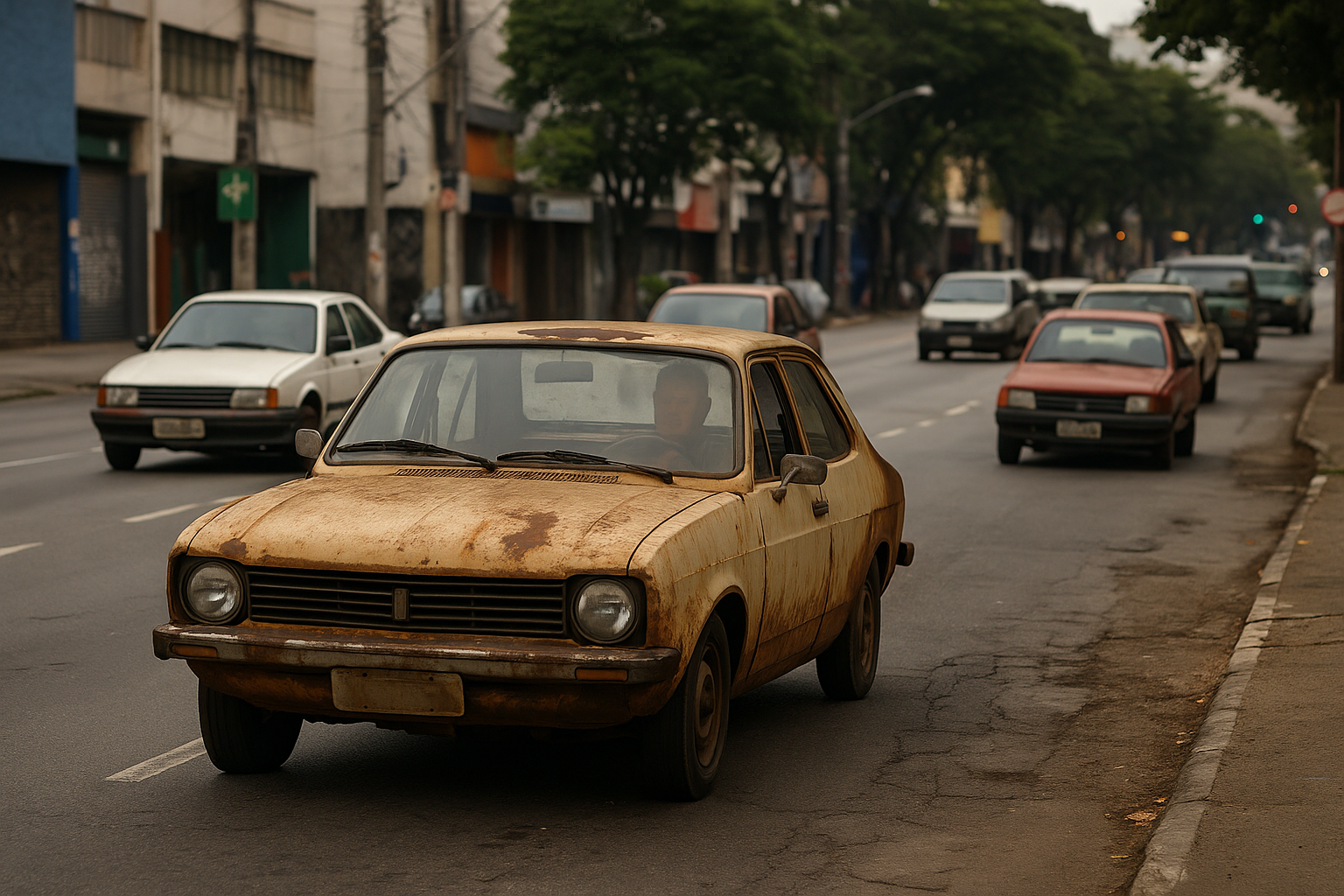


Sindipeças Survey Reveals Real Brazilian Fleet, With Accelerated Aging and 62.1 Million Vehicles Actually in Circulation in the Country
The Sindipeças survey shows a scenario very different from the official numbers from Senatran. In 2024, the agency registered 123.97 million vehicles in Brazil. However, this total includes cars, motorcycles, mopeds, scooters, trailers, and semi-trailers. The problem is that many of these vehicles are no longer in circulation but remain registered due to lack of official deregistration.
Deregistration of a vehicle requires facing complicated bureaucracy. At the end of its useful life, the owner often doesn’t know how to proceed or simply doesn’t complete the process. Thus, the official number is overestimated.
Sindipeças’ Own Methodology
To correct this distortion, Sindipeças uses technical criteria to calculate the actual circulating fleet. Scrapping rates, losses in traffic accidents, and abandoned vehicles in dismantling yards are taken into account.
-
Luciano Hang revealed that Havan’s air fleet has already accumulated more than 20,000 landings, 10,000 flight hours, and 6 million kilometers traveled, and he says that without the planes, the company would never have grown so quickly.

-
A historical discovery in the Andes Mountains reveals a gold deposit valued at 770 billion reais hidden over 4,000 meters above sea level on the border between Chile and Argentina, and the whole world is watching.

-
With just joint compound, white glue, and pigment, you can make a homemade paint that yields double the conventional amount, saves up to 70%, and leaves the wall with a finish that no one would believe wasn’t store-bought paint.

-
Home environment can influence the brain, mood, and well-being: studies indicate an increase of up to 15% in productivity, a reduction of 12% in stress with plants, and a direct impact of the circadian rhythm on the 24 hours of the day.


This data helps over 500 manufacturers of auto parts, both domestic and foreign, to plan the production of replacement parts.
According to the study, in 2024 Brazil had 62.1 million motor vehicles and motorcycles in circulation. Of these, 48.1 million were motor vehicles and 14 million were motorcycles.
The fleet growth between 2023 and 2024 was 2.8%, above the 0.8% per year recorded between 2016 and 2023. Motor vehicles grew by 2%, and motorcycles by 5.7%. Together, these vehicles account for 85.4% of the total fleet.
Fleet of Vehicles Becoming Increasingly Older
Another noteworthy statistic is the aging of the fleet. In 2015, vehicles up to five years old represented 38.5% of the motor vehicle fleet.
In 2024, this percentage dropped to 22.3%, falling from 16.5 million to 10.7 million units, a decrease of 35.2%.
Meanwhile, vehicles older than 16 years increased from 17.6% to 23.8% during this period. The average age of cars rose from 8 years and 10 months to 11 years and 2 months. Motorcycles follow the same trend: in 2015, 85% were up to 10 years old; today, only 65% are.
Proposals and International Comparisons
One solution could be a recycling program alongside fleet renewal and Technical Vehicle Inspection. However, political support for these measures is lacking. In the international comparison, Brazil has 4.4 inhabitants per vehicle. Argentina has 2.6, and Mexico, 2.4. The situation remains the same.
With information from MSN.




Nos locais por onde circulo não é como essa foto aí do Armagedon. Algum carro mais velho e/ou mal cuidado se vê mas aí entraria as “autoridados” policiais para minimizar os riscos de acidentes.
Duvido que haja um com frota de carros mais velhos que Cuba.
Essa foto deve ser no Uruguai