





 Portuguese
  English
  Spanish
  6 min of reading
  18 comments


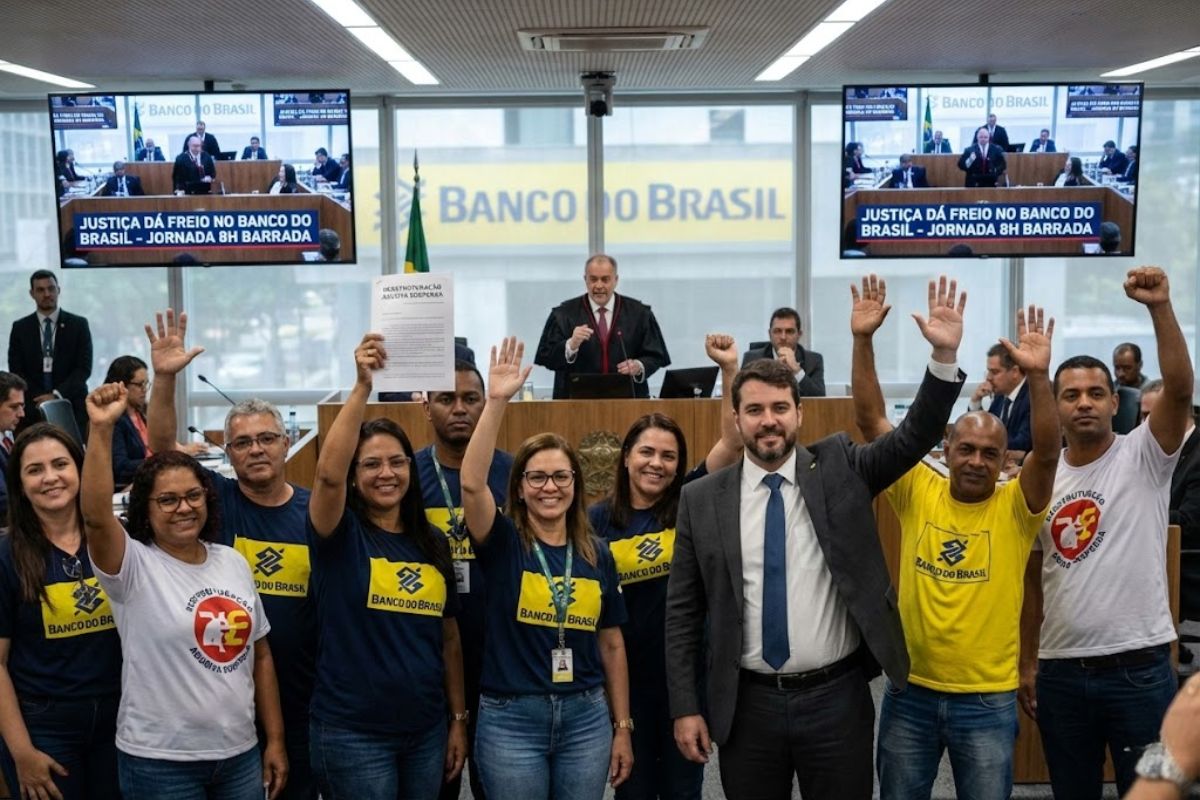


Preliminary Decision of the 12th Labor Court of Brasília Prohibits Banco do Brasil from Using Restructuring to Force 8-Hour Workday, Maintains Compensation for Advisors, Blocks Mass Decommissioning, and Sets Daily Fine of Two Thousand Reais per Worker, Reversible in Favor of the Employee Directly Threatened by the Measure.
On December 19, 2025, the Labor Court determined that Banco do Brasil cannot withdraw commissioned positions or reduce the salaries of advisors from Strategic Units who refused to transition from the special 6-hour workday to the 8-hour workday. The injunction was granted by the 12th Labor Court of Brasília, following an action by the Bankers’ Union of the Federal District against the ongoing restructuring.
On December 21, 2025, the decision became public with the release of the terms of the injunction, which classifies Banco do Brasil’s conduct as “indirect coercion” and establishes a daily fine of two thousand reais per affected employee, initially capped at two hundred thousand reais, should the bank fail to comply with the court order while the merits of the case are pending.
What the Injunction Against Banco do Brasil Determines
At the heart of the decision is the express prohibition against linking the maintenance of the gratified position to the acceptance of the 8-hour workday.
-
The institute that trained the greatest aerospace engineers in Brazil has just opened its first campus outside São Paulo after 75 years: ITA Ceará will have R$ 445 million, new courses in energy and systems, and classes are expected to start in 2027.
-
Luciano Hang, owner of Havan, goes to Juiz de Fora after the tragedy in February, brings R$ 1 million, hands out R$ 2,000 cards, and donates up to R$ 15,000 to victims in the region.

-
The Brazilian passport allows legal residence in dozens of countries without the need for a prior visa, and most Brazilians are unaware that they can apply for residency directly upon arriving in nations in South America, Africa, and even Europe.

-
Petrobras sends a message to Brazilian truck drivers after fuel collapse and reveals plan to have 100% domestic diesel.


The judge determined that Banco do Brasil refrain from requiring the extension of the workday as a condition for the employee to retain their commission, preserving the 6-hour workday provided for in the CLT for bankers who do not hold a fully trusted position.
Banco do Brasil must maintain employees who did not opt for the 8-hour workday, or who were not selected for the new positions, in the same roles, with the same compensation and in the same location, until a final decision on the merits is reached.
In practice, the restructuring cannot be used, for now, to redistribute these advisors as “surplus” or demote them with loss of function.
The injunction also points out that any noncompliance results in a daily fine for each affected worker, turning each individual case into an immediate regulatory liability.
The fine, reversible in favor of the affected employee, serves as an economic pressure tool to deter unilateral measures during the ongoing internal changes.
How Internal Restructuring Became Targeted by the Judiciary
The request analyzed by the judiciary originated from the Bankers’ Union of the Federal District, which reported that Banco do Brasil’s restructuring, within the “Digital Acceleration Movement” and “Structuring Movements” programs, began classifying as “surplus” the advisors from Strategic Units who did not accept the 8-hour workday or were not chosen for the new positions.
According to the union, the framework of these programs paved the way for a mass decommissioning effective January 5, 2026, with abrupt salary reductions for employees who have always worked a 6-hour shift and had no history of poor performance.
The implicit message reported in the action was clear: either the worker accepted the newly expanded workday or they would lose their commission.
In analyzing the described scenario, the judge found a concrete risk of immediate harm to workers and that the restructuring, as conducted, exceeded the limit of simple internal reorganization, taking on the contours of pressure to alter an essential condition of the contract, with direct impact on compensation and personal life of the involved bankers.
Indirect Coercion and the Special 6-Hour Workday
One of the central points of the injunction is the classification of conduct as “indirect coercion.”
Rather than a legitimate offer to change the work schedule, with truly free acceptance, the practice described in the records is presented as a forced choice between two losses: giving up the special 6-hour workday, provided for in Article 224 of the CLT, or losing the commissioned position and the corresponding compensation.
The decision emphasizes that the 6-hour workday is a consolidated right of bankers who do not hold a fully trusted position, precisely due to the exhausting nature of the activity and the historical protection of the category.
Altering this regime as a condition for maintaining a commission, without adequate collective negotiation, is viewed by the judge as a violation of the protective logic of labor legislation.
In practice, the message is that structural changes in large banks cannot be implemented at the cost of threatening loss of position, especially when the employee simply wishes to preserve the work schedule under which they have always operated.
The injunction temporarily prevents the use of restructuring as a pressure tool to extend work hours through unilateral action by the employer.
Daily Fine, Scope of the Decision, and Next Steps in the Process
The injunction established a daily fine of two thousand reais per affected worker in the event of noncompliance, initially limited to two hundred thousand reais, an amount that will be reverted to the affected employee if the order is not complied with.
The daily fine mechanism aims to prevent the decision from being treated as an abstract recommendation and reinforces the binding nature of the court order regarding personnel management.
The immediate scope of the measure is focused on the advisors from Strategic Units affected by the restructuring programs, but the precedent is relevant to the entire category, as it demonstrates that the extension of work hours cannot be imposed disguised as an “option.”
Any attempt to link the retention of commissioned positions to the waiver of basic rights is likely to be analyzed under the same coercion lens.
A conciliation and instruction hearing has been scheduled for April 13, 2026, when the union and Banco do Brasil will present their arguments in more detail.
Until then, the bank must maintain the non-opted workers in their current conditions of work hours, function, and compensation, under penalty of accumulating fines and strengthening the argument of abuse in the conduct of the restructuring.
What the Union and the Bankers’ Lawyers Say
The lawyers representing the union stated in a note that the injunction recognizes the seriousness of Banco do Brasil’s conduct and prevents workers from being punished for a unilateral and abusive restructuring.
In the defense’s view, the decision reinforces that decommissioning cannot be used as an intimidation mechanism to push for changes in work hours.
The entity also emphasizes that the attempt to implement cuts and structural changes on the eve of the holiday period increased the psychological impact on bankers, which was considered by the court when evaluating the risk of harm.
By halting the measure, the injunction sends a message to the entire financial sector that internal adjustments must respect legal limits and cannot rely on fear of immediate income loss to force compliance.
For the union, the case marks a dividing line: if the indirect coercion thesis is confirmed in the merits trial, other similar restructurings may be contested using the same basis, including in institutions attempting to replicate the model of extending hours under the threat of mass decommissioning.
The process thus will be monitored as a possible precedent for future labor disputes in the banking sector.
In light of this decision and the restructuring model adopted, in your opinion, does Banco do Brasil tend to completely withdraw from this strategy of forcefully extending work hours, or will it attempt to redesign the pressure on the commissioned employees through other means?










Como ex funcionário aposentado conheço os métodos sujos empregados pelo Banco do Brasil para aumentar os lucros abusivos crescentes que registra a cada ano fiscal. O processo de sucateamento lento das estatais passa obrigatoriamente pelo desrespeito aos funcionários, que torna cada vez mais desestimulante trabalhar nessas instituições estatais diminuindo o interesse em vestir a camisa e atingir as metas, que estão cada ano mais absurdas. O Banco do Brasil nunca desiste de encontrar maneiras de poupar e ao longo dos últimos 30 anos vem esquecendo quem é que cumpre as exigências de metas e lhes dá o lucro irreal que tem obtido ano a ano, seu quadro de funcionários, um dos mais produtivos e competentes dentre as estatais.
Eita povo cheio de mimimi contra o Banco do Brasil sinhô!.
As perseguições contra o Banco do Brasil é antiga. Pra que tamanho confusão para uma instituição bancária que sempre marcou presença nas economias do nosso país. Eita povo cheio de mimi sinhô!.