





 Portuguese
  English
  Spanish
  5 min of reading
  25 comments


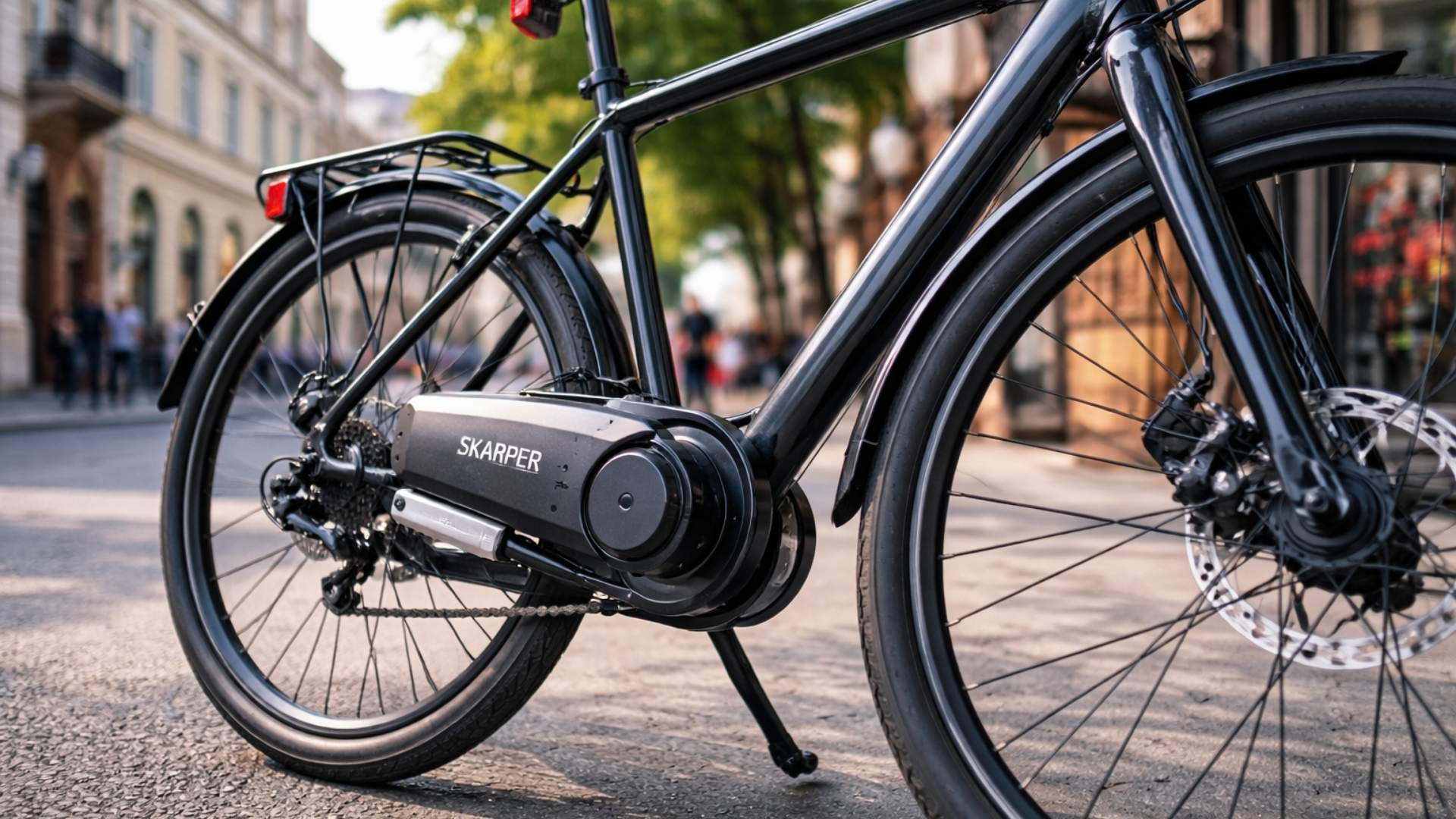


British System Invests in Quick Attachment on Disk Brake to Bring Electric Assistance to Conventional Bicycles, Without Changing Wheels or Altering the Frame, Using Removable Module, 250 W Motor and Integrated Battery, Focused on Urban Use, Road and Gravel.
An equipment created in the UK promises to provide electric assistance to conventional bicycles without requiring a motor in the hub, wheel changes, or wiring spread across the frame.
This is the system from Skarper, which uses a removable module attached to the left side of the rear of the bicycle and transfers power to the wheel through a special brake disk called DiskDrive, which replaces the original rear rotor.
The company claims that the setup works with a 250 W motor, full recharge in 2.5 hours, and a range of up to 50 km in eco mode.
-
The only man-made structure in the world that can be clearly seen from space is not the pyramids of Egypt nor the Great Wall of China.

-
An analysis by NASA highlighted that the Great Wall of China and the Pyramids of Egypt are not visible to the naked eye from the International Space Station, and only one man-made structure is visible in this way.

-
Chinese submersible discovers a colossal system of giant craters on the Pacific floor, previously unknown, teeming with life and so rich in hydrogen that they may help explain the origin of life on Earth.

-
A mysterious structure has been found beneath an ancient city in Egypt — and the most impressive thing is what technology has revealed hidden for 2,600 years.


Quick Attachment After Initial Rotor Installation
The main hook is the quick attachment after the initial rotor installation.
Skarper describes that the user only needs to replace the rear brake disk with a DiskDrive.
From there, the module “clicks” to go in and out in seconds.
This allows for switching between pedaling without assistance and using electric traction only when necessary.
In practice, the conversion is not universal for all types of bicycles.
The brand states that the system was designed for bicycles with rear disk brakes and 160 mm rotor, within a range of rims of 26 to 29 inches.
Included are urban, road, gravel, and hardtail mountain bike models.
Integrated Battery and Range Data

According to the manufacturer’s public data, the battery is integrated into the module and has 240 Wh.
The complete package weighs about 4.5 kg, with an approximate addition of 600 g compared to a common brake rotor due to the DiskDrive.
The company also publishes that the range varies by mode of use.
In Eco mode, the announced range reaches 50 km.
In Turbo mode, the range drops to about 30 km.
For partial recharging, Skarper states that 30 minutes on the plug can yield between 10 and 15 km, depending on usage conditions.
Disk Brake as Traction Interface
The operation relies on the idea of using the disk brake as an interface, without compromising its primary function.
The DiskDrive is a rotor that maintains traditional braking, but incorporates a gear arrangement.
This setup allows the module to deliver torque to the rear wheel from the non-driven side.
In a market dominated by kits with motors in the hub or central motors, the differential is that the electric component is concentrated in an external and removable block.

Meanwhile, the bicycle maintains the entire original mechanical system.
Use With or Without Electric Assistance
The company describes that the system can be used in a switched manner.
The cyclist can ride with the module attached and turned off.
It is also possible to remove the equipment and pedal normally.
According to Skarper, there is internal freewheel to minimize resistance when pedaling without the motor, even with the set installed and turned off.
The rationale is to reduce drag and ease the transport of the module when the bicycle is parked.
Sensors, Control and Mobile App
In driving, the brand states that the assistance is controlled by a pedal sensor, capable of identifying incline and adjusting the support to the effort.
Skarper informs that this sensor has a rechargeable battery with an estimated autonomy of 17 to 18 hours of use.
A full recharge of the sensor takes about one hour when it is completely discharged.
This component is part of the operational package of the system, along with the charger and access to the app.
The app allows for power mode adjustments and software updates.
Compatibility Limits and Recommended Use
The promise to “transform any bicycle” appears in the product communication, but compatibility has objective limits.

The brand claims that it does not recommend use on full suspension bicycles, nor in extreme modalities such as downhill or competitive cross-country.
The declared focus is on urban commuting, road, gravel, and light trails.
For mountain bikes that come from the factory with a 180 mm rear rotor, Skarper states that it may be possible to reduce to 160 mm.
This adjustment, however, may require help from a specialized workshop.
Max Speed and Technical Requirements
The maximum speed disclosed by the manufacturer is 25 km/h with assistance, aligned with the European standard for electric bicycles.
The company also states that the product can be installed without modifications to the frame.
It is necessary for the bicycle to have a compatible rear disk brake and a geometry that allows attachment to the chainstay on the left side.
Skarper offers a photo verification system and a compatibility questionnaire on its official page.
Partnership with Red Bull Advanced Technologies
The project gained visibility after the announcement of the partnership with Red Bull Advanced Technologies.
According to specialized reports, the cooperation involved simulation engineering and refinement of internal components.
The focus was said to be on reducing size and increasing the robustness of the transmission set.
Industry press also highlighted that the system maintains 250 W motor and 240 Wh battery, with an aim for quick and reversible conversion.

Initial Reviews and Points of Attention
In initial ride reviews, specialized vehicles described the set as compact and well integrated into the rear triangle.
The analyses point to the product as an alternative for those who want targeted assistance, without turning the bicycle into a permanent e-bike.
At the same time, the tests highlight that changing the rotor does not completely eliminate the initial installation step.
The process may require specific tools and adjustment of the brake caliper.
This detail often leads many users to seek a workshop, especially those without experience in disc brake maintenance.
Usage Context in Brazil
In the Brazilian scenario, solutions of this type attract attention for two main reasons.
The first is the growth of urban bicycles with disk brakes in recent years.
The second is the possibility of removing the electric module and taking it with you, reducing the risk of theft.
On the other hand, the focus on a 160 mm rotor and usage restrictions show that the system does not replace a dedicated e-MTB for heavy trails.





Onde fazer essa adaptação
Onde comprar e qual o valor?
Interessante, mas deveria ter colocado o valor