





 Portuguese
  English
  Spanish
  4 min of reading
  7 comments


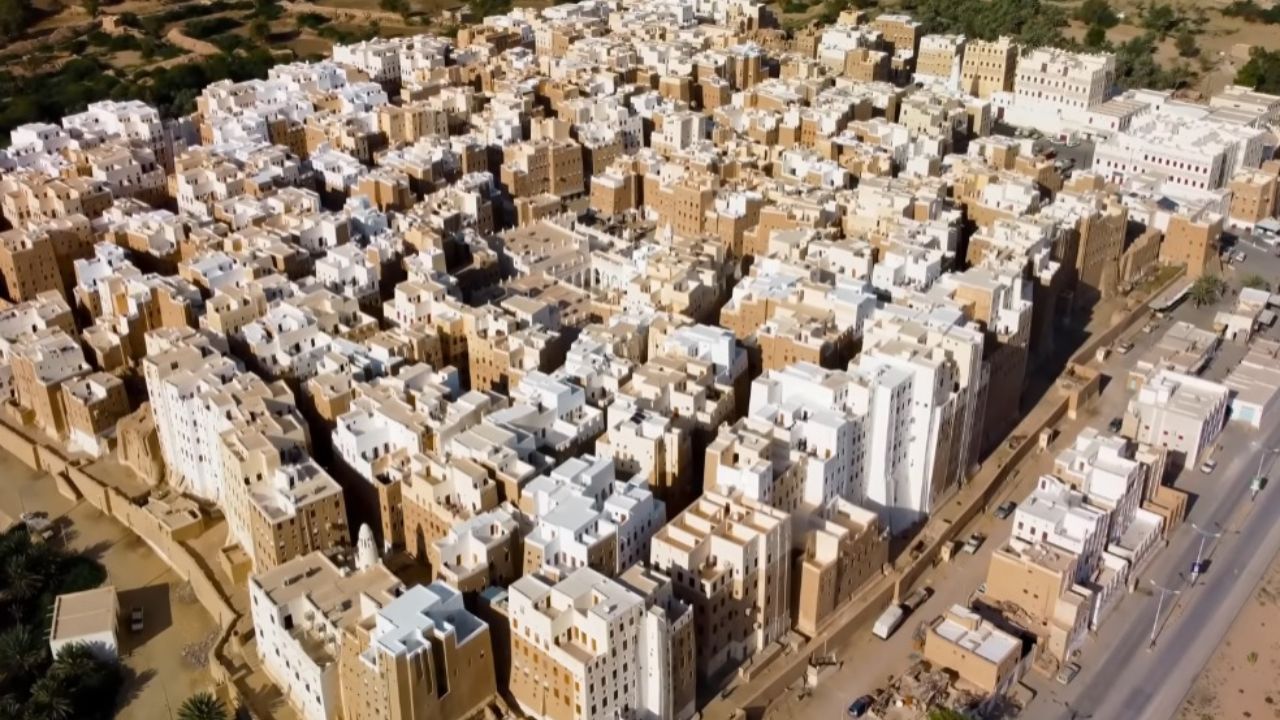


How The 500-Year-Old “Skyscrapers” Of Yemen Use Vernacular Engineering To Challenge The Desert, But Now Face Collapse.
The city of Shibam, located in the arid valley of Wadi Hadhramaut in Yemen, presents a profound architectural paradox. Known as the “Manhattan of The Desert”, it comprises around 500 tower houses that rise vertically from the plain, many reaching 11 stories high. What defies modern logic is its building material: these are 500-year-old “skyscrapers” made almost entirely of adobe bricks, a mixture of clay, straw, and water, sun-cured.
This feat of vernacular engineering, mostly dating back to the 16th century, led to the city being inscribed as UNESCO World Heritage in 1982, described as “the oldest and best example of urban planning based on the principle of vertical construction”. However, this achievement of human resilience, born out of the need for defense and climate adaptation, now faces a confluence of crises, war, economic collapse, and climate change, that threaten to erase centuries of history.
The Secret Engineering Of Adobe
The survival of Shibam’s 500-year-old “skyscrapers” is not a miracle but the result of a hyper-rational engineering system. The primary material, adobe brick, is fundamental. Although it has a fatal weakness—water can dissolve it, it has two crucial advantages: excellent compressive strength (bearing weight) and high thermal mass. The thick walls absorb the intense heat of the day and slowly radiate it at night, keeping the interior comfortable.
-
These living root bridges and ladders are over 700 years old and help indigenous people survive in one of the rainiest regions in the world.

-
From sertanejo star to international investor: Ana Castela invests millions in a mansion in the USA, creates a themed accommodation in Orlando, and shows that the “boiadeira” also wants to grow away from the stage.

-
The 10 most stunning motorhomes in the world: a $3 million trailer with a rooftop nightclub and garage for a Ferrari, “palaces on wheels” with Italian marble, private cinema, and five-star hotel luxury for billionaires.

-
Trump wanted to spend $400 million on the White House, but the courts prohibited the million-dollar construction.


To build upwards, the master builders of Shibam developed an integrated system. First, the foundations and the first meters are made of stone, creating a “boot” impervious that protects the adobe from ground moisture and minor flooding. Second, the walls are conical, meaning they are dramatically tapered: they are thick at the base and progressively thinner on each floor. This lowers the center of gravity and distributes weight, ensuring stability. Finally, an internal matrix of wooden beams is inserted into the walls, “tying” the structure to resist lateral forces, such as wind.
More Than “Clay”: The Sacrificial Skin And Maintenance
With the structure resolved, the final enemy was erosion caused by rain and wind. The solution was a strategy of continuous maintenance, visible in the very skin of the buildings. The exterior walls are covered by a thick layer of lime or gypsum. This layer is not permanent; it is intentionally sacrificial. It is designed to erode and fail, protecting the vital structural bricks underneath.
This establishes a “maintenance pact” between the city and its inhabitants. The survival of Shibam over the centuries is not due to a static permanence, but to a continuous cycle of renewal and repair. After each rainy season, the inhabitants must inspect and reapply the sacrificial plaster. The city is a living organism that requires constant care.
Why Build Upwards In The Desert?
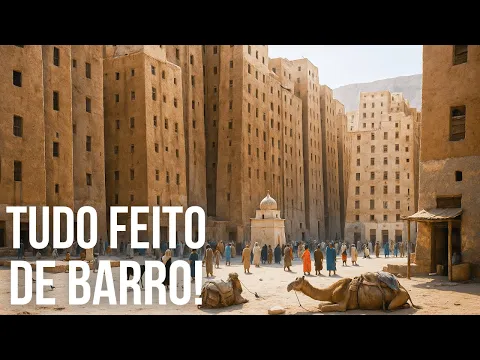

The extreme verticality of Shibam was not an aesthetic choice, but a rational response to two existential threats: man and nature. The city was planned from the start with a fixed perimeter, surrounded by a defensive wall. Since horizontal expansion was impossible, the only direction for the city to grow, as the population increased, was upwards.
This wall was essential for defense against tribal attacks. The architecture itself is a fortress: the ground floors have no windows, and the single entrance was easily defensible. As dangerous as the invaders were, however, the geography was equally perilous. Shibam is built on the floodplain of a wadi (dry riverbed), prone to flash floods that can be violent. The current incarnation of the city was built after a catastrophic flood in the 16th century. By building tall towers on stone foundations, the inhabitants placed their lives and belongings above the level of any conceivable flood, sacrificing only the ground floors, used for storage or animals.
A Living Heritage Under Extreme Threat
Despite its ingenuity, the future of Shibam is uncertain. In 2015, the UNESCO World Heritage Center placed the city on the List of World Heritage in Danger. The city faces a perfect storm of crises that are overloading its vernacular system. Conservation reports indicate that extreme weather events, such as cyclones (2008) and severe floods (2020), are causing damage that the original design did not foresee, saturating the foundations.
This environmental threat is compounded by the Yemen Civil War. Although Shibam has avoided the frontlines, the conflict has caused a economic and humanitarian collapse. This collapse broke the “maintenance pact”: families, plunged into poverty, no longer have the resources to repair the “sacrificial skin” of the buildings. Furthermore, the war led to a loss of knowledge, with master builders who held generational wisdom leaving the region. The “immune system” of Shibam, its ability to repair itself, has failed.
The Perennial Lesson Of Shibam
Shibam does not defy logic; it exposes the biases of our industrialized logic. It proves that local, low-energy materials, such as earth, can create dense, high-performing urban environments. It is a masterful example of passive design and thermal management, achieving human comfort without energy costs.
The tragedy of Shibam is a warning. It teaches that architecture, however ingenious, is not a static object. Its survival depends entirely on the social, economic, and political fabric that supports it. When that fabric unravels, through war, poverty, or loss of knowledge, the structures, no matter how brilliant, unravel with it.
Do you believe the world has a responsibility to save places like Shibam, even amidst conflict? And what lessons can this 500-year-old engineering teach our modern architects? We want to know your thoughts on this paradox.






Essa cidade deveria constar como uma das maravilhas do mundo. A UNESCO deveria intervir para que não acabe , alarmando o mundo para angariar ajuda humanitária dos países árabes que são riquíssimos.
Acredito que sim, mas precisaremos da paz. Acho extremamente importante a engenharia moderna voltar a essas técnicas antigas que a rigor são sustentáveis.
Conhecimento tem que ser guardado para as pessoas que ficam poderem mantê-lo e usá-lo.
A biblioteca do local deveria ser onde o conhecimento deveria ser guardado.
No caso todo trabalho feito dos técnicos locais deveria ter sido guardado.