





 Portuguese
  English
  Spanish
  5 min of reading
  5 comments


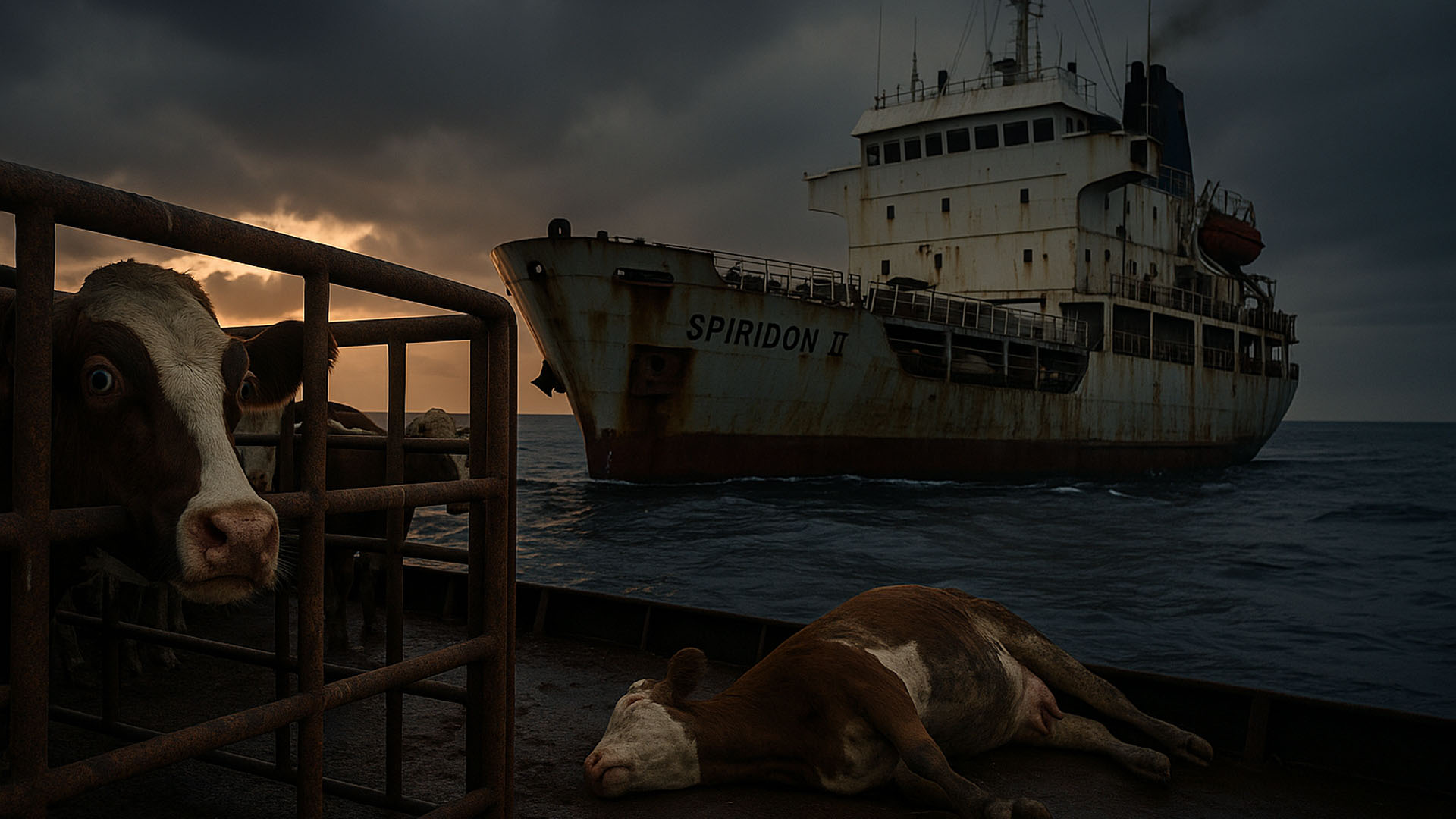


Spiridon II Vessel, with 2,901 Pregnant Cows Loaded in Uruguay Heading to Turkey, Has Been Adrift Between Europe and Africa for Weeks. NGOs Call it a “Death Voyage,” Pressure European Governments, and Rekindle Discussion on Live Animal Exports, a Sensitive Topic Also for Brazil.
Nearly 3,000 Uruguayan Cows have been trapped for over two months on the cargo ship Spiridon II, which is crossing the Mediterranean towards South America. The vessel has been prevented from unloading its cargo in Turkey due to documentation issues and is now described by activists as a “death ship.”
The ship, registered under Togo and built in 1973, left Montevideo on September 19/20 with 2,901 pregnant heifers destined for fattening and breeding in Bandirma, Turkey. Upon arriving at its destination on October 22, the cargo was rejected due to irregularities in mandatory ear tags and health records.
Since then, the Spiridon II has spent weeks anchored off the Turkish coast, in quarantine, with reports of overcrowding, extreme heat, lack of ventilation, and carcasses accumulating on board. Under pressure from public opinion and organizations like the Animal Welfare Foundation (AWF), the authorities allowed only a quick stop for refueling before ordering its return to Uruguay.
-
With over 14 million baskets of earth moved, an ancient North American metropolis built a monumental pyramid of 30 meters and established a city with 20,000 inhabitants nearly a thousand years ago.
-
A 1,900-year-old treasure emerges from a Roman house destroyed by fire and sealed since antiquity in Romania, with coins and metals fused among the ashes.
-
The Brazilian colonial city that stopped in time and shares territory with a rocket launch base.

-
79-year-old woman challenges limits, visits 193 countries in the world after 56 years of planning and reveals the behind-the-scenes of a global journey that few have managed to accomplish.


NGOs warn that, with the new crossing taking about a month, the animals could spend 87 days at sea, many already weakened, sick, or dead. For activists, the crisis exposes a systemic failure in the international live cattle trade and serves as a warning for exporting countries like Brazil and Uruguay.
How the Spiridon II Vessel Became Trapped Between Uruguay and Turkey


The Spiridon II departed from the port of Montevideo headed for Bandirma carrying pregnant Uruguayan heifers, on a route that is now common in the trade of live cattle between South America and the Mediterranean. The outbound journey took just over a month, within the expected time frame for this type of transport.
Upon arriving in Turkey, the cargo was halted after inspectors identified hundreds of animals without the correct identification documentation via ear tags or electronic chips, required to track their origin and health status. With no consensus between Turkish and Uruguayan authorities, the ship remained anchored in open water for weeks, without authorization to unload the cows.
Reports from previous inspections show that the 52-year-old vessel had already accumulated over 80 registered deficiencies and provides about 4,000 m² for the animals, a space considered insufficient in situations of prolonged delays. Nevertheless, the vessel was authorized to transport nearly 3,000 cattle in a single trip.
Deaths, Abortions, and Hunger: What Animal Welfare Reports Indicate
Organizations like the Animal Welfare Foundation and Tierschutzbund Zürich, which are monitoring the case, assert that at least 58 cows have died since leaving Uruguay. Reports also indicate about 140 births on board and the existence of 90 “untraceable” calves, raising suspicion of deaths or disposal of bodies at sea.
The organizations describe a scenario of overcrowding, floors covered in feces, strong ammonia odor, and the presence of flies, with exhausted animals attempting to remain standing in a cramped space. Images released by activists show bags with carcasses on the deck and reports from crew members about the severity of the conditions.
Veterinarians specializing in live cattle transport warn that the heifers, many in late pregnancy, suffer from heat stress, lack of space, and poor ventilation, factors that significantly increase the risk of abortion and calf deaths. According to a statement from AWF, these animals were already weakened by the end of the outbound journey, and each extra day at sea amplifies their suffering.
Another critical point is the availability of feed and water. Navigation specialists consulted by maritime outlets state that ships of this size usually carry only what is necessary for the planned route, with little leeway for delays. A technical report warns that, without a new complete refueling, the risk of hunger on board is “very real”.
There is also concern for the crew, who face extended shifts in an unhealthy environment without proper training to handle sick animals and emergency births. NGOs fear that the lack of structure could lead to the disposal of bodies at sea and possible environmental impacts, with the decomposition of large amounts of organic matter in the busy waters of the Mediterranean.
Live Cattle Export: Why the Case Concerns Brazil
Although the episode involves Uruguayan cattle, the Spiridon II case resonates directly in Brazil, one of the largest live animal exporters in the world. Data from international organizations indicate that the country has ranked among the top in live cattle exports by sea, mainly to the Middle East and North Africa.
In 2023, a first-instance decision from the Federal Court even banned the export of live animals in all Brazilian ports, based on animal welfare arguments. The measure was celebrated by protection organizations, but the case remains in legal dispute, and trade continued after appeals.
Recent reports indicate that Brazil is expected to set a record for live cattle exports in 2025, reinforcing the weight of agribusiness in this market and intensifying the clash between animal welfare advocates and representatives of the livestock sector. For some experts, the Spiridon II drama can be used as an extreme example of what can occur on long-duration voyages departing from Brazilian ports as well.
The Brazilian history includes episodes of significant repercussions, such as protests at the port of Santos against shipments of tens of thousands of cattle under unsanitary conditions and accidents where animals fell into the sea during loading onto cattle ships. These cases have led to specific judicial decisions and public civil actions but have not resulted in a definitive ban on the activity.
International Pressure and Possible Paths to Avoid New Tragedies
The Spiridon II crisis has led organizations such as Compassion in World Farming and AWF itself to pressure international bodies like the World Organisation for Animal Health (WOAH), the European Union, and the Uruguayan government for immediate intervention. The entities advocate for urgent inspections, the transshipment of still-alive animals to onshore facilities, and, in the medium term, the end of live animal exports by sea.
Countries like New Zealand have already passed laws to gradually ban this type of transport, betting on the export of refrigerated meat as an economic alternative with a lower risk of tragedies like the Gulf Livestock 1 ship, which sank with thousands of cattle.
Animal law specialists remind that Brazil could follow a similar path, combining progressive restrictions, incentives for the meat processing industry, and stricter welfare rules on ships, while Congress discusses bills that attempt to limit or eliminate the export of live cattle.
In the comments, do you agree with the proposal to ban live animal exports by ship, even if it impacts the economy for farmers and Brazilian ports? Or do you believe it would be sufficient to reinforce the rules and inspections without ending transportation? Leave your opinion.






This is what nightmares are made of.Only one route to go.BAN live **** export.
A rather important correction – nearly three thousand, not nearly 3 cows.
At LEAST 58 cows had died by 14 November; that number would be much higher now.
Half of the 2,901 heifers loaded were pregnant and at LEAST 150 birthed or miscarried before 14 November.
They have not restocked feed since 9 November.
The ship sailed to the western edge of Sicily in the Mediterranean Sea and then headed BACK to the port of Benghazi in Libya – a full two days sailing. One hopes that there are quarantine facilities there for the purpose of offloading the remaining cows and calves, most likely for destruction, and the dead bodies for disposal.
It would make little sense to add another four days to a 30-day voyage back to Montevideo to restock or refuel.
She has now been docked in Benghazi port for over 32 hours, so that is a good sign.
Live **** export is EVIL & needs to STOP asap.