





 Portuguese
  English
  Spanish
  5 min of reading
  0 comments


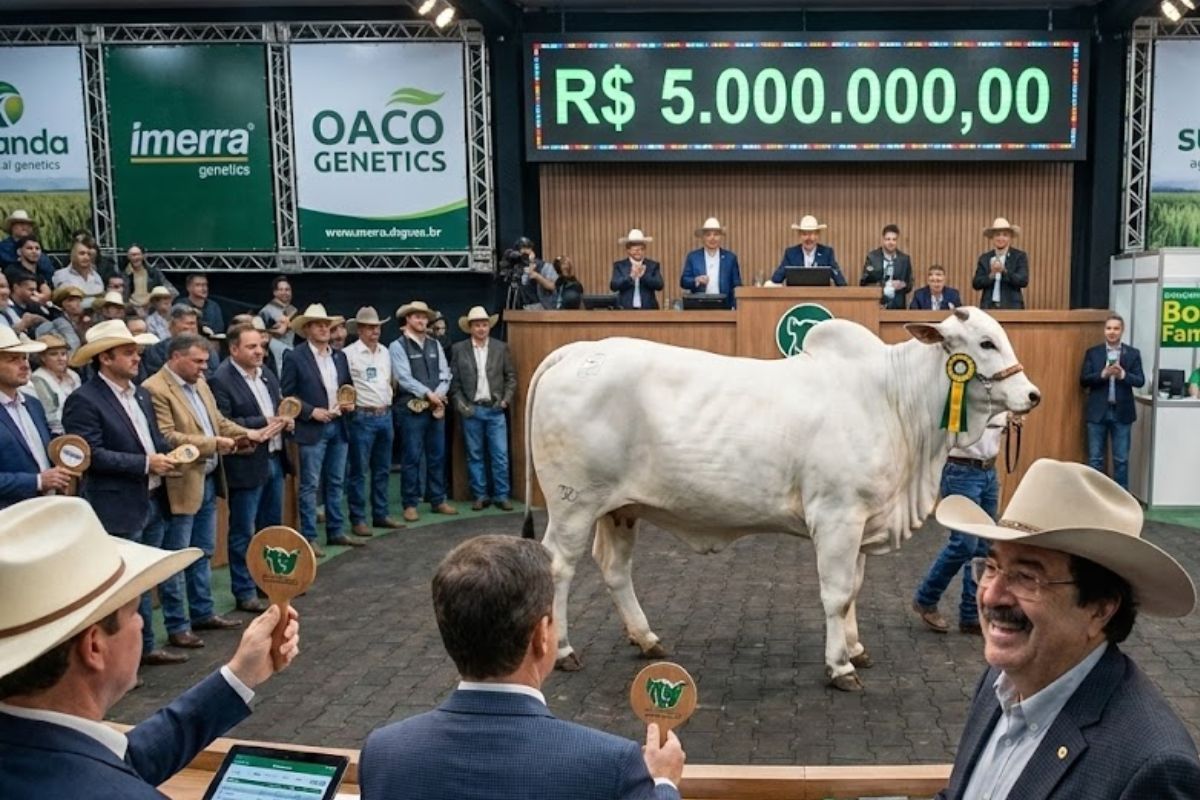
Cattle Auctions Became Showcases for Genetics and Business in Brazilian Livestock. Paulo Marques, Partner at Biolab and Owner of Casa Branca Agropastoril, Brought R&D Management to the Field, Driving Records Like Viatina-19, Valued at R$ 21 Million, and Dividing the Sector with His Innovation and Early Maturity Strategy.
On May 3, 2022, the announcement of Viatina-19 FIV Mara Móveis, valued at R$ 21 million and registered in the Guinness World Records, Became a Symbol of What Cattle Auctions Have Come to Produce: Million-Dollar Cows and a New Race for High-Value Genetics in Brazil.
Behind this turnaround is Paulo Marques, partner at the pharmaceutical company Biolab and owner of Casa Branca Agropastoril, who claims to have transferred a typical industry mindset, focused on research, to within the gate, with goals, metrics, and constant innovation, a strategy that impresses, provokes criticism, and stirs the entire premium livestock sector.
Who is Paulo Marques and Why He Became a Reference for the Most Valuable Cows

The trajectory presented by Marques defies the stereotype of the “agricultural heir.” He recounts humble beginnings, noting that his father worked as a traveling salesman throughout the interior of Minas Gerais, selling medications in a time of limited logistical infrastructure, even using donkeys.
-
The eggshell that almost everyone throws away is made up of about 95% calcium carbonate and can help enrich the soil when crushed, slowly releasing nutrients and being reused in home gardens and vegetable patches.

-
This farm in the United States does not use sunlight, does not use soil, and produces 500 times more food per square meter than traditional agriculture: the secret lies in 42,000 LEDs, hydroponics, and a system that recycles even the heat from the lamps.

-
The water that almost everyone throws away after cooking potatoes carries nutrients released during the preparation and can be reused to help in the development of plants when used correctly at the base of gardens and pots, at no additional cost and without changing the routine.

-
The sea water temperature rose from 28 to 34 degrees in Santa Catarina and killed up to 90% of the oysters: producers who planted over 1 million seeds lost practically everything and say that if it happens again, production is doomed to end.


The family work ethic, according to him, started early: in childhood, the children participated in the routine of the pharmaceutical company, folding leaflets, averaging a thousand leaflets per night, and he recalls entering herb maceration tanks at the age of 11.
This environment is described as the basis for his management profile, which would later be applied to Cattle Auctions and genetic improvement.
From Experience with Milk to Total Focus on Beef Cattle

Before establishing himself as a strong name in genetics, Marques recounts an early phase with dairy cattle in Pouso Alegre, Minas Gerais.
The turning point occurs when he decides to professionalize his operations and focus on beef cattle with a business logic, looking at productivity, time, and return.
At this point, he claims to have identified a critical bottleneck: while developed countries were slaughtering cattle at around 2 years old, the Brazilian average was 4 years, or 48 months.
For him, this affected cost, efficiency, and perceived value, helping to explain why Brazil sold beef for $2,000 a ton, while other markets sold for $6,000 or $7,000.
His conclusion was straightforward: without early maturity and quality, there is no consistent premium cattle industry, nor sustainable results in Cattle Auctions.
The “Mathematics of Quality” That Shortened the Cattle Cycle
Marques contrasts two models. In the “old model,” cattle took an average of 48 months to reach slaughter, increasing pasture maintenance costs and affecting quality characteristics.
In the “Casa Branca model,” the goal shifts to reduce the cycle to 20 to 24 months, focusing on tender meat, marbling, and greater added value.
To support this change, he reports that he sought top genetics from Canada, Texas, and South Africa, introducing breeds like Angus, South African Simmental, and Brahman for industrial crossings.
The promise is a more predictable and productive cattle industry, feeding the narrative and market appetite for Cattle Auctions with elite animals.
The “Pharmaceutical Method” Applied to Genetics, and What This Changes on the Farm
The difference he points out is not just buying good animals, but operating like a R&D company. Biolab, cited as a reference for research investment, has allegedly inspired the routine of tests and projects at Casa Branca Agropastoril, aiming to enhance genetic consistency.
Among the examples mentioned is a pioneering project: the first embryo splitting in Brazil, which is said to have produced identical twins with nearly 80% utilization.
This type of initiative, according to the narrative, helps explain how certain animals become phenomena in Cattle Auctions, because it’s not just “beauty,” it’s biological predictability and multiplication capacity.
Viatina-19, Records, and What Is Really Being Sold
The case that made headlines is Viatina-19 FIV Mara Móveis, valued at R$ 21 million and registered in the Guinness World Records. The central point in the explanation presented is that the value does not lie in the meat of the animal, but in its biological capacity.
The cow is treated as a “biofactory,” capable of producing consistent ova and transmitting desirable traits to many offspring, such as racial beauty, carcass, and precocity.
This logic transforms genetics into an asset and fuels the price escalation in Cattle Auctions, creating the so-called million-dollar cows.
Why the Strategy Divides Opinions Within the Sector
Marques’ approach is described as ambitious and, at the same time, controversial.
Supporters argue that it professionalizes premium agriculture, accelerates productivity gains, and creates a genetics ecosystem with an international standard. Critiques cite the risk of confusing display with results and making records the ultimate goal.
Marques himself issues a warning that is often repeated in discussions within the field: a trophy doesn’t pay for feed. In his view, the show ring is a showcase, but the real focus is genetics to produce more, in less time and less space.
This statement summarizes the tension between spectacle and efficiency, especially when Cattle Auctions gain the character of a national event.
Angus, Certification, and the Attempt to “Popularize” Premium Meat
Another point mentioned is Marques’ role in expanding Angus beef in Brazil, leading rigorous certification projects.
The consequence would be the opening of partnerships with large companies, such as McDonald’s, and the attempt to broaden access to premium meats through standardization and scale.
In practice, what he advocates is that genetics and management need to communicate with the market.
It’s not enough to sell an expensive animal in Cattle Auctions if the production system doesn’t deliver consistent quality at the consumption end.
Succession, Governance, and What Remains as Legacy
The foundation also describes a family succession process and corporate governance. Marques claims to have already passed the operational baton to the new generation while maintaining strategic influence and the legacy of innovation, including support from consultancies and research centers abroad, such as a Biolab unit in Canada.
The final message he leaves to agriculture is one of resilience: not being afraid to make mistakes.
Do you think these million-dollar cows in Cattle Auctions strengthen premium livestock or create a showcase bubble that could burst?








-

-

-

-

-

-

9 pessoas reagiram a isso.