





 Portuguese
  English
  Spanish
  3 min of reading
  0 comments


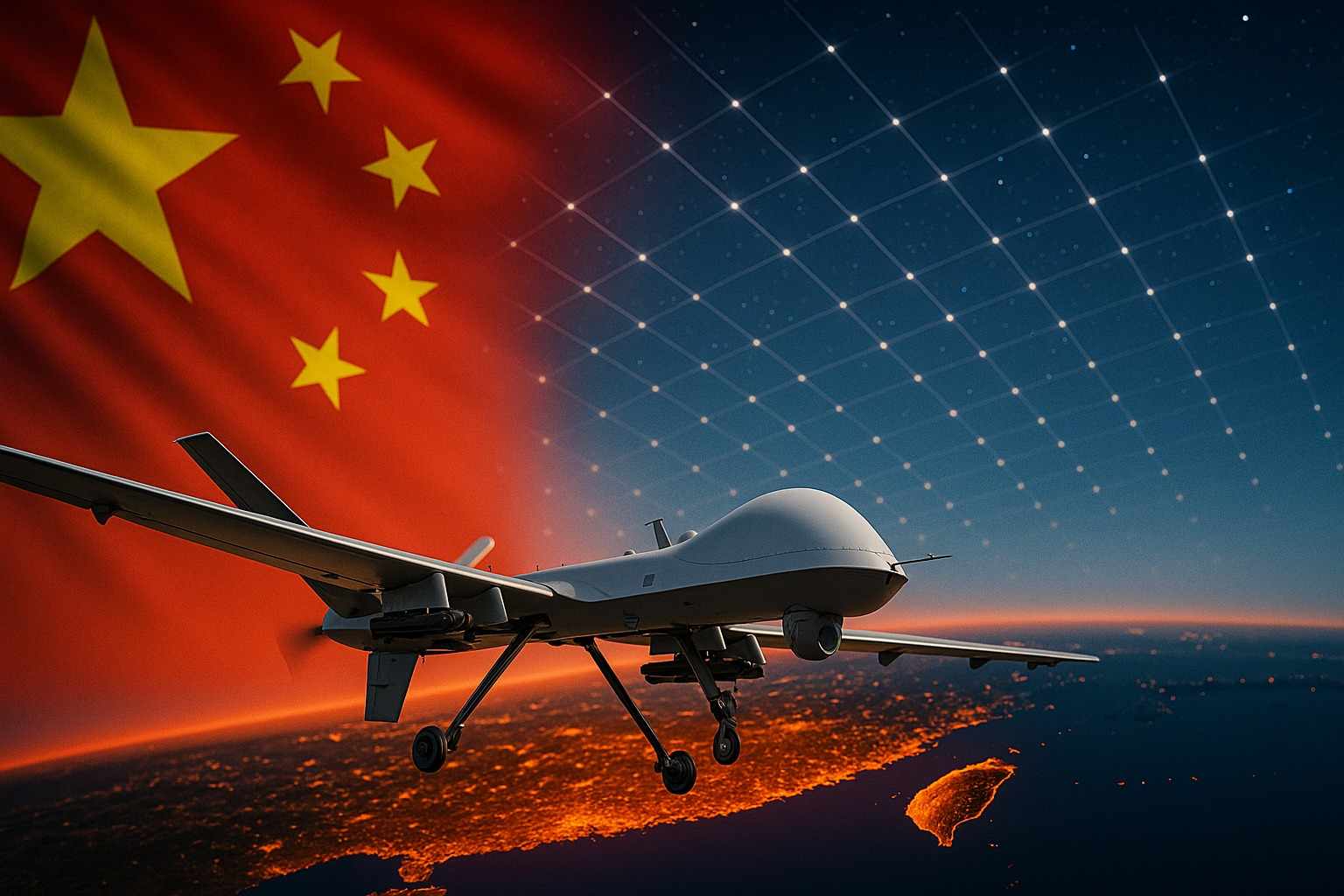
Unprecedented Military Simulation Describes The Size Of The Apparatus Needed To Face A Network Of Over 10,000 Satellites That Alternate Route, Frequency, And Connection In Seconds
Instead of focusing solely on the theoretical possibility of blocking Starlink, Chinese military strategists demonstrate increasing concern about the hypothesis that such a measure may be attempted in a real scenario involving Taiwan.
The complexity is high, because Taiwan and its allies could depend on a constellation of over 10,000 satellites capable of alternating frequencies, redirecting traffic, and resisting interference in real time.
Chinese researchers presented, in a recent simulation study, the most detailed public attempt so far to model a possible countermeasure.
-
No one expected this under a common street: archaeologists find 3 intact oak barrels, buried about 400 years ago, with traces of lime and pieces related to 17th-century construction.

-
After decades of failed attempts, Brazil is once again looking to space with an orbital rocket measuring 12 meters, weighing 12 tons, costing R$ 189 million, and scheduled for launch in 2026, in a new race to finally achieve autonomous access to orbit.

-
The Earth will plunge into a few minutes of darkness in broad daylight in August 2026, when a total solar eclipse transforms the sky into one of the most impressive astronomical phenomena in recent years.

-
How the terraforming of Mars can transform the planet: artificial aerosols can increase the temperature by up to 35°C in 15 years, creating conditions for liquid water.

Published on November 5 in the journal Systems Engineering and Electronics, the article concludes that interrupting Starlink service in an area comparable to that of Taiwan is technically feasible, but only through the use of a massive electronic warfare force. According to the study, the dynamic structure of the network represents the main challenge for any operation of this type.
Constant Movement And Orbital Change Create Uncertainties
Instead of treating Starlink as a static system, researchers highlight that its constantly changing geometry is the biggest obstacle.
The study, conducted by teams from Zhejiang University and the Beijing Institute of Technology, emphasizes that orbital plans vary continuously, causing satellites to enter and exit the field of view all the time.
This behavior generates extreme uncertainty for any military force seeking to monitor, track, or interfere with downlink signals.
Unlike older networks, based on a few fixed geostationary satellites, Starlink operates entirely differently.
Traditional systems can be blocked by overlaying the signal coming from the Earth, but the low-orbit constellation completely alters this scenario. Its satellites move quickly and are deployed by the thousands, and a user terminal does not remain connected to just one point. The exchange is constant, forming a constantly variable mesh in the sky.
According to the researchers, even if one link is interrupted, the terminal switches to another satellite in a matter of seconds, making sustained interference difficult over time.
Distributed Swarms Emerge As The Only Practical Alternative
The team led by Yang argues that the only realistic countermeasure would be a fully distributed jamming strategy. Instead of relying on a few powerful ground stations, an attacker would need hundreds or even thousands of synchronized small devices, deployed in the air via drones, balloons, or aircraft. Together, these platforms would form a wide electromagnetic barrier over the combat zone.
The simulation tested jamming conditions considered realistic, causing each airborne device to emit noise at different power levels.
The study compared wide-beam antennas, which cover larger areas with less energy, and narrow-beam antennas, which are more powerful but dependent on precise pointing. For each point on the ground, the model assessed whether a Starlink terminal would still be able to maintain a usable signal.
Estimates Point To The Need For Nearly A Thousand Aerial Units
The researchers calculated that completely suppressing the signal over an area equivalent to that of Taiwan, which is about 36,000 square kilometers, would require at least 935 synchronized jamming platforms, not considering backup units, terrain obstacles, or future system upgrades.
By using cheaper energy sources, at 23 dBW, with a spacing of approximately 5 kilometers, the need would rise to about 2,000 units.
The team emphasizes that the results remain preliminary, as important aspects of Starlink’s anti-jamming system remain classified.








Seja o primeiro a reagir!