





 Portuguese
  English
  Spanish
  3 min of reading
  0 comments


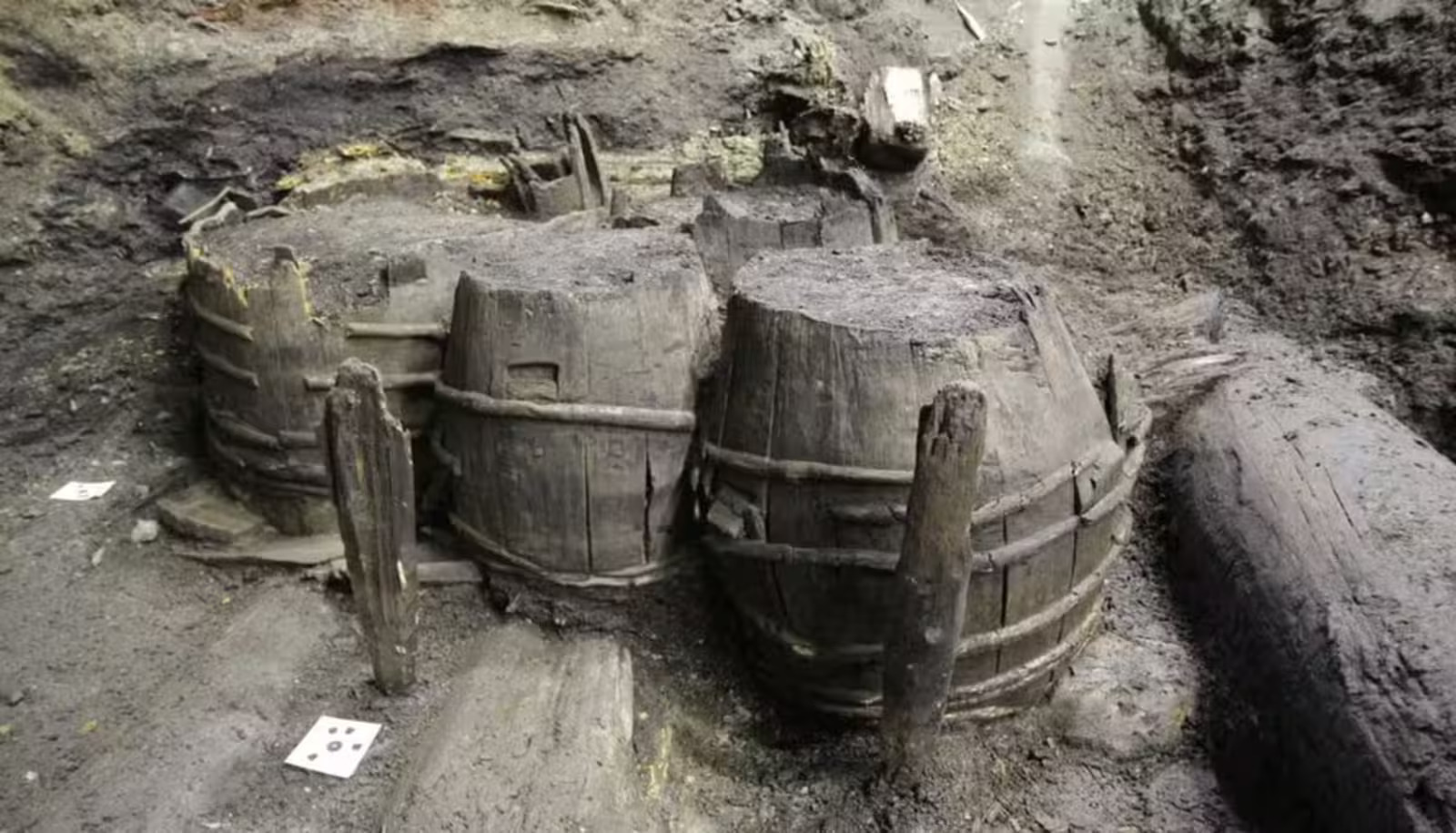
Archeologists found three intact barrels with lime beneath a street in Skien, Norway, revealing 17th-century construction and urban expansion practices
Under a street in the center of Skien, Norway, archeologists found three intact wooden barrels, buried about 400 years ago, with traces of lime inside. This archeological find helps explain construction, storage, and urban growth practices in the city during the 17th century.
Find of the barrels beneath the street
The discovery occurred beneath a common street in Skien, a city located at the end of the river network in the region.
Due to its strategic position, the municipality played a significant role in trade and maritime transport.
-
Human brains without bodies are kept “alive” in a laboratory in the USA to test drugs against Alzheimer’s and Parkinson’s while scientists face a debate about consciousness after death.

-
Tiny robots inspired by ants can build and demolish structures on their own in a Harvard experiment.
-
Mansion basement becomes archaeological site: engravings possibly made by enslaved people are found in a property over 260 years old in Ouro Preto

-
A 13-meter marine predator, larger than two articulated buses, spent decades in Texas museum collections right under the noses of paleontologists: now named Tylosaurus rex, it had serrated teeth capable of crushing skulls and dominated the oceans of North America 80 million years ago.


Skien received grains, sharpening stones, and timber from northern Telemark and exported these goods to England and northern Europe. This context helps situate the urban and economic importance of the city.
This trade flow reinforced the connection between supply, construction, and growth.
“We had never seen such a well-preserved collection of barrels and were very curious to know what they might have been used for,” said Kristine Ødeby Haugan from the Norwegian Institute for Cultural Heritage Research.
What was at the site
In addition to the oak barrels, found covered by damp soil and debris, researchers located a wooden tamper, an impact tool used to compact materials. Around it, there was a layer of lime.
Inside the barrels, blocks of lime and some demolition materials were found. The set drew attention for its state of preservation and the way it was preserved beneath the street.
Use of lime in construction
The archeologists believe that the buried barrels were used to store hydrated lime, ready for use and protected from the cold. Later, the material would be mixed with sand and water to produce mortar.
The barrels and the tamper likely formed part of a system for storing and preparing construction material for long periods.
The archeological find reveals how activities related to construction and craftsmanship operated.
At that time, lime mortar was essential for both masonry and finishing of buildings. It may have played an important role in the reconstruction of stone buildings in the center of Skien after a fire.
Preservation and public interest
To avoid damage during the works, the barrels and the tamper were disassembled and removed from the site. The expectation is that the pieces will be preserved, reassembled, and eventually displayed to the public.
The excavation also sparked great interest among the residents. As the work takes place inside a large tent, preventing direct access, the team began organizing guided tours to present the findings.
According to Haugan, the interest shows that history can go beyond museums. The excavation project, accompanied by local and international media, will have new phases in other areas of the city in the coming months.
With information from Revista Galileu.


-

1 person reacted to this.