





 Portuguese
  English
  Spanish
  3 min of reading
  0 comments


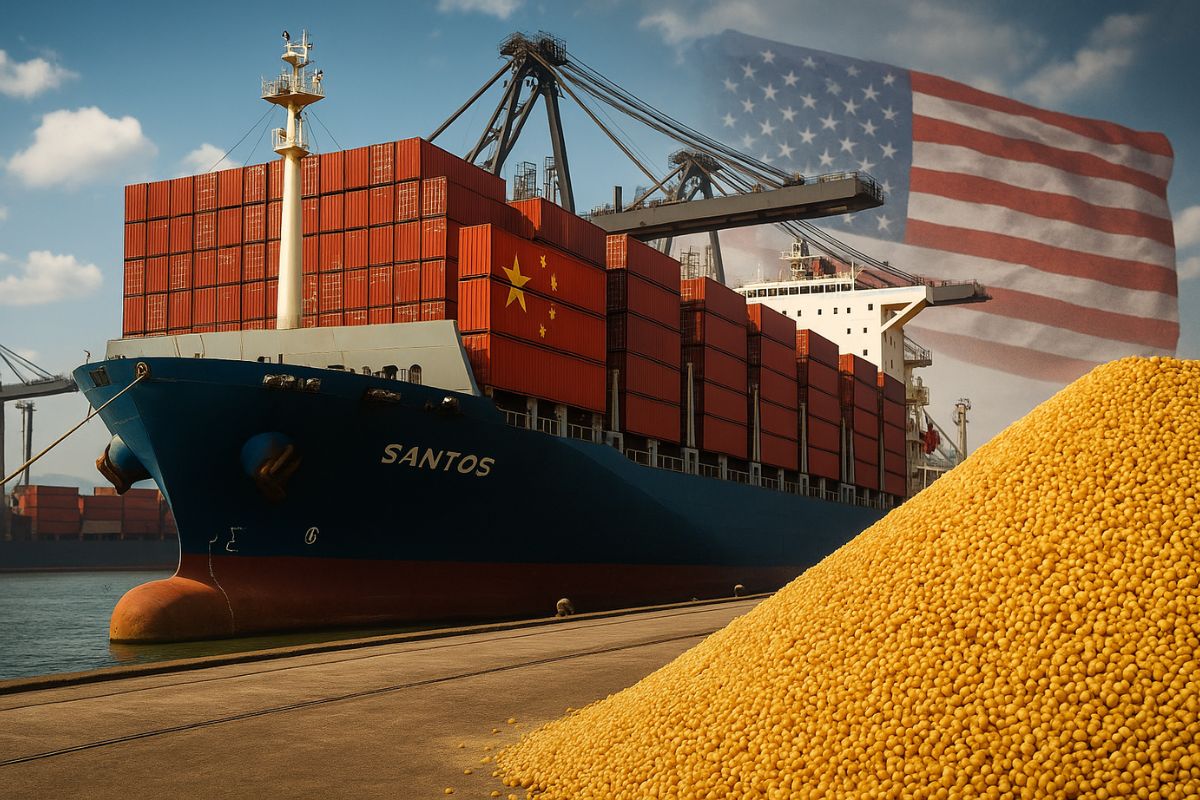
China Has Decided to Heavily Invest in the Port of Santos to Export Soybeans and Worries the U.S. With Tariffs Imposed by Washington, Beijing Bets on Brazilian Agribusiness and Transforms the Port of Santos into a Key Piece of Its Global Strategy.
In recent weeks, China has decided to heavily invest in the Port of Santos as a way to ensure the export of Brazilian soybeans and reduce its dependence on agricultural imports from the United States. The move coincides with the escalation of the tariff war between Beijing and Washington and is already causing concern in the American government and among farmers in the country.
The Port of Santos, responsible for almost 30% of Brazil’s trade balance, recorded its busiest month in history in July. Between vessels from the Chinese state-owned company Cosco and the advance of operations by COFCO, a giant in Chinese agribusiness, cargo movement skyrocketed. There were 900,000 tons of grains shipped and over 200,000 tons in containers, consolidating the strategic importance of the São Paulo complex.
How Did China Decide to Heavily Invest in the Port of Santos?
The terminal under construction at the Port of Santos is operated by COFCO, a Chinese state-owned company specializing in agricultural commodities. The project is valued at US$ 285 million and aims to increase the export capacity from 4 million to 11 million tons annually of grains.
-
“No one will make us change the Pix,” says Lula after the US report.

-
Lula responds directly to Trump and says that Pix is from Brazil and will not change under pressure from anyone, after a report from the United States pointed out the Brazilian payment system as an American trade barrier.

-
Amazon has just announced a new fee on all deliveries, and your online purchases will become more expensive starting April 17, including for those buying from the United States here in Brazil.

-
He sold his share for R$ 4 thousand, saw the company become a giant worth R$ 19 trillion, and missed the opportunity of a lifetime.


The lease signed during the government of São Paulo guarantees the state-owned company the right to explore the space for 25 years, paying about R$ 100 million annually in revenues to the port authority. For China, the return is billion-dollar: just in 2023, the country imported US$ 60 billion in food from Brazil, of which soybeans accounted for the largest share.
Why Are the U.S. Worried?
The Wall Street Journal has already classified the new terminal as a project that could “cost billions to American farmers”. This is because the tariff war imposed by the Trump administration in 2018 left deep scars: the U.S. agricultural sector lost over US$ 27 billion in exports. Now, the expansion of Chinese infrastructure in Santos threatens to consolidate Brazil as the main supplier to Asia.
Additionally, China has decided to heavily invest in the Port of Santos at a time when 90% of the current capacity for grain exports is already in use. In other words, any increase in efficiency reinforces Brazil’s position against competitors.
What Does Brazil Gain from This Move?
For Brazilian agribusiness, the benefits are clear: more investment in infrastructure, greater export capacity, and guaranteed outflow of production. The terminal can reduce historical logistical bottlenecks, facilitating the export of soybeans, corn, and sugar to the international market.
However, experts warn of the risks of excessive dependence on China. With almost one-third of Brazilian soybeans passing through Santos, the presence of Chinese state-owned companies controlling the outflow could limit Brazil’s negotiating power in the future.
An Ongoing Geopolitical Game
The Port of Santos has become a piece on the chessboard of the dispute between China and the United States for control of the global grain trade. While Beijing invests in logistics and food security, Washington watches the loss of market share to its strategic rival.
Brazil, for its part, needs to balance immediate gains with the need to protect its long-term autonomy. As the Chinese experience has shown, strong state-owned companies and strategic planning are key elements to not losing ground in billion-dollar negotiations.
The fact that China has decided to heavily invest in the Port of Santos shows how the Asian country acts proactively to protect itself from trade crises. For Brazil, it may mean short-term gains, but also strategic challenges in the future.
And you, do you believe that Brazil gains more than it loses with the Chinese presence at the Port of Santos, or are we giving up sovereignty in exchange for immediate investments? Leave your opinion in the comments — we want to hear from those closely following the impact of this change.









Seja o primeiro a reagir!