





 Portuguese
  English
  Spanish
  4 min of reading
  0 comments


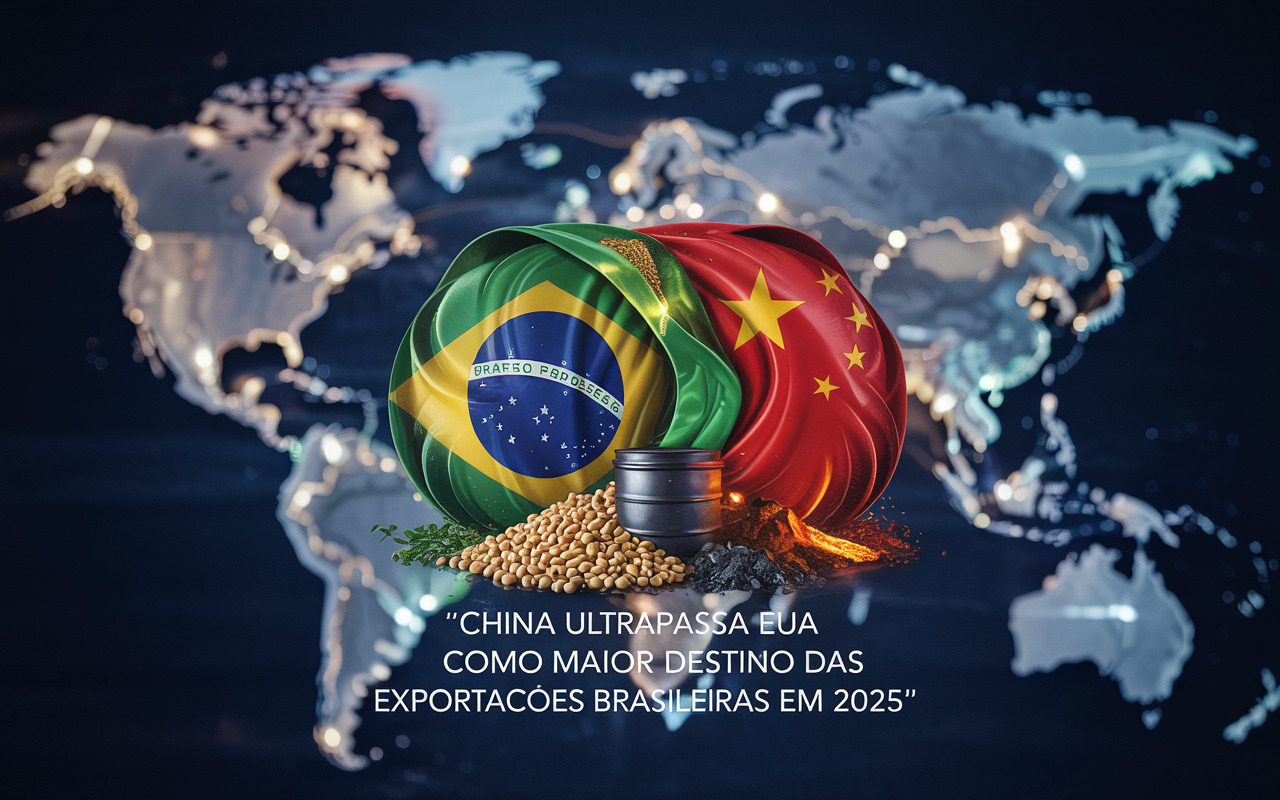
China Surpasses USA as Largest Destination for Brazilian Exports in 2025, with Soy, Oil, and Ore Above US$ 90 Billion and Global Impact.
In 2025, Brazil’s foreign trade marks a milestone that redefines its role in the world: China has surpassed the United States as the largest destination for Brazilian exports, undeniably establishing itself as the country’s number one trading partner. The numbers are significant — while sales to the Chinese exceeded US$ 90 billion, exports to the USA were around US$ 40 billion.
This movement is not just statistical: it reconfigures the global trade map and shows how Brazil is becoming increasingly dependent on Chinese demand for strategic commodities like soy, oil, and iron ore.
The Importance of Soy, Ore, and Oil
The basis of this dependence is triple and unwavering:
-
The Ukraine war exposes the strength of the M113 armored vehicle amid modern warfare with military drones.

-
Maritime geopolitics: China and the USA compete for strategic ports in Peru.
-
Iran shoots down two US aircraft: F-15 fighter crashes in mountainous area, one crew member is rescued and another is still missing; second crash in the Persian Gulf exposes still active air defense, says US intelligence.

-
USA and China compete for Brazil over resources that could be worth trillions — rare earths put the country at the center of a global dispute


- Soy: the most exported product by Brazil, with China accounting for over 70% of purchases. In 2025, the export value already exceeds US$ 35 billion, driven by Chinese demand for animal feed and vegetable oil.
- Iron Ore: another pillar of the trade balance, with exports above US$ 23 billion to the Chinese, who remain the largest global consumers of steel.
- Crude Oil: has become the second largest commodity exported by Brazil, with sales to China already exceeding US$ 25 billion in 2025, driven by pre-salt.
Combined, these three products alone already represent over US$ 90 billion in exports to Beijing, clearly highlighting the concentration of Brazil’s export agenda.
The Contrast with the United States
While China is skyrocketing as the destination for Brazilian exports, the USA is losing relative space. Even with a historical record in 2024, when Brazilian exports to the American market surpassed US$ 40 billion, the gap with the Chinese more than doubled.
In the USA, Brazil mainly exports sugar, semi-finished iron, steel, ethanol, and industrialized products. These are higher value-added products that diversify the agenda, but the scale does not compare to China’s appetite for commodities in massive volume.
This contrast reveals Brazil’s dilemma: between the quantity guaranteed by the Chinese market and the quality of the American agenda, which allows for more value addition but on a smaller scale.
The Geopolitics of Trade
The shift in the export map is not merely economic: it is geopolitical.
- For China, consolidating Brazil as a strategic supplier of grains, energy, and ore is part of its long-term food and energy security strategy.
- For the USA, the loss of ground reinforces concerns about Chinese influence in Latin America, historically regarded as its sphere of influence.
- For Brazil, excessive dependence on a single buyer creates vulnerabilities: any fluctuation in Chinese demand or trade barriers can strongly affect the trade balance.
This new reality pressures Brasília to diversify partners, but so far, the strength of the Chinese market has prevailed.
The Effect on Brazil’s Trade Balance
Thanks to performance with China, Brazil recorded yet another historic surplus in its trade balance in 2025. Only exports to the Asian giant accounted for nearly 35% of the total exported by the country.
This weight reinforces the importance of the bilateral relationship but also exposes the risk of concentration. Economists warn: Brazil cannot rely so heavily on just three commodities and a single buyer. A slowdown in the Chinese economy would have a direct and immediate impact on Brazil’s external accounts.
Over US$ 90 Billion in Exports to China
The achievement of over US$ 90 billion in exports to China in 2025 can be seen as a victory for agribusiness, mining, and the oil sector. However, it also raises an uncomfortable question: is Brazil consolidating itself as a supplier of raw materials without advancing in higher value-added products?
While China expands its high-tech industry and seeks global leadership in areas like semiconductors, clean energy, and artificial intelligence, Brazil remains trapped in the position of commodity exporter.
The trap is clear: in the event of a decline in international prices or diplomatic tensions, the country would be vulnerable to an immediate currency crisis.
The Future of Trade Relations
In 2025, Brazil faces a strategic choice.
- Bet even more on China, accepting dependence in exchange for stability in exports.
- Diversify trade partnerships, expanding agreements with the European Union, Middle Eastern countries, Africa, and Mercosur neighbors.
- Invest in industrialization and innovation, so that its export agenda goes beyond soy, ore, and oil.
Whichever path is chosen, the fact is undeniable: China has already reconfigured Brazilian foreign trade, becoming not only the largest partner but a determinant actor for the future of the national economy.








-

Uma pessoa reagiu a isso.