





 Portuguese
  English
  Spanish
  6 min of reading
  1 comment


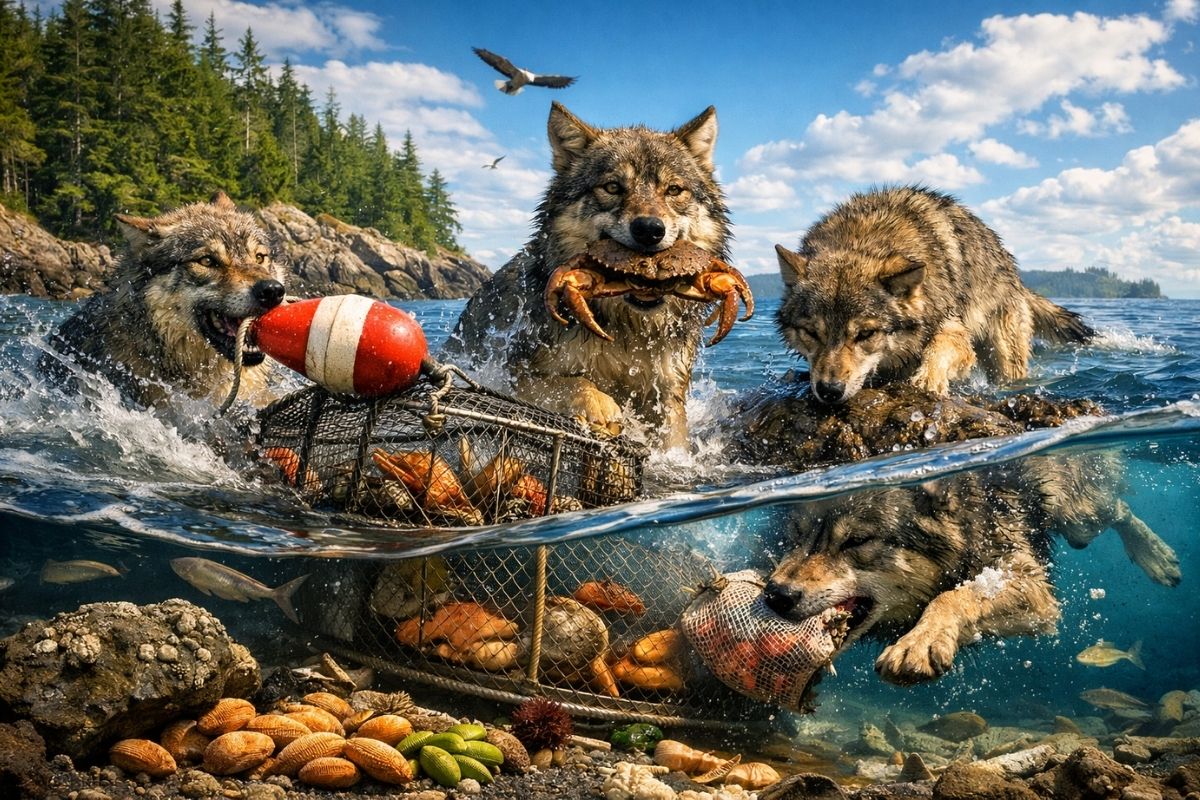


Researchers In British Columbia Sighted Coastal Wolves That Learned To Swim To Crab Trap Buoys And Expose A Rare Adaptive Intelligence In Wildlife.
For a long time, Heiltsuk community guardians and researchers from British Columbia wondered who was damaging crab traps left in shallow and deep areas of the coast, always with teeth marks and missing bait. The traps were found on the shore with deformed structure, displaced buoys, and no clear sign of the responsible party. It was only when remote cameras were installed near the equipment that the unexpected answer emerged: coastal wolves that learned to swim to the buoys, pull the line with focus, and drag the traps out of the water in search of easy food.
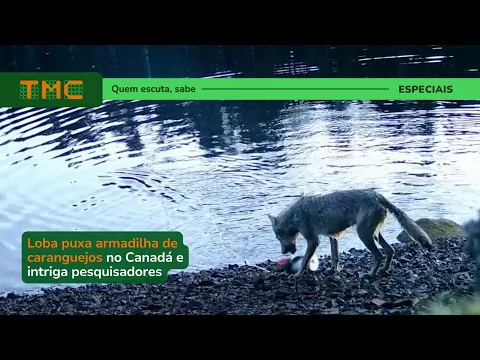
The images showed a she-wolf swimming to the shore with a buoy between her teeth, repositioning her body for a better angle and repeatedly pulling the rope to make the trap emerge from the depths. Then she opens the bait compartment, grabs the treat, and leaves. For ecologist Kyle Artelle, who leads the study published in the journal Ecology and Evolution, this is a highly efficient, focused, and, above all, learned behavior, which expands the understanding of the adaptive intelligence of these animals.
From The Mystery Of The Damaged Traps To The Unexpected Discovery

The case began as a field puzzle. In a monitoring program for the European green crab, an invasive crustacean threatening clam beds and seagrass ecosystems, the Heiltsuk First Nation, through the Haíɫzaqv Guardians, had been spreading specially designed traps in shallow intertidal zones and deeper waters, marked by colorful buoys.
-
With a cost per shot close to zero, the DragonFire laser could change naval warfare in 2027 and provide British ships with nearly unlimited defense against drones.

-
A British startup creates tires that generate electricity in electric vehicles when passing over potholes, speed bumps, and cracks.

-
Scientists have created robots made with living cells that have their own nervous system, swim on their own, explore the environment, and self-organize without any genetic engineering, and now they want to do the same with human cells.

-
Students create a solar-powered ambulance that operates without a plug, without fuel, and still keeps medical equipment running in remote areas.


Starting in 2023, some of this equipment began to be found damaged, with teeth marks and no bait.
In the shallow traps, accessible at low tide, the team suspected wolves or bears. In the deeper traps, the initial hypothesis leaned towards otters or seals, as they are aquatic animals.
No one imagined that wolves had learned to swim to distant buoys, manipulate ropes, and explore human traps in deep water.
The doubt was only resolved when researchers installed remote cameras facing the buoy area.
It was then that they recorded, for the first time, the behavior of the she-wolf pulling the line with swift and decisive movements until making the trap appear on the surface.
The scene revealed not only the “culprit” but also a sophisticated form of interaction between a land predator and structures created by humans.
Wolves That Learned To Swim To The Buoys And Use Human Traps
The video captured by Artelle and his colleagues shows an impressive step-by-step. First, the she-wolf emerges from the water, swims towards the buoy and holds it firmly.
Next, back on the beach, she adjusts her body and head position for more leverage on the rope. Then, she executes a series of quick, precise, and rhythmic pulls, until the crab trap, still attached to the line, emerges from the bottom.
For the researchers, this is not a reflexive instinct or something purely genetic. It is a behavior that coastal wolves have clearly learned to swim, test, repeat, and refine over time, likely observing the impact of their movements on the buoys and the trap lines.
According to Artelle, you can see the efficiency with which the she-wolf moves, indicating that this pattern has been practiced and perfected, and likely shared among pack members.
This sequence also raises the discussion about tool use. By systematically pulling a buoy attached to a rope to obtain food that is inside an artificial structure on the ocean floor, coastal wolves demonstrate a type of interaction with objects created by humans that approaches the idea of functional tool use, where the animal manipulates elements of the environment to achieve a specific goal. Even though the exact label still depends on scientific debate, the complexity of the action is undeniable.
A Partnership Between Science, Territory, And The Heiltsuk People

The discoveries did not arise in isolation in a laboratory, but from a long-standing collaboration with the Heiltsuk First Nation in Bella Bella, British Columbia.
For over a decade, the community has been facing the advance of the European green crab, originally introduced in California and now expanding northward, where it directly affects clam beds and seagrass areas that serve as shelter for young fish.
In this context, the monitoring program, with traps in shallow and deep zones, became essential to trying to contain the crustacean’s expansion.
It was exactly this constant effort to monitor and protect the ecosystem that opened the opportunity to catch wolves that learned to swim and boldly and precisely explore these traps.
The presence of the cameras, initially designed to monitor the structures and understand the impact of the green crab, ended up revealing completely new behavior in coastal wolves.
Co-author Paul Paquet and Artelle emphasize that this type of research, built in partnership with communities living in the territory for generations, allows for the perception of behavioral nuances that could go unnoticed in studies further removed from local reality.
Continuous coexistence with the environment and the accumulated knowledge of the Heiltsuk were essential to interpret what the images showed.
Coastal Wolves, Shellfish, And Close Coexistence With Humans
The “thief” of the traps is identified as a rare species of canid known as the coastal wolf or sea wolf, a top predator that thrives in marine environments.
Unlike populations of wolves that primarily rely on terrestrial prey, these coastal wolves have adapted to live on a diet that includes salmon, shellfish, and even seals, intensely exploring the interface between forest, rocky coast, and open sea.
In much of the province, wolves are seen as bothersome predators and are often hunted. In Bella Bella, however, the relationship is different.
The Heiltsuk community, through the Wolf and Haíɫzaqv Biodiversity Project, does not hunt these animals, allowing a pack to live around the town and coexist with humans for millennia, in a dynamic of mutual respect and observation.
Artelle points out that the rugged and densely forested landscape, both on land and at sea, makes that region one of the few places in the world where wolves can be “real wolves,” maintaining complex natural behaviors, such as fishing, exploring low tides, and now interacting with crab traps set by humans.
In this unique coexistence, coastal wolves have learned to swim confidently among buoys and boats, integrating the human environment into their routine of searching for food.
An Unprecedented Adaptive Intelligence In Wildlife
For the scientists involved, the implications of the video go far beyond solving the mystery of the damaged traps.
The record reveals a completely new dimension of coastal wolf behavior, showing that they can quickly learn sophisticated strategies to access resources, passing on this knowledge within the group.
Artelle describes the behavior as inspiring. By seeing wolves that learned to swim to distant buoys, pull ropes precisely, and manipulate human traps, we gain a new perspective on what it means to be a wolf, with learning, experimentation, and adaptation capabilities that rival what we often associate only with our own species.
This discovery also reinforces a broader idea: when top predators coexist with humans and their structures, complex interactions arise that do not fit into simple categories of “conflict” or “harmony.”
Many of these encounters reveal a potential for behavioral innovation in wildlife that is still far from being fully understood.
If a she-wolf can learn to swim, pull a buoy, and dislodge a trap from the ocean floor, what more can these coastal wolves learn to do in the future?
After learning the story of the coastal wolves that learned to swim to crab traps and steal bait from the ocean floor, do you think this type of adaptive intelligence should be viewed more as a problem for fishing or as a fascinating proof of the learning capacity of wildlife?






Chama-se a esse processo de evolução ****.