





 Portuguese
  English
  Spanish
  3 min of reading
  0 comments


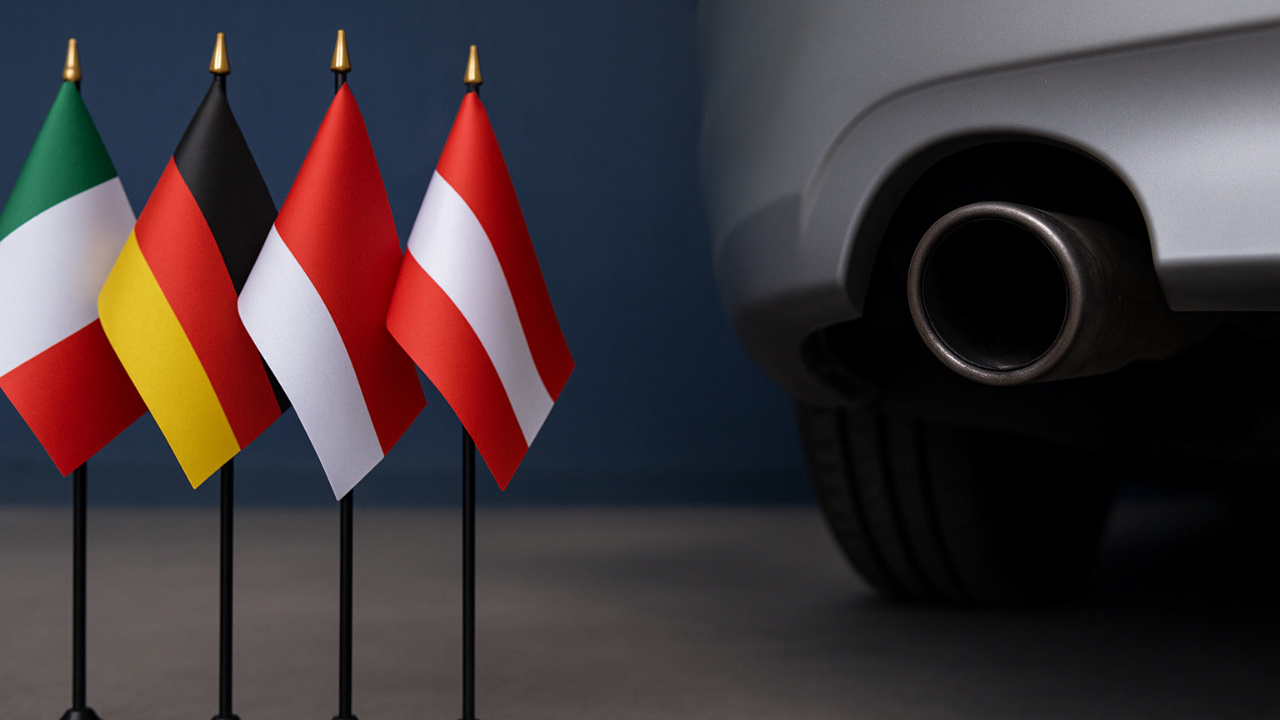
Countries Pressure The European Union To Review The 2035 Ban And Advocate For Technology Neutrality To Preserve The Automotive Industry.
The European Union has returned to the center of the climate debate after receiving, this week, a formal request from several countries to review the ban on combustion cars starting in 2035.
The movement, led by Germany, Italy, Poland, and Hungary, took place in Brussels, where the governments sent letters to the European Commission demanding flexibilizations.
They claim that the rule, as defined, directly threatens the European automotive industry, which is already facing high costs, a lack of components, and low demand for fully electric models.
-
Spain challenges the USA and closes its airspace for operations against Iran, raising global tension and provoking the threat of a trade rupture.

-
While no other country manufactures tanks in Latin America, Argentina activates the TAM 2C-A2 and raises a curiosity about the technological lag in the region.

-
A Russian ship with 730,000 barrels of oil has just arrived in Cuba while Mexico negotiates fuel sales through private companies: the communist island is desperately seeking alternatives after losing its supply from Venezuela due to American military action.

-
Iranian drones and missiles destroyed a 270 million dollar American spy plane in Saudi Arabia, splitting the E-3 Sentry aircraft in half and injuring 12 military personnel in an attack that exposes the vulnerability of U.S. bases in the Persian Gulf.


The appeal gained momentum because, according to the countries, the revision is necessary not only to protect jobs but also to ensure global competitiveness.
Seven Countries Advocate For Technology Neutrality As The Foundation Of European Policy
According to Euronews, seven nations—Bulgaria, the Czech Republic, Germany, Hungary, Italy, Poland, and Slovakia—declared it “imperative” to allow hybrids to continue being sold after 2035.
The letters sent to the bloc reinforce that the energy transition must respect the principle of technology neutrality, a concept that advocates for each government’s freedom to choose its own solutions to reduce emissions without compromising the pace of innovation.
Thus, they argue that the European Union cannot impose a single technological path, especially in such a heterogeneous market as automotive.
Automotive Industry Criticizes Insufficient Infrastructure
In addition to regulatory concerns, the countries highlighted that the continent still lacks adequate infrastructure to support the total fleet replacement with electric vehicles.
There are not enough uniformly distributed charging points, especially outside major urban centers.
Similarly, hydrogen refueling routes are still in their infancy. Therefore, the governments called on the Commission to “improve the availability” of these services before maintaining the 2035 ban without adjustments.
Combustion Cars Remain Strategic For Half The EU Population
The countries opposed to the ban on traditional engines represent about half of the European Union, which highlights the political impact of the discussion.
They warn that their manufacturers are going through a critical period.
In addition to high energy prices, businesses face battery shortages—an essential component for electric vehicles—and low public acceptance of fully electric models, which still suffer from high costs and limited range.
Alternatives Gain Strength As An Intermediate Solution
Among the proposals presented to the European bloc are the continuation of hybrid vehicle production, the expansion of hydrogen-powered cars, and the encouragement of biofuel use.
For the signing countries, these options increase competitiveness, reduce emissions, and alleviate pressure on the charging infrastructure.
Thus, the defense of these paths reinforces the importance of technology neutrality to balance environmental goals and industrial viability.
Debate On The 2035 Ban Should Intensify
With growing pressure, the European Commission will have to assess whether to maintain the current rule or incorporate flexibilizations.
The decision will directly impact the future of combustion cars and the direction of the automotive industry on the continent.
Meanwhile, governments and manufacturers await definitions that can ensure predictability for the sector, which is experiencing the biggest transformation since the advent of the combustion engine.










Seja o primeiro a reagir!