





 Portuguese
  English
  Spanish
  6 min of reading
  7 comments


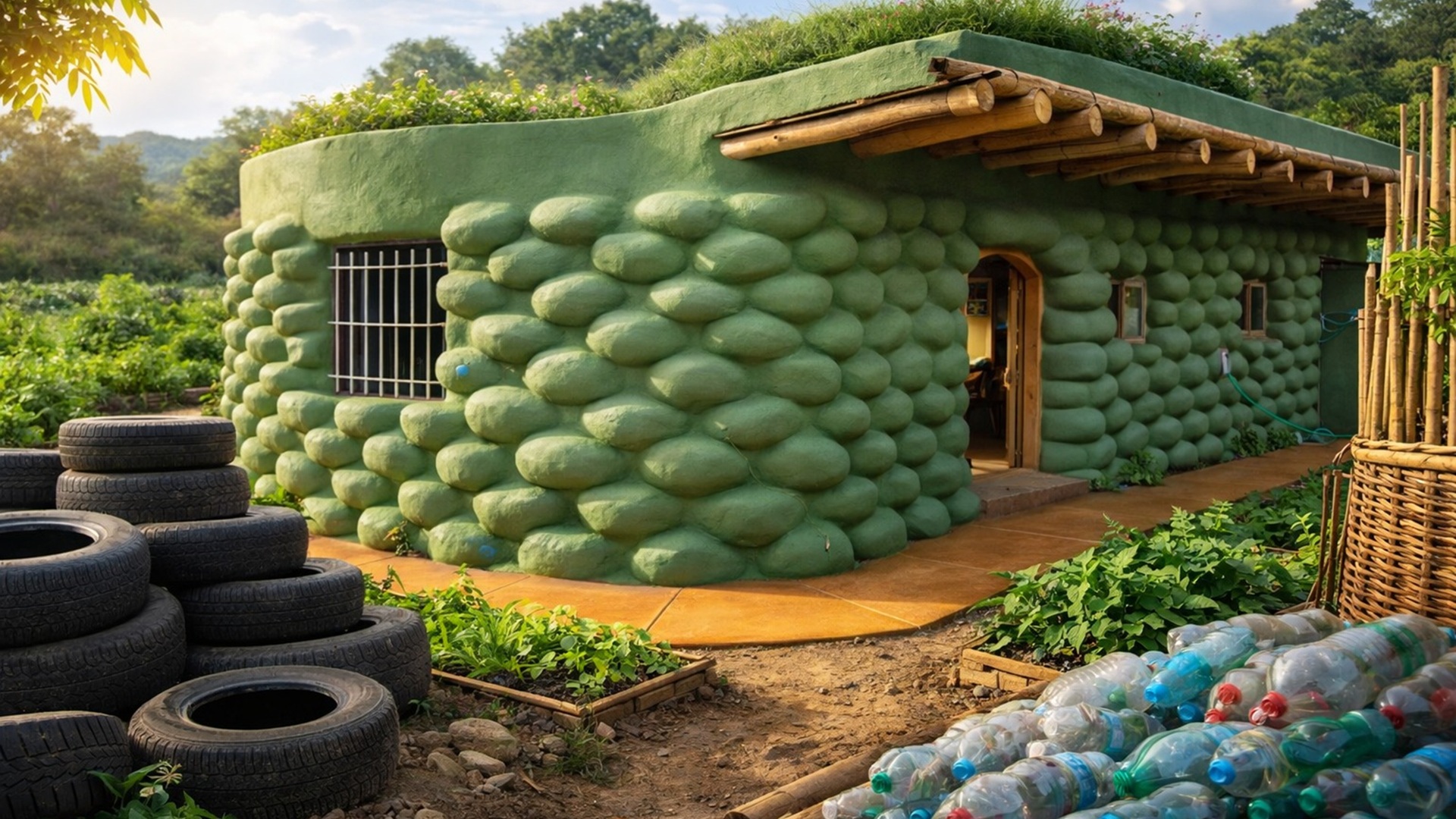


The Reuse of Tyres, Plastic Bottles, Maritime Containers, Wood, Bamboo, Clay and Earth Bags Has Been Applied in Different Countries as a Low-Cost Solution to Reduce Waste, Reuse Discarded Materials and Enable Functional Constructions, from Houses to Pools and Community Buildings
The reuse of discarded and natural materials in construction methods has been applied in different regions of the world as a way to reduce costs, avoid waste and enable functional houses, using tyres, wood, containers, clay, plastic, bamboo, and compacted earth in residential and community projects.
Used Tyres Gain Structural Function in Walls and Foundations

Car tyres take between 120 and 140 years to decompose, making them a long-term environmental problem.
Since they do not biologically degrade, they accumulate in landfills and pose a high fire risk, releasing toxic byproducts during combustion.
-
How an innovative city combines high technology, well-being, and sustainability to become the largest reference in clean energy on the planet.
-
Couple buys 1846 church in ruins for R$ 660,000, invests R$ 3.2 million in renovations, transforms it into a millionaire mansion, and even preserved a historic cemetery with over 300 graves.

-
He started running at 66 years old, broke records at 82, and is now a subject of study for having a metabolic age comparable to that of a 20-year-old, in a case that is intriguing scientists and inspiring the world.

-
Oldest tree on the planet reappears after 130 years of searches: Wattieza, 385 million years old, was 10 meters tall and had no leaves or seeds; Gilboa fossils in New York solved the mystery in 2007.


In some projects, these tyres have been repurposed as construction material. One example presented is the children’s development center in Cape Town, South Africa, where tyres replaced bricks and concrete blocks in the walls.
The method consists of filling the tyres with earth to increase weight and stiffness. They are then stacked similarly to conventional masonry. The walls are finished with a mixture of clay and straw, a traditional technique that has been used for centuries.
In addition to institutional use, there are records of private residential constructions made with tyres. In these cases, the technique follows principles similar to masonry, with the selection of uniformly sized tyres and controlled stacking on foundations made from the same material.
After excavating the land and marking the perimeter, the tyres are positioned and filled with sand. Since the shape is circular, many of these houses do not have straight corners, resulting in curved structures.
To ensure stability, builders follow basic standards, including internal reinforcements in the walls. Areas for doors and windows receive special attention, with the application of cementitious mixtures to support concentrated loads.
Some constructions include round windows, whose frames are also made with tyres positioned vertically and secured carefully. The remaining voids are filled with mixtures of clay, sawdust, stones, and brick fragments.
After reaching the desired height, the walls receive internal and external plaster. The external finish is finer, while the internal aims for uniformity. The roof, in one of the examples, was made with boards and asbestos cement sheets.
In the end, more than a thousand tyres were diverted from landfills, being incorporated into the house structure. The result is a functional building constructed with abandoned materials, following basic technical criteria.
Wood and Cement Form Massive Walls With Ancestral Technique

Another technique presented uses firewood or logs, a practice known since the 10th century B.C. Despite its antiquity, the method continues to be employed in current constructions, especially in saunas and small buildings.
In this system, dry, barkless logs are placed side by side, forming layers similar to bricks. The space between them is filled with a mixture of cement, which acts as a structural binder.
Wood makes up between 40% and 60% of the wall volume. The ends of the logs extend a few centimeters outward, giving a characteristic appearance to the building.
According to the examples presented, this type of wall provides good thermal insulation, comparable to that of conventional walls, efficiently retaining heat.
Maritime Containers Are Transformed Into Pools and Residences

The use of cargo containers as a base for residential constructions has become popular in various countries. A standard container is about 12 meters long and 2.4 meters wide, with part of the internal space occupied by thermal insulation.
This limitation leads residents to optimize every square meter, using multifunctional furniture. However, the standardized shape also opened the door to non-residential applications.
Canadian specialists have developed pools made from maritime containers. The main advantage is the reduced installation time, as the structure is prepared in the factory and delivered ready for use.
These pools do not require deep excavations or weeks of work in the backyard. It is enough to connect the necessary systems. Some versions include side windows, turning the nearly 2.5-meter deep tank into a decorative element.
For this type of use, it is recommended that the container be relatively new, avoiding contamination risks from previously transported residues.
Clay and Plant Fibers Replace Cement in Natural Walls

Before the widespread use of cement, civilizations combined clay with plant fibers to create resistant materials. This technique continues to be used in alternative constructions.
The mixture includes common clay, which can be extracted from the construction site, combined with fibers such as straw, barley, or palm leaves, depending on regional availability.
The material is carefully mixed and applied to bricks or placed in molds. After drying, it forms rigid and durable walls, comparable to those made with conventional cement.
This method reduces the use of industrialized materials and makes use of local resources, maintaining simple processes known for centuries.
Plastic Bottles Turn Into Blocks in Projects in Northern Europe

In Finland, concerns about plastic waste led to the development of constructions that use PET bottles as substitutes for bricks. They are used in barriers, balconies, and even in complete buildings.
The bottles are filled with lightweight plastics, such as packaging and films, to increase strength. They are then arranged in rows, with the space between them filled with cement.
The preparation of the bottles does not require special skills, which reduces costs and construction time. The process consumes little energy and allows for the reuse of large volumes of waste.
Bamboo and Straw Structure Houses Assembled Off-Site
Bamboo, a fast-growing plant, has been used as an alternative to traditional wood in various countries. In regions where it is abundant, it allows for significant reductions in construction costs.
One example is a greenhouse in Thailand built with bamboo for only 25 dollars. The material is mainly used as structural support and roofing framework.
In Hawaii, complete bamboo houses can be built in one to ten days. A company has developed an industrialized method to create walls, ceilings, and partitions in bamboo.
The process starts with the design defined with the client. Construction occurs in a workshop, regardless of the weather. Then, the house is disassembled, transported, and reassembled at the final site in just a few days.
In Slovakia, a similar technique uses panels made of thick straw bundles. The material undergoes treatment to ensure fire resistance and is inserted into wooden structures.
The compact surface protects against moisture and heat loss. Construction is carried out without the use of water and generates no waste. A floor can be erected by a small team in two to four days.
The heating costs of these houses are low, as heat loss from straw walls is minimal, making the system efficient in cold climates.
Reinforced Earth Bags Replace Conventional Blocks
Another method presented uses bags filled with earth as a structural base. Alone, these bags would be unstable, requiring additional reinforcements to ensure safety.
The walls receive internal and external coating with a mixture of clay and straw. Between some layers, barbed wire is placed, whose hooks prevent the bags from shifting.
After raising most of the structure, a metal frame is inserted for final reinforcement. Despite the high physical effort, the almost zero cost of the walls makes the technique attractive.
These solutions show that alternative construction depends on the choice of materials capable of replacing traditional bricks and blocks, maintaining stability and functionality, even with limited resources.






Ótima criatividade
Só penso que em um incêndio se torna extremamente difícil apagar, pois são materiais de fácil combustão.
Verdade esse é o perigo
São idéias, algumas antigas, que podem fazer uma melhor adaptação e uso de materiais descartáveis que levariam anos para se decompor.
Nestes exemplos não vi nenhuma ideia utilizando garrafas de vidro tipo longe neck.