





 Portuguese
  English
  Spanish
  6 min of reading
  0 comments


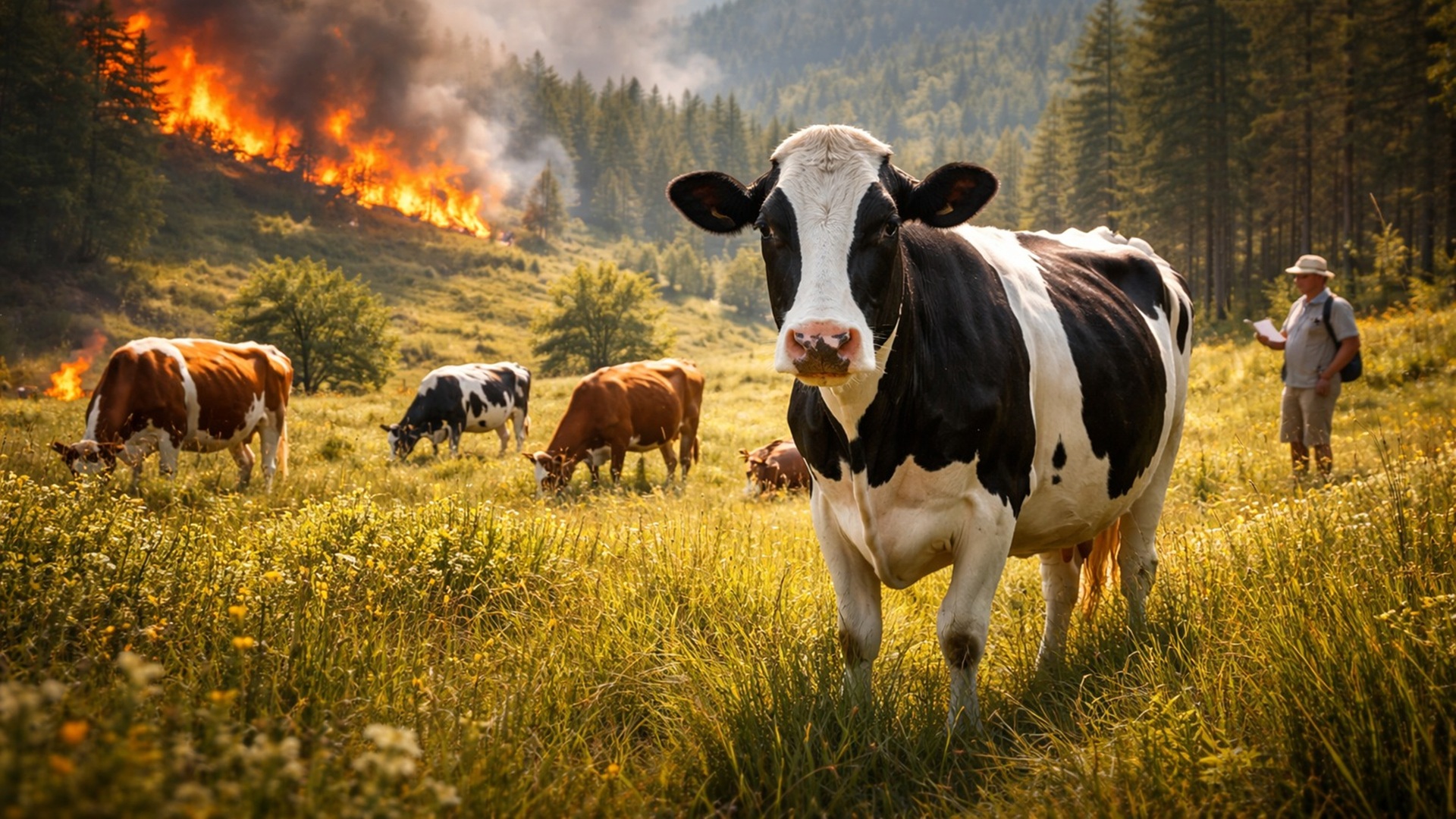
Research Indicates That Controlled Grazing Can Reduce Flammable Biomass, Favor Native Species, and Increase Carbon Storage in Soils
The debate about the role of livestock in climate change has gained new momentum in California, where recurring wildfires, methane emissions, pasture management, and public policies intersect in a sector that generated nearly US$ 13 billion in 2023.
Environmental Pressure and Direct Accusations Against Livestock
Last January, while wildfires were affecting large areas of the Los Angeles region, PETA sent a box of matches to Governor Gavin Newsom, accompanied by a letter signed by Tracy Reiman, the organization’s executive vice president.
In the text, Reiman stated that methane emitted by livestock would be accelerating global warming and creating conditions for increasingly extreme fires, advocating for the end of public subsidies for meat and dairy.
-
What if the Sun disappeared suddenly? Simulation shows Earth in darkness within minutes, extreme cold, and rapid collapse of life on the planet.

-
A 2,400-year-old iron foundry has been discovered in Senegal with 100 tons of slag, 35 furnace bases, and signs of nearly eight centuries of continuous metallurgical activity.
-
Four humans are flying towards the Moon inside the Orion capsule launched by the SLS rocket, and on April 6, Artemis II will disappear behind the far side of the Moon without communication with Earth for nearly an hour.
-
Worlds covered by water, atmospheres filled with hydrogen, and the possibility of life beyond Earth: ocean planets are rewriting the map of cosmic search and forcing scientists to rethink where to look.


The message closed with a direct provocation: “The choice is yours. Cow milk or California?”, a phrase that quickly circulated among environmentalists, rural producers, and state authorities.

The Economic Centrality of Livestock in the State
California has more dairy cows than Wisconsin and leads milk production in the United States, also holding a prominent position in national beef production.
Although recognized for its agricultural diversity, milk remains the state’s main product, with livestock occupying about one-third of California’s land, despite a decline in meat consumption since the 1970s.
In 2023, the dairy and beef sectors totaled nearly US$ 13 billion, a figure that surpassed Hollywood’s box office during the same period, reinforcing the economic weight of the segment.
Historical Criticisms and the Evolution of Environmental Discourse
Distrust of livestock predates the current climate debate and dates back to the 1970s, when organizations like the Sierra Club opposed grazing in protected areas of the Sierra Nevada.
During that period, criticisms focused on soil erosion, river pollution, and loss of native flora, issues that shaped conservation policies for decades.
As the climate agenda progressed, the focus shifted to greenhouse gas emissions, and the documentary Cowspiracy solidified the image of the cow as a symbol of climate change.
Methane: Potency, Duration, and Livestock Participation
Methane is an extremely potent greenhouse gas, capable of trapping about 80 times more heat than CO₂ over twenty years, even though it remains in the atmosphere for a shorter time.
According to agricultural economist Aaron Smith, approximately half of California’s methane emissions come from livestock, primarily from cows’ burps and manure decomposition.
However, pasture ecologist Lynn Huntsinger points out that when emissions are converted to CO₂ equivalents, the entire agriculture sector accounts for about 8% of the state’s emissions.
Pastures as Complex Ecological Systems
California’s pastures cover more than half of the state and have historically evolved alongside herbivores and periodic disturbances, forming distinct ecosystems from recently deforested regions.
In this perspective, livestock does not automatically act as a climate villain but as an agent within ecological systems that have been profoundly altered by decades of improper management or abandonment.
The central issue, according to researchers, is not just the number of cows, but the absence of well-managed grazing in the appropriate locations.
The Use of Grazing as an Environmental Tool
Huntsinger and other researchers use grazing to control invasive species, protect watersheds, and reduce the risk of wildfires in increasingly dry landscapes.
According to the ecologist, cows, sheep, and goats, although not native, can help make landscapes more similar to those with which the flora and fauna historically evolved.
When managed properly, these practices promote biodiversity and reduce the likelihood of fires starting and spreading, an argument that is gaining traction in public debate.
The Expansion of Invasive Species in Pastures
Over the past two centuries, invasive species such as wild oats, medusa-head, long-tail bromeliads, and goatgrass have spread across California fields, displacing native grasses.
These plants, native to Europe and the Mediterranean basin, grow faster, develop deep roots, and show greater resistance to drought, fire, and trampling.
As a result, temporary ponds have disappeared, habitats for birds such as the burrowing owl have shrunk, and flowers essential for pollinators have ceased to exist.
Livestock Feeding Preference and Ecological Effects
One little-known aspect is that livestock prefer to consume these invasive species, behavior linked to the domestication process that occurred about 10,000 years ago in the Fertile Crescent. Studies indicate that complete removal of grazing may lead to the decline of pollinated plants and the insects that depend on them, altering local ecological chains.
Additionally, moderate trampling by livestock disturbs the soil, a condition necessary for the germination of some native flowers, contributing to plant diversity.
Carbon in Soil and Reduction of Flammable Fuels
Well-managed grazing can stimulate the growth of plant roots, increasing the carbon stored in the soil and contributing to carbon sequestration. At the same time, reducing dry biomass decreases the available fuel load for fires, a critical factor in a state prone to prolonged droughts.
A 2022 study estimated that livestock removed approximately 5.4 billion pounds of flammable biomass from California’s pastures, reducing risks.
Livestock, Urbanization, and Territorial Fragmentation
Despite these potential benefits, extensive livestock farming faces droughts, rising costs, and pressure from urban development, leading producers to reduce herds or sell land.
In many cases, the result is the urbanization of open areas, increased territorial fragmentation, and a heightened risk of wildfires in peri-urban zones.
Organizations like the California Rangeland Trust offer conservation easements to protect land and maintain responsible management with livestock farming.
Wildfires and Associated Emissions
Reducing wildfires also means reducing greenhouse gas emissions, as, in 2020, these events were responsible for nearly a quarter of the state’s total emissions.
Huntsinger argues that grazing can complement controlled burns, which are difficult to authorize and execute, reducing fuel load by up to 50%.
Without these interventions, historically managed landscapes tend to transform into dense and highly flammable brush, exacerbating the climate problem.
Methane, Manure, and Official Reduction Targets
California is home to about 1.7 million dairy cows, producing approximately 113 million liters of manure per day, stored in tanks that concentrate emissions.
These reservoirs account for nearly a quarter of the state’s methane emissions, prompting the goal set in 2016 to reduce these emissions by 40% by 2030.
Instead of direct taxes, the state adopted incentives to convert methane into renewable fuel through anaerobic digesters.
Biogas, Incentives, and Controversies
The Low Carbon Fuel Standard offers incentives to capture methane and transform it into biogas used in transportation, reducing net emissions.
Critics fear that the policy may promote intensive farming models, while supporters point to real reductions in a context with few quick solutions available.
So far, studies have not shown a deliberate increase in production due to subsidies, although the debate remains open among experts.
Scientific Innovation and the Rumen Microbiome
Even more complex is the reduction of methane produced by cows’ burps, a focus of research on modifying the rumen microbiome.
Teams in California are investigating solutions inspired by red seaweeds and genetic editing techniques to reduce methane production over the animal’s productive life.
The studies are still in the experimental phase but indicate promising paths to tackle one of the livestock industry’s main climate challenges.
The environmental impact of livestock depends on how, where, and why the activity is carried out, with no universal or immediate solutions for all contexts.
Eliminating livestock abruptly may increase fires, reduce biodiversity, and accelerate rural depopulation, while maintaining intensive practices without changes also proves unsustainable.
Amid historical criticisms, scientific innovation, and ecological management, the debate remains open, with academic contributions associated with the Rausser College of Natural Resources.







-

2 pessoas reagiram a isso.