





 Portuguese
  English
  Spanish
  5 min of reading
  0 comments


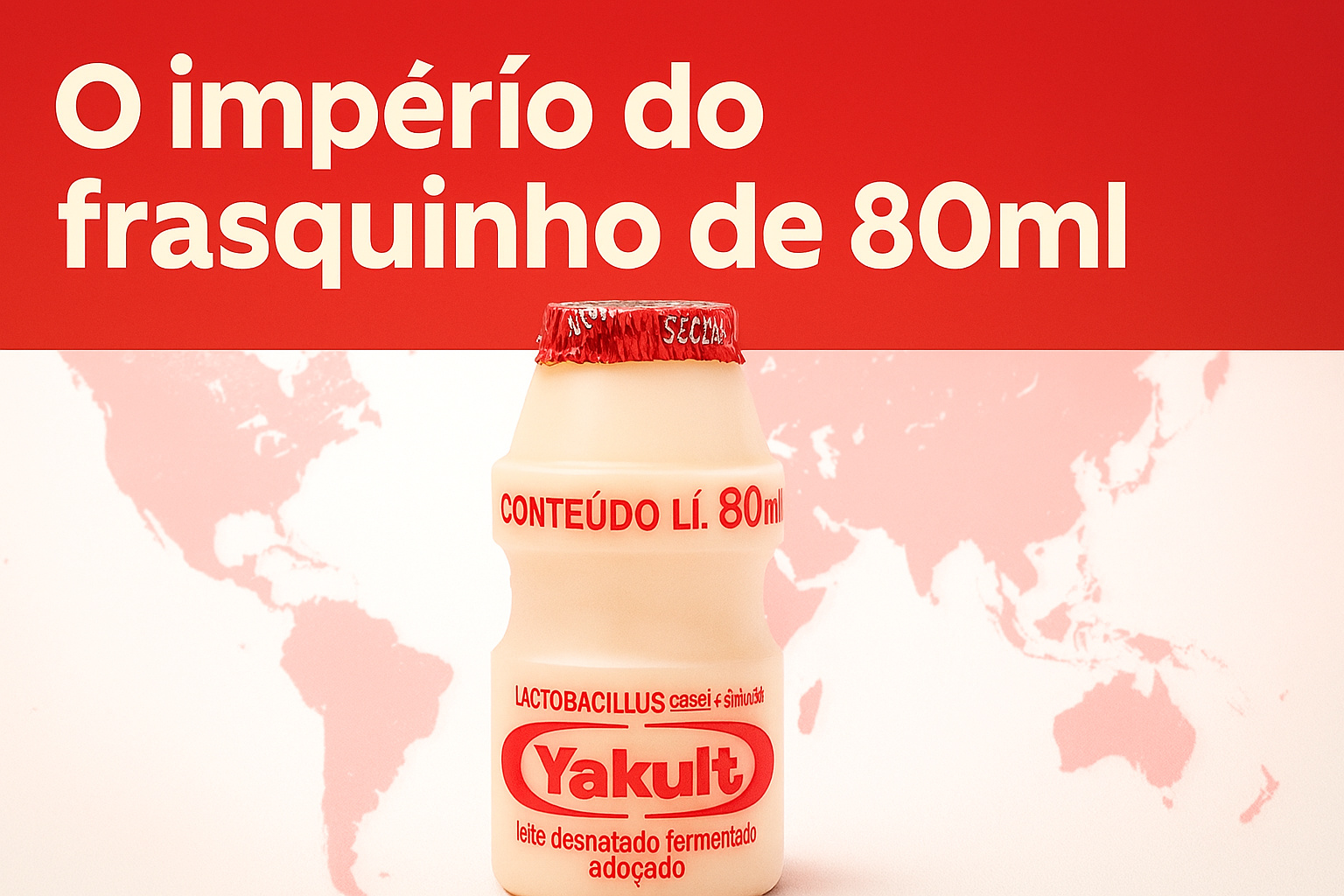
Founded in 1938, Yakult is present in 40 countries, generates £2 billion a year, and has become an icon in Brazil with its 80 ml bottle and billions of probiotics.
Few brands in the world manage to unite tradition, science, and emotional connection like Yakult, one of the most well-known beverages on the planet and a symbol of health and innovation for over eight decades. Founded in 1938 in Tokyo, Japan, by microbiologist Minoru Shirota, the company was the world pioneer in the production of probiotic foods, paving the way for a billion-dollar market that today drives industries in nutrition, cosmetics, and pharmaceuticals.
With a presence in more than 40 countries, factories spread across five continents, and an annual revenue exceeding £2 billion (approximately R$ 13 billion), Yakult has transformed a simple 80-milliliter bottle into a global symbol of intestinal health and longevity — and in Brazil, it has achieved a status that goes far beyond just a beverage: it has become part of popular culture.
The Scientific Origin: The Vision of a Japanese Microbiologist
The story of Yakult begins with the journey of physician Minoru Shirota, born in 1899. In the early 20th century, Japan faced serious public health issues, especially with intestinal diseases that affected thousands of people due to a lack of basic sanitation.
-
He started running at 66 years old, broke records at 82, and is now a subject of study for having a metabolic age comparable to that of a 20-year-old, in a case that is intriguing scientists and inspiring the world.

-
Oldest tree on the planet reappears after 130 years of searches: Wattieza, 385 million years old, was 10 meters tall and had no leaves or seeds; Gilboa fossils in New York solved the mystery in 2007.

-
A 48-square-meter house assembled in hours with 4,000 bricks made of recycled plastic that does not absorb moisture, has natural thermal insulation, and costs less than 90,000 reais in a complete kit.

-
Luciano Hang revealed that Havan’s air fleet has already accumulated more than 20,000 landings, 10,000 flight hours, and 6 million kilometers traveled, and he says that without the planes, the company would never have grown so quickly.


While studying at the School of Medicine of Kyoto University, Shirota dedicated himself to understanding how the gut microbiota influenced the immune system. In 1930, he isolated and cultivated a specific strain of Lactobacillus casei, resistant to stomach acidity and capable of reaching the intestine alive — something unprecedented at the time.
This discovery led to Lactobacillus casei Shirota, the microorganism that would become the heart of Yakult. The brand’s name came from the word “jahurto”, derived from Esperanto and inspired by the term “yogurt.” In 1938, the product began to be distributed in Japan, initially in glass bottles and focusing on improving children’s digestive health.
From a Laboratory Idea to a Global Phenomenon
The success was so rapid that, in the following decades, Yakult expanded throughout Asia, America, and Europe. In the 1960s, the door-to-door distribution model, carried out by uniformed women known as “Yakult ladies”, revolutionized the concept of direct sales.
Today, more than 80,000 distributors operate in countries like Japan, Mexico, Indonesia, Brazil, India, and South Korea, delivering millions of bottles daily to homes, schools, and offices. The system is considered one of the largest home distribution programs in the world.
According to corporate reports, Yakult currently produces more than 40 million units per day — an impressive scale for a beverage that has maintained the same formula for almost a century.
Brazil as One of the Largest Markets in the World
Yakult arrived in Brazil in 1966, with the inauguration of the first factory in Londrina (PR). Two years later, production was transferred to São Bernardo do Campo (SP), where the largest industrial complex of the brand outside Japan was established.
The São Paulo plant has the capacity to produce more than 2 million units per day, supplying the entire national territory and exporting to countries in Latin America. Brazil is now one of the five largest Yakult consumer markets in the world, alongside Japan, Mexico, Indonesia, and the Philippines.
In addition to traditional Yakult, the company has launched lower-sugar versions and derivative products, such as Yakult 40, Yakult Max, and Sofyl, a fermented yogurt with the same probiotic strain.
The 80 ml Bottle That Became a Cultural Icon
Part of Yakult’s success lies in its unmistakable design. Created in 1968, the plastic bottle of 80 ml was designed to ensure the ideal dose of probiotics and withstand pasteurization without compromising the integrity of the bacteria.
Over time, the bottle came to represent much more than a container — it became a nostalgic symbol of childhood and family health.
In Brazil, it gained an almost affectionate status, appearing in memes, parodies, and even packaging collections. In 2019, the Yakult bottle was considered one of the most recognized industrial designs on the planet, according to a ranking by the Japanese magazine Nikkei Design.
The Probiotic Empire: The Science Behind the Success
The secret of Yakult is its simplicity rooted in science. Each bottle contains about 10 billion Lactobacillus casei Shirota, which help balance gut flora and strengthen the immune system. Clinical studies conducted by the company in partnership with universities such as Tokyo University, Kyoto University, and USP confirm the benefits for digestion, nutrient absorption, and even the reduction of intestinal infections.
The company also invests heavily in research and innovation: it maintains scientific institutes in Japan, Mexico, and Belgium, focused exclusively on microbiology, immunology, and functional nutrition.
A Legacy of Longevity and Health
More than just a brand, Yakult represents a life philosophy based on the belief that “a healthy gut is the path to a long and balanced life.” This idea was advocated by Dr. Shirota himself until his death in 1982 and continues to be the central focus of the company.
The company invests in educational programs, sponsors research, and promotes lectures on healthy eating in schools and communities, actions that reinforce its role as a science and public health company, not just a beverage producer.
Today, more than 40 million people consume Yakult every day. The product is sold in countries as diverse as France, Indonesia, Mexico, Australia, and Brazil, maintaining the same size and original flavor.
In an era dominated by ultra-processed products, the small 80 ml bottle continues to be synonymous with purity, well-being, and tradition.
From the laboratory in Kyoto to supermarket shelves in Brazil, the history of Yakult proves that sometimes, the greatest revolutions begin in small doses.









-

-

4 pessoas reagiram a isso.