





 Portuguese
  English
  Spanish
  11 min of reading
  2 comments


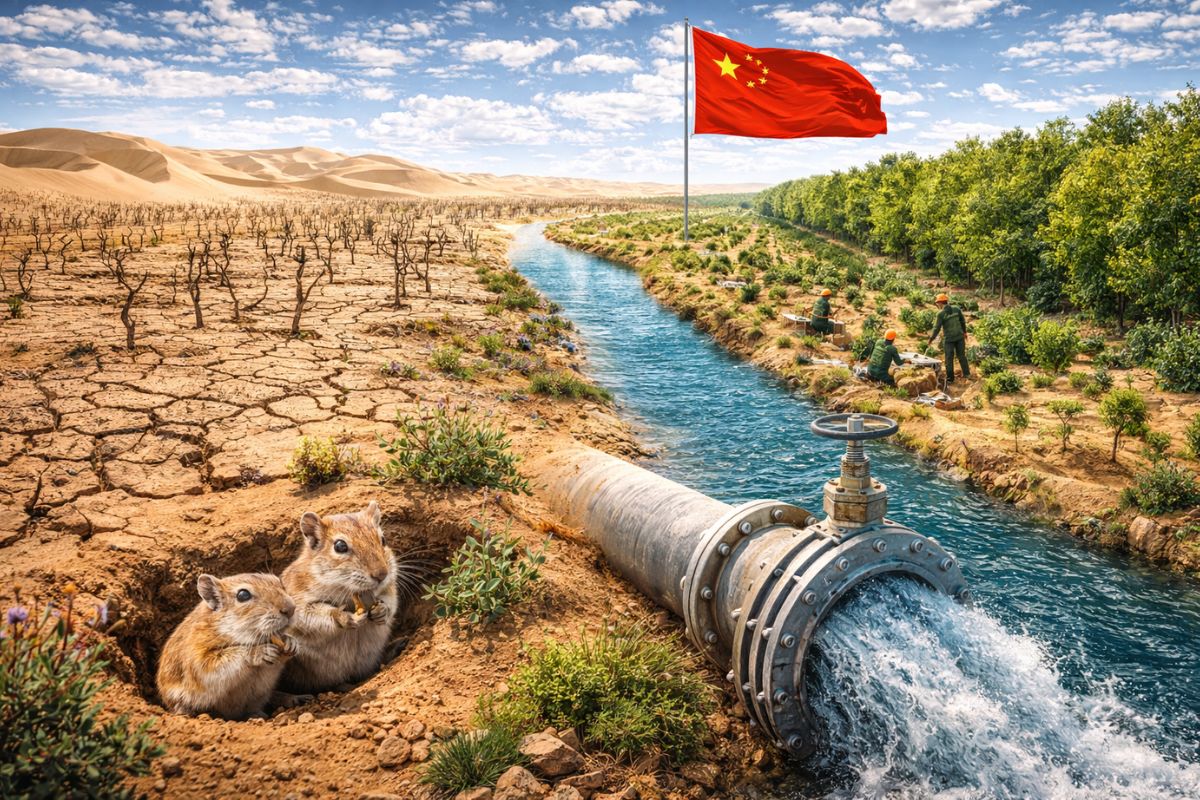


As Desertification In China Swallows 7 Million Hectares Per Year, The Country Bets On The Green Great Wall, Native Species, And Megaprojects Of Water To Curb Desertification.
Desertification has already swallowed 7 million hectares of fertile soil per year and transformed a third of Chinese territory into degraded land; now the country is abandoning monocultures, betting on native species, burrowing animals, and megaprojects of water to try to curb the advance of deserts.
Desertification is a silent disaster. It doesn’t demolish buildings at once like an earthquake, or sweep cities away like a flood, but it slowly corrodes the thin layer of living soil that sustains all our food, our water, and a good part of the global economy. While you read this text, about 40% of the planet’s land is already in a state of drought, and over 70% of the land surface is suffering some kind of impact.
Every year, desertification transforms 7 million hectares of fertile soil into dead land, equivalent to dozens of football fields per minute. It’s not just “sand occupying space”: it’s water disappearing, crops collapsing, villages migrating, and dust storms crossing continents.
-
With a cost per shot close to zero, the DragonFire laser could change naval warfare in 2027 and provide British ships with nearly unlimited defense against drones.

-
A British startup creates tires that generate electricity in electric vehicles when passing over potholes, speed bumps, and cracks.

-
Scientists have created robots made with living cells that have their own nervous system, swim on their own, explore the environment, and self-organize without any genetic engineering, and now they want to do the same with human cells.

-
Students create a solar-powered ambulance that operates without a plug, without fuel, and still keeps medical equipment running in remote areas.

China is the extreme laboratory of this problem. One third of all Chinese territory has already been affected by desertification, directly impacting the lives of about 400 million people. Deserts like Gobi continue to swallow thousands of square kilometers of pasture, entire oases have been on the verge of being buried, and sandstorms have carried dust as far as South Korea, Japan, and the United States.
On some days, Beijing wakes up under a yellow sky, with dust a thousand times above the safe limit for lungs. Faced with this threat, China decided to confront desertification with what it had that was simplest and most powerful at hand: trees, lots of trees. But the attempt to build a “green wall” exposed deep errors – and forced the country to rethink everything, from the type of forest to the use of rodents and even artificial rivers along the edge of the desert.
Desertification: The Silent Disaster That Sustains (And Threatens) Civilization
Desertification is, above all, a collapse of soil and water. It begins with more intense droughts, improper management, deforestation, overgrazing, and agricultural techniques that strip the vegetation cover until the land is bare.
Without roots to hold the surface, the wind carries away the fertile layer; without organic matter, rainwater fails to infiltrate and runs off, opening furrows and carrying away what little is left.
Historical cases show the magnitude of the problem. The ancient Lake Chad, which was once one of the largest freshwater lakes on the planet, has lost about 90% of its area since the 1960s.
In the United States, the Dust Bowl of the 1930s stripped hundreds of millions of tons of fertile soil from the plains, forcing over 500,000 people to abandon farms and cities.
It wasn’t a “climatic accident”: it was an explosive combination of droughts with intensive and destructive use of the soil.
Not by chance, a former UN Convention Secretary on Desertification summed up the drama with a brutal phrase: “20 centimeters of topsoil is all that separates our species from extinction.”
If this layer disappears, then the capacity to produce food, store water, and maintain a minimally stable climate also disappears.
The Green Great Wall of China: The World’s Largest Reforestation Bet

In the country most affected by desertification today, the response has come on an unprecedented scale. China decided to confront desertification by building a “Great Green Wall” of forests, a belt of trees stretching thousands of kilometers along the edges of the deserts, especially around the Gobi. The idea seemed simple: if the desert is advancing, plant trees until it stops.
For over four decades, the country has mobilized millions of people, students, soldiers, farmers, and urban workers to plant trees in arid, water-deprived regions.
Military aviation dropped seeds from above, teams dug holes in concrete-hard soil, and drip irrigation systems were installed right in the desert.
The result, from above, looked spectacular. Satellite images showed new green belts emerging where there was once only sand and degraded pastures.
Official reports spoke of billions of trees planted, and the green wall became promoted as a symbol of “ecological engineering” on a national scale.
But there was a problem: trees are living organisms, not concrete blocks. And what seemed like victory began to crumble a few years later.
When The Forest Dies Standing: 85% Of The Trees Do Not Survive
The same green wall that seemed to curb desertification revealed deep fissures. In many areas, two to five years after planting, young forests began to die en masse.
From afar, the blocks of trees still looked healthy. Up close, researchers described a frightening picture:
There were no insects. There was no grass. There were no signs of a living ecosystem. The soil, hard as brick, did not absorb water and lacked microorganisms to recycle organic matter.
When it rained, water ran off the surface like it was concrete.
Studies pointed out brutal numbers: in some regions, up to 85% of planted trees ended up dying after a few years.
In areas of Inner Mongolia and Ningxia, over a million hectares of forest plantations collapsed in just 5 to 7 years. To try to compensate, communities planted four, five, six times in the same spot, and still failed.
The reason was simple and devastating. To grow quickly, the young trees pulled more and more water from the groundwater. As natural recharge was low, the water table fell by 10 to 60 meters in certain areas.
Old wells dried up, fields cracked, the soil began to sink. Desertification was not being fought: it was being pushed to another level.
Behind these numbers was a combination of structural errors.
The Three Major Errors Of The “Green Wall”
The first mistake was monoculture in extreme territory. The Chinese strategy prioritized fast-growing species like poplars and Siberian elms.
These are trees that grow quickly, facilitate mechanization, yield good satellite photos, and feed reports.
Only ecologically they are a cataclysm waiting to happen: shallow roots, high water consumption, low resistance to pests, and little genetic diversity.
Billions of identical trees side by side turned the forest belt into a feast for insects and diseases.
In the 2000s, the long-horned beetle spread and destroyed nearly a billion trees, at a rate scientists compared to a “wildfire without fire.”
In a natural forest, with dozens of different species, this type of pest would not have the same impact.
The second mistake was skipping the basic architecture of a healthy ecosystem. Instead of creating three layers of vegetation, grasses, shrubs, and trees, projects jumped directly from bare soil to tall trees.
Without grass to retain moisture, without shrubs to break the wind at ground level, without the network of symbiotic fungi to regenerate the soil, the forests remained “standing”, but on a dead foundation. From a distance, it looked like a forest; up close, it was just wood on dust.
The third mistake was perhaps the most serious: planting forest where forest cannot exist. Large portions of Gobi are outside the moisture routes that come from the ocean, with extremely low annual rainfall.
In these conditions, betting on large blocks of trees is forcing an ecological system that cannot sustain itself. It’s like trying to keep an aquarium without ever replenishing the water.
These mistakes are not exclusive to China. The Soviet Union, in the 1940s and 1950s, tried something similar: a windbreak forest belt in dry lands, with a few fast-growing species.
In just over a decade, most of these forests collapsed due to drought, pests, and soil degradation.
The conclusion of Soviet scientists at the time was direct: “The forest failed because it was planted where forest cannot exist.”
Burrowing Animals: Invisible Engineers Against Desertification

When the failures of the green wall became undeniable, a new idea gained momentum in China: using burrowing animals as allies in soil recovery.
The logic comes from a not-so-obvious fact: soil is not just a layer of immobile dust, but a colossal living system, with billions of organisms in tunnels, cracks, and microscopic networks. About a quarter of all the biomass on the planet is below the surface.
In this underground world, creatures like gerbils, gerboas, moles, termites, earthworms, and beetles act as natural “civil engineers.”
Each tunnel opens up space for water to infiltrate, each gallery breaks compaction, and each root pulled deeper brings carbon and moisture to lower layers. The result is softer, wetter soil, less prone to erosion and with a more stable temperature.
An ecologist even described the gerboa as “the most efficient biological economy machine the desert has ever created.”
These rodents have lived for thousands of years in extreme environments, endure heat, drought, and survive with very little water.
Their holes function as micro-ecological recovery stations: there, the moisture lasts longer, and seeds have a better chance of germinating.
Moreover, the constant activity of these animals reduces the risk of fires, as it breaks the layer of dry leaves, creates pockets of moisture, and accelerates the decomposition of organic matter. In other words, they help to keep carbon locked in the soil, instead of releasing it back into the atmosphere.
Theoretically, increasing the presence of native burrowing animals in degraded areas would be like hiring an army of super-low-cost ecological engineers. But nature itself reminds us that no solution is magic.
When The Rodents Get Out Of Control
In balanced ecosystems, rodents represent about 5% to 10% of animal biomass. In degraded environments, without predators and without diversity, this number can explode.
A single female gerbil can have up to six litters per year, with several pups in each, meaning that small populations can turn into thousands of individuals in just a few seasons.
Without owls, foxes, and birds of prey, which have largely disappeared from much of northern China, these rodents spread faster than the trees can recover.
They gnaw roots, consume grasses, and expose the soil again. Just losing grass cover for 3 to 6 months can cause the soil to lose up to 40% of its capacity to retain water, reopening the door to desertification.
Cases in other countries show the magnitude of the risk. A rodent explosion in Kazakhstan destroyed almost 40% of wheat areas in some provinces in a single year.
In Mongolia, governments had to launch campaigns in areas equivalent to entire states to try to control populations that got out of control.
Moreover, rodents are hosts to dozens of pathogens that can affect herds and crops. In monoculture landscapes, where everything is the same, the same species, the same age, the same weakness, any pest finds a perfect feast.
The very loss of about a billion trees in China due to the long-horned beetle is a reminder of how fragile simplified systems can be.
In other words: burrowing animals are essential for soil health, but they are not a “silver bullet” against desertification. Without diversity, without water, and without predators, they can exacerbate the problem they were supposed to help solve.
From Mass Planting To The Restoration Of Native Ecosystems
In the face of this scenario, forests dying standing, potentially uncontrolled rodents, groundwater in decline, China has begun to silently adjust its strategy against desertification.
Instead of measuring success only by the number of trees planted, pilot projects began to focus on the restoration of entire ecosystems, mirroring the native vegetation of each region: combinations of conifers, broadleaf trees, bamboo groves, and natural fields.
Instead of a uniform “green carpet” to look good in satellite images, the priority has become to reconstruct habitats mosaics, with more species, more layers of vegetation, and more resilience.
The rule has become clear: plant only where nature allows and with local species already adapted, instead of insisting on large monocultures in extremely dry areas.
At the same time, agreements with environmental organizations were made to expand projects with native species and better monitor the real impact on soil, water, and biodiversity.
Examples elsewhere reinforce that this approach makes sense. In the Negev Desert, in Israel, forests planted with native drought-resistant species not only survived for over 50 years but also improved the soil and created cooler microclimates around.
The logic is the same: the right trees, in the right place, with multi-layered structure and respect for water limitations.
Yet, desertification continues to advance minute by minute in various regions of China. And when neither native species nor fine management adjustments are enough, the country appeals to another tool: water on a continental scale.
When The Trees Are Not Enough: Artificial Rivers Along The Edge Of The Gobi
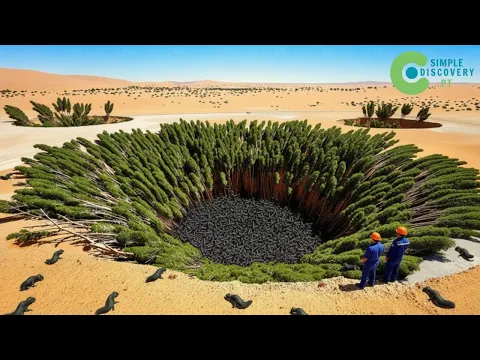

If the weak point of desertification projects is water, the logical response of a country with gigantic ambition is to try to “import” water to the desert.
One of the boldest plans underway envisions an artificial river stretching hundreds of kilometers, bringing water from frozen mountains to the heart of the Gobi.
The idea is to use melting water and glaciers from a large mountain range, channeling this resource through a cascading system of reservoirs, small dams, artificial canals, pumping stations, and locks.
This is not just about irrigation: it’s a mega hydraulic and logistical undertaking designed to reshape northwest China.
This water would serve for agriculture, sustain energy and mining sectors, and allow a new line of linear cities along the canal, right on the edge of the desert.
Some describe the project as an attempt to create a kind of “Chinese Las Vegas” in the Gobi, based on heavy infrastructure and intensive water resource use.
But if the green wall showed that planting too much can dry out the underground, such a system raises even greater doubts: where will all this water come from in the long term?
What will be the impact on rivers, glaciers, and source ecosystems? What new climate problems may arise when trying to “tame” the desert with heavy engineering?
Desertification In China: Local Problem, Global Alert
The Chinese crisis is, in practice, a global case study on desertification. It condenses almost all dilemmas: more intense droughts, degraded soils, forests planted where they shouldn’t exist, vulnerable monocultures, risky use of rodents as biological solutions, expensive megaprojects for water, and a race against time to prevent the land from turning to dust.
At the same time, it shows that it is not enough to “paint the planet green” with any tree, anywhere.
Desertification is a problem of soil, water, climate, and biodiversity all at once. It demands the right species, proper scales, ecological recovery time, and, above all, humility to recognize limits. The quantity of trees does not replace ecology.
The IAEA (UN agency) states that land degradation is increasing at a rate of 5 to 7 million hectares per year.
The question that remains is direct: if desertification is already swallowing 7 million hectares per year and China needs to combine a green wall, rodents, and artificial rivers to react, how much time do we have until other countries are forced to make decisions as extreme as these?
And you, do you think the smartest path against desertification is to bet on megaprojects of engineering, on slower and local ecological restoration, or on a combination of both strategies?






Acho que fazer barreira não adianta o certo seria recomeçar o ecossistema bem mais a frente porque se não parar de vir essa areia com vento ela com tempo consegue cobrir então acho que o problema tem que começar a resolver des do começo
Israel ja demonstra muita experiencia no assunto, creio que pedir ajuda seria uma boa pratica. Do pouco que entendi, vao recomecar com pequenos projetos que incluiam o estudo e desenvolvimento de ecosistemas completos, variedades de plantas, microorganismos, agua, materia organica, etc… Creio que chegarao no objetivo, vale abpena continuar tentando pois se o mundo nao frear a desertificacao, nossa especie podera ter de ser drasticamente reduzida…