





 Portuguese
  English
  Spanish
  5 min of reading
  1 comment





Tunnels and Columns Beneath the Giza Plateau Awaken New Theories About Engineering and Symbolism in Ancient Egypt. The Discovery Reignites the Debate About What May Still Be Hidden Beneath the Millennial Sand of Giza.
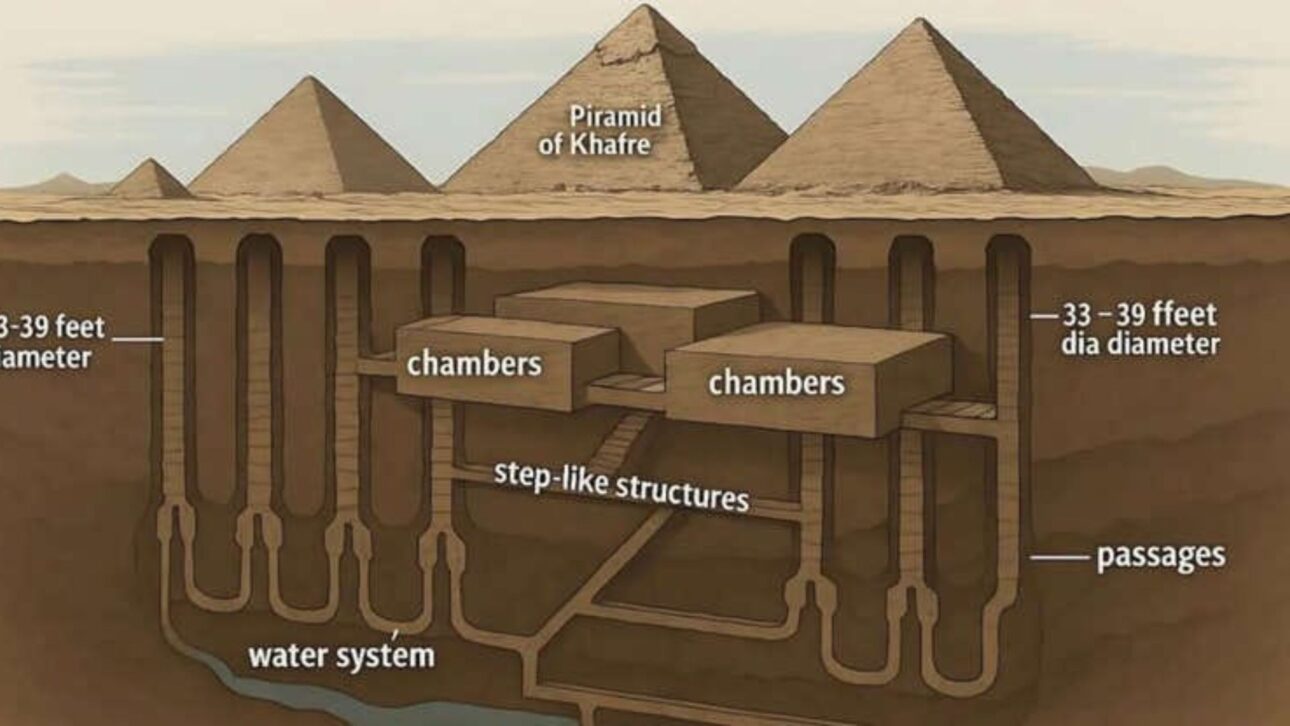
Researchers led by Egyptologist Armando Mei claim to have mapped tunnels, stone columns, and vertical shafts beneath the Giza Plateau, in the vicinity of the Great Sphinx and the pyramids of Khufu and Khafre.
The work, performed with ground-penetrating radar and tomography, describes an underground network that, according to the team, reveals a planned design with possible practical or ritual functions.
Shafts and Cavities Beneath the Sphinx and the Pyramids
According to the group, three main shafts appear distributed in a triangular formation in an area adjacent to the Sphinx and the pyramids of Khufu and Khafre.
-
He started running at 66 years old, broke records at 82, and is now a subject of study for having a metabolic age comparable to that of a 20-year-old, in a case that is intriguing scientists and inspiring the world.

-
Oldest tree on the planet reappears after 130 years of searches: Wattieza, 385 million years old, was 10 meters tall and had no leaves or seeds; Gilboa fossils in New York solved the mystery in 2007.

-
A 48-square-meter house assembled in hours with 4,000 bricks made of recycled plastic that does not absorb moisture, has natural thermal insulation, and costs less than 90,000 reais in a complete kit.

-
Luciano Hang revealed that Havan’s air fleet has already accumulated more than 20,000 landings, 10,000 flight hours, and 6 million kilometers traveled, and he says that without the planes, the company would never have grown so quickly.


The distance between them, less than 50 meters, was interpreted as a sign of a deliberate geometric pattern.
The survey associates these points with the so-called Kefren Project, which compiles data obtained from successive scans.
The first shaft is said to be located to the northeast of the Sphinx.
The opening, described as square and carved in rock, would provide access to a shaft about 40 meters deep, roughly the height of a 12-story building.
Credit: Image associated with the radar study in Giza.
The inner walls, also square in section, would have limestone and sandstone cladding, with a regular finish.
Just a few meters ahead, about 12 meters from this first shaft, the researchers mention a cavity approximately 24 meters wide.
The cut, due to the precision observed in the images, was classified by the group as difficult to explain by natural processes.
The internal engineering would remind the team of solutions adopted on the surface of Giza.
The second shaft would appear aligned with the Khafre Processional Causeway, which links the Valley Temple to the pyramid complex.
In the layout, the technicians report the presence of two vertical “doors” of similar design, reinforcing the hypothesis of planning and repetition of construction solutions along the underground route.
On the east side of the Khufu pyramid, the third shaft would stand out for having stone block reinforcements near the entrance.
This arrangement would suggest, according to the group’s assessment, a possible elevation or guidance device for elements between the underground and the surface, indicating frequent use for practical or ritual purposes.
Geometry and Alignments: A Design That Dialogues with the Sky
In addition to the triangular distribution, the authors correlate the underground mapping with the alignments of the pyramids.
At this point, they revisit the hypothesis of correspondence with the Orion’s Belt, a theme present in the literature about the plateau and reused as an interpretative key.
For the team, the proximity between the shafts, the repetition of measurements, and the internal finish would support the idea of a unique project, in which architecture, technology, and philosophical conception would be integrated.

Credit: Public domain image, as per Wikimedia Commons.
Although the final meaning remains debated, the arrangement is presented as a piece that adds depth to the reading of the complex: surface and subsurface acting in an articulated manner, in accordance with astronomical and functional relationships.
How the Underground Mapping Was Done
The prospecting utilized ground-penetrating radar and tomography in a wide area around the Sphinx.
From the scans, researchers describe interconnected galleries, chambers, and vertical columns.
Far from isolated anomalies, these columns would be regular elements of the layout, operating as portals that connect tunnels and chambers at different levels.
The functional hypothesis points to a system designed for subterranean circulation and specific uses.
According to the authors, the resulting mesh would form a coherent set of known engineering solutions from Ancient Egypt.
The precision at the interfaces, the regularity of the sections, and the pattern of structural reinforcements seen in the main shafts reinforce the reading that this is a work thought out from end to end, and not random features produced by geological dynamics.
Possible Functions: Hydraulics, Ritual, or Hidden Chambers
- Three explanatory avenues are considered by the team:
- A hydraulic system linked to the Nile, with a logic of control or regulation of water beneath the plateau.
- An infrastructure for ceremonies and rituals, in dialogue with the cult and with symbolic pathways.
The possibility that some of the hidden chambers mentioned by Herodotus may correspond to this underground.
Whichever the function, the researchers emphasize the precision of the internal finishes, from wall junctions to reinforced accesses, in tune with the magnitude of the pyramids. For them, nothing there would have been left to chance.


What the Leaders of the Study Say
In a text quoted by the team, Armando Mei summarizes the ambition of the work by stating that, for decades, the true extent of the “underground world” of Giza has been ignored and that the mapped shafts may reveal a lost chapter of techniques and ceremonial practices.
He also highlights that “what is hidden at the bottom of these shafts remains a mystery”, but maintains that each measurement and each radar image would point to the same conclusion: the plateau still holds secrets.
Although the statements focus on the geophysical data and the repetition of geometric patterns, the group emphasizes the need to expand the empirical base with new measurements and field studies to reduce uncertainties.
If the interpretations are confirmed, the set reorders the reading of the complex as an integrated organism, with surface and subsurface operating in a coordinated manner.
The hypothesis of alignment with the stars, combined with a potential hydraulic logic, brings together engineering, cosmology, and ritual in a unique narrative about the planning of Giza.
Besides the academic impact, there is evident public interest.
The fascination for passages and hidden chambers adds to the idea that Ancient Egypt operated with a high degree of technical precision and systemic vision.
The Giza Plateau, in this context, would remain capable of providing answers to open questions about function, chronology, and symbolism.







Muito interessante e desafiador. Tem sim que aprofundar as pesquisas e descobertas. Todos estão ávidos por explicações.