





 Portuguese
  English
  Spanish
  4 min of reading
  1 comment


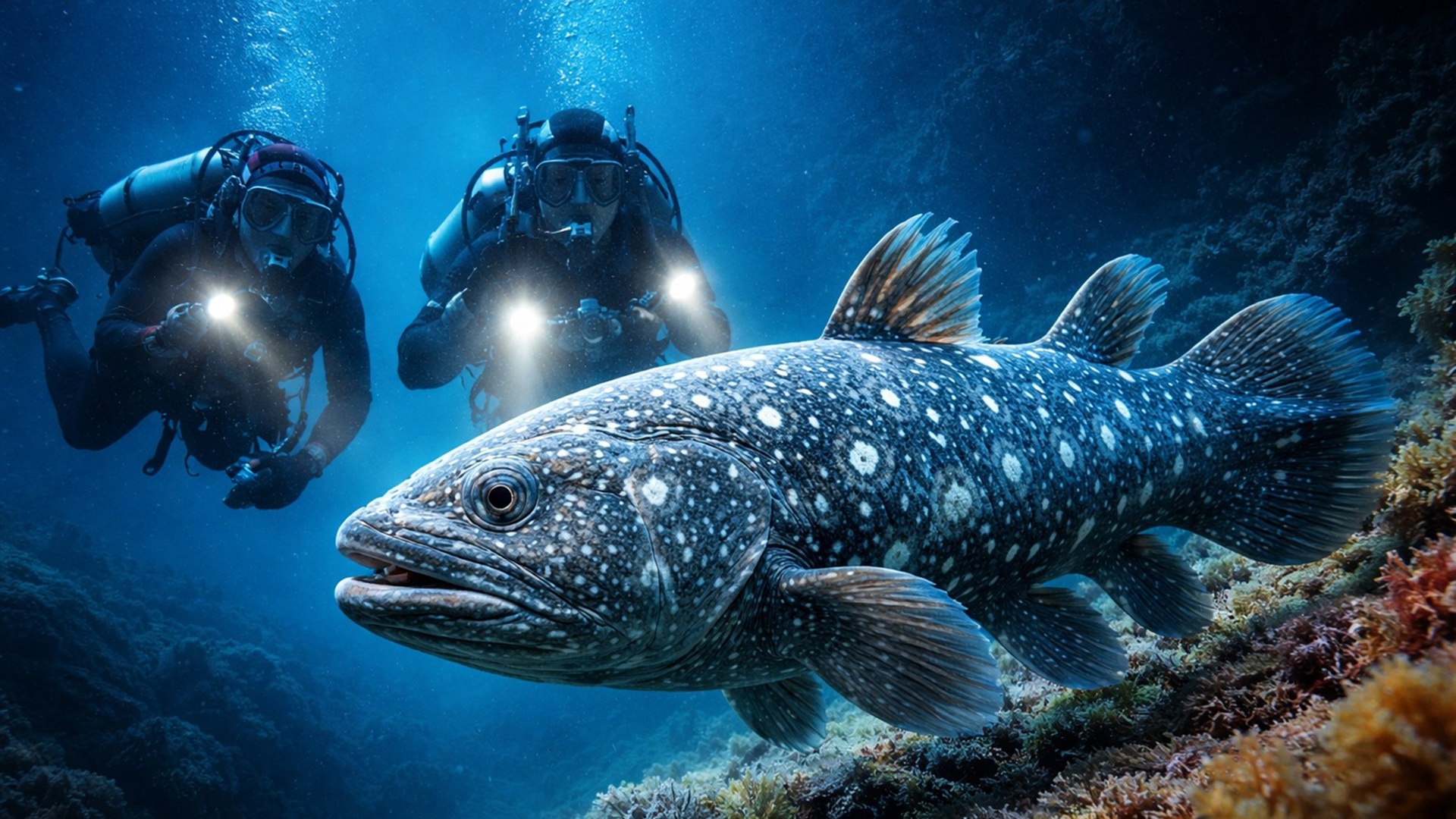


Unprecedented Record By Two French Divers At Almost 145 Meters Deep, After Two Years Of Searches And More Than 50 Dives, Documents For The First Time A Living Coelacanth In Its Natural Habitat In The Maluku Province, Expanding Data On Distribution, Environmental Risks And Future Conservation Strategies For The Species
In October 2024, two French divers recorded for the first time a coelacanth in its natural habitat in the Maluku Province, Indonesia, at almost 145 meters, after two years of mapping and more than 50 descents, expanding knowledge about the species’ distribution.
First In Situ Observation In Indonesia
Off the coast of the Maluku Islands, in Indonesia, Alexis Chappuis and Julien Leblond descended to almost 145 meters deep and found a coelacanth, a record documented on video by the magazine Scientific Reports. The encounter marks the first filmed observation of the species in the Maluku Province.
Equipped with closed-circuit rebreathers and supported by years of research, the divers made more than 50 dives over the course of two years. The objective was to locate the elusive Latimeria menadoensis in the deep waters of the Maluku archipelago, following meticulous mapping of the seabed.
-
Does compulsive lying exist? What does science know about mythomania and why does it go beyond ‘lying too much’?

-
Marine fossils found at over 8,800 meters altitude on Everest and in large mountain ranges have proven that entire continents move, oceans disappear, and tectonic plates collide over millions of years, revolutionizing science in the 20th century.

-
What if the Sun disappeared suddenly? Simulation shows Earth in darkness within minutes, extreme cold, and rapid collapse of life on the planet.

-
A 2,400-year-old iron foundry has been discovered in Senegal with 100 tons of slag, 35 furnace bases, and signs of nearly eight centuries of continuous metallurgical activity.

During the crossing of a narrow underwater canyon, the team spotted a dark blue shape that materialized ahead. Sprinkled with white spots and moving slowly, the fish remained still on a ledge covered with sponges, allowing for quiet filming before disappearing into the darkness.
One day later, the same animal was found again. The confirmation was made by the unmistakable pattern of spots, solidifying the record as the first repeated observation of the same individual in the region, reinforcing the significance of the find for marine biology.
A Living Fossil From Ancient Times
For decades, it was believed that the coelacanth had disappeared with the dinosaurs, until the unexpected discovery of a specimen in 1938, off the coast of South Africa. Since then, only two species have been confirmed in deep marine environments.
The recognized species are Latimeria chalumnae, in the western Indian Ocean, and Latimeria menadoensis, in the deep waters around Indonesia. The term “living fossil” is often used, although it does not fully describe the evolutionary trajectory of the group.
The anatomy of the coelacanth preserves ancestral characteristics, such as fleshy fins resembling limbs, a bipartite skull, and a vestigial lung. These traits provide insights into the transition from sea to land in the evolution of vertebrates, maintaining ongoing scientific interest.
Increasing Pressures In Deep Habitats
The depths where coelacanths live, generally between 100 and 400 meters, have long served as natural protection against human activity. However, this isolation has been decreasing with environmental changes and the expansion of activities in deep seas.
Among the cited risks are rising sea temperatures, plastic pollution, underwater noise, and the expansion of deep-sea tourism. Even remote habitats are beginning to face cumulative pressures, reducing the safety margin for rare species.
The International Union for Conservation of Nature classifies Latimeria menadoensis as vulnerable. The assessment considers the species’ extremely slow reproductive cycle and low population recovery capacity.
Coelacanths can live over 100 years, reach sexual maturity around 55 years, and have gestation periods of up to five years. These factors make each individual essential for long-term survival, raising the impact of single losses.
Indications Of An Unknown Population
Although the observation does not confirm the existence of a local population, the record strongly suggests this possibility. Vast stretches of deep waters between Sulawesi and West Papua remain unexplored, offering potential refuges for other individuals.
Rare images show the coelacanth drifting along a rocky ledge in the deep waters of Indonesia. The recorded behavior, with slow movements and stationary presence, contributes to more accurate descriptions of habitat use.
The repetition of the encounter on consecutive days reinforces the hypothesis of local residency. For researchers, the observed pattern indicates specific shelter areas in deep reefs, still poorly documented by regional marine science.
Research Enters A New Phase
The team is now planning studies based on non-invasive genetic sampling in nature.
The approach will allow for the investigation of genetic diversity, movements, and distribution without capturing or disturbing the observed specimens, expanding the ecological data set.
According to the study’s authors, the first encounter with a coelacanth in a wild state in an area with no previous records represents a crucial step in understanding the species’ biogeography, natural behavior, and habitat, as well as underlining protection strategies.
By deepening knowledge about the coelacanth’s life in the wild, researchers hope to strengthen conservation efforts for one of the rarest and oldest marine vertebrates on Earth, amidst increasing threats to deep reefs.








Quase impossível ler alguma coisa com tanta propaganda..