





 Portuguese
  English
  Spanish
  5 min of reading
  0 comments


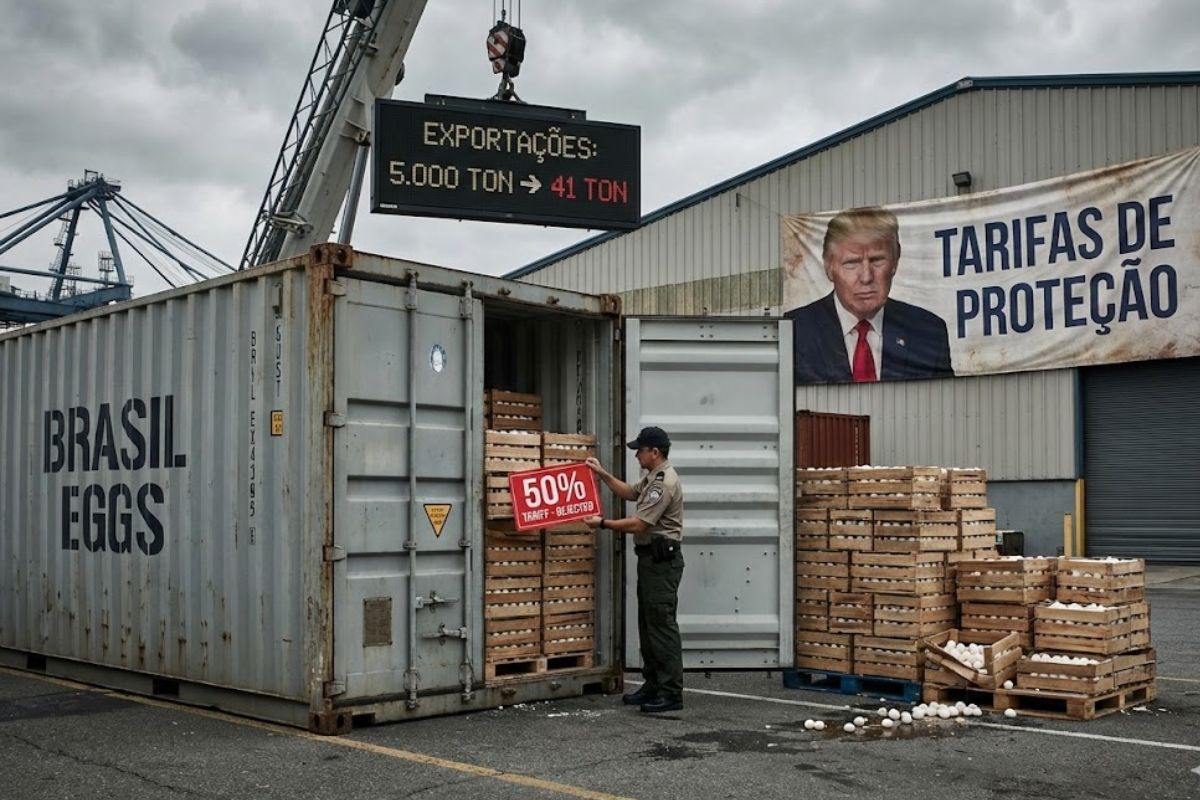
While The 50% Tariff Has Dropped For Coffee And Meat, Eggs Remain In The Sights Of The USA: After The Avian Flu Crisis Boosted Purchases Of Over 5,000 Tons In June, The Brake Imposed In August Dropped Shipments To Only 41 Tons In October 2025 In Brazil.
In August 2025, the 50% tariff imposed by Donald Trump on Brazilian eggs came into effect and changed the game for exports to the United States. After a boom driven by the avian flu crisis and eggs sold at record prices in American supermarkets, sales plummeted from over 5,000 tons in June to just 41 tons in October.
According to the G1 portal, published in December 2025, the numbers from the Brazilian Animal Protein Association show that, even with the sharp slowdown at the end of the year, the spike caused by the lack of product in the USA is expected to make Brazil end 2025 with a 116.6% increase in egg exports. Between January and October, sales to the American market have already accumulated a growth of 1,037.52% compared to the same period in 2024, and for the first time, the volume shipped is expected to exceed 1% of national production.
Tariff Remains For Eggs, But Eases For Other Foods
The 50% tariff was imposed by the United States on several Brazilian products and began to take effect in August 2025. Since then, there has been relief for part of the agribusiness. Coffee, meat, and other items have already had the surcharge removed, but eggs continue to bear the brunt of the trade dispute.
-
The institute that trained the greatest aerospace engineers in Brazil has just opened its first campus outside São Paulo after 75 years: ITA Ceará will have R$ 445 million, new courses in energy and systems, and classes are expected to start in 2027.

-
Luciano Hang, owner of Havan, goes to Juiz de Fora after the tragedy in February, brings R$ 1 million, hands out R$ 2,000 cards, and donates up to R$ 15,000 to victims in the region.

-
The Brazilian passport allows legal residence in dozens of countries without the need for a prior visa, and most Brazilians are unaware that they can apply for residency directly upon arriving in nations in South America, Africa, and even Europe.

-
Petrobras sends a message to Brazilian truck drivers after fuel collapse and reveals plan to have 100% domestic diesel.

In practice, this means that the Brazilian product arrives more expensive to the American consumer and loses competitiveness precisely at the moment when Brazil had gained ground during a supply crisis in the United States.
The decision to maintain the tariff on eggs has interrupted the phase in which the sector was talking about a ‘celebration’ of exports to the North American market.
From 220 Tons At The Beginning Of The Year To Just 41 In October
The surge in sales began in January 2025, when the United States purchased 220 tons of eggs from Brazil. Within a few months, the curve exploded and surpassed 5,000 tons in June, maintaining a high level in July, when exports were around 3,000 tons.
The scenario changed starting in August, precisely when the 50% tariff came into effect. American purchases began to dwindle and, in October, only 41 tons of Brazilian eggs were shipped to the United States.
In practical terms, this signifies a decrease in sales that threatens the boom initiated by the supply crisis in the USA.
Avian Flu Crisis Created The Window That The Tariff Now Closes
The United States entered 2025 already pressed by the avian flu, which has affected the country since 2022. The virus continued to spread and, until November 18, more than 100 outbreaks had been reported, which forced the culling of about 8 million birds since September.
The Department of Agriculture’s rule is strict: once an infected hen is identified, all surrounding birds are culled.
With fewer hens in production, the supply of eggs plummeted. In February 2025, some supermarkets simply had no product on the shelves, while others began to limit the quantity per customer to avoid shortages and resale.
There was even the theft of 100,000 eggs from a trailer in Pennsylvania, a load valued at $40,000.
The result appeared in prices. In March 2025, a dozen eggs peaked at $6.22, equivalent to about 33 reais, and became a symbol of the cost-of-living crisis for the American middle class.
The most recent data from September shows a drop to $3.48, around 18.48 reais, with the partial normalization of supply.
Rule Change Opened Space For Brazil In The American Market
Until January 2025, Brazilian eggs had a timid presence in the United States and could only be used as animal feed.
Beginning this year, the rules changed and the product was released as an ingredient in processed foods, such as cake mixes and ice creams, still without direct access to the shelves as fresh eggs.
Even without being displayed in whole boxes in supermarkets, this regulatory change, combined with the internal supply crisis, opened a rare window for Brazilian exporters and helped boost the volume shipped throughout the first half of the year.
The maintenance of the 50% tariff tends to reduce this space, precisely when the industry was adapting to the sanitary and logistical requirements of the American market.
Japan Advances, Chile Retreats And The Egg Export Culture Is Born
The United States was not the only destination benefited by the reconfiguration of the egg trade.
Between January and October, purchases from Japan grew by 230% compared to 2024, solidifying the country as the second-largest customer of Brazilian eggs. Chile, ranked third, reduced imports by 41% in the same period.
For the president of the Brazilian Animal Protein Association, Ricardo Santin, this movement shows that Brazil is creating an egg export culture, with companies organizing to meet different markets, quality standards, and sanitary requirements.
Even so, the vast majority of production continues to be aimed at internal consumption, and the increase in external sales still starts from a small base.
Record Production In Brazil And Huge Appetite In The USA
Brazilian production is expected to close 2025 at 62.25 billion units of eggs and could reach 66 billion in 2026.
In practice, this means an average consumption of 287 eggs per inhabitant today, with projections rising to 307 units per person next year. The combination of higher income, practicality, and the quest for cheaper protein supports this internal growth.
On the other hand, the American market maintains an equally robust appetite. It is estimated that each resident of the United States consumes over 284 eggs per year, leading national daily consumption to about 250 million units.
In states like Espírito Santo, which features among the highest price increases in Brazil, the impact of external demand and international supply disruptions is also reflected in the consumer’s wallet.
What Is At Stake If The Tariff Remains In Effect For Eggs
Even with the recent drop in purchases from the United States, the balance for 2025 will still be positive for the Brazilian exporter due to the boom in the first months, supporting the projection of a 116.6% increase in total exports.
The question is whether this pace will be sustainable if the 50% tariff remains in effect in 2026 specifically for eggs.
If the surcharge continues, the trend is that companies will direct more products to markets like Japan and seek new destinations in Asia and Latin America, reducing dependence on the United States.
On the other hand, if there is tariff relief, the experience of recent months shows that Brazil has the capacity to quickly respond to increased demand and expand its presence in the world’s largest market for processed eggs.
In your opinion, should the 50% tariff be lifted for Brazilian eggs, or are the United States right to maintain protection for local producers even after the avian flu crisis?










Seja o primeiro a reagir!