





 Portuguese
  English
  Spanish
  3 min of reading
  0 comments


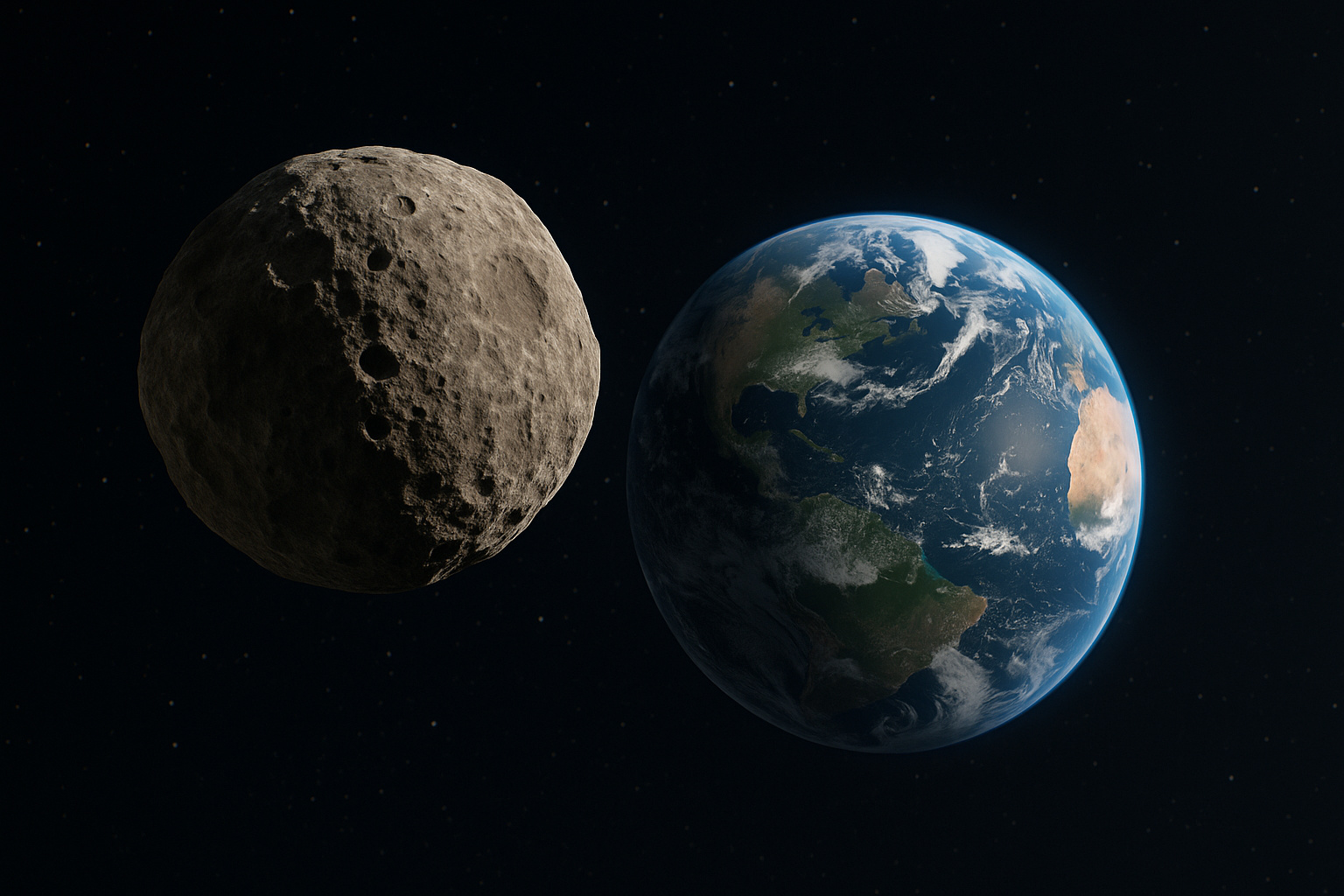
Discovery Made By Pan-STARRS In Hawaii Confirms That The Celestial Body Has Been Accompanying Earth For More Than Six Decades In An Orbit Synchronized With The Sun
An unprecedented astronomical discovery revealed a phenomenon that intrigues the scientific community. On August 2, 2025, astronomers confirmed that Earth has gained a new quasi-moon, a celestial body that travels along with the planet without being tethered by its gravity. The confirmation came from the Pan-STARRS observatory in Hawaii, a world leader in the detection of near-Earth objects (NEOs).
Researchers observed that this quasi-moon has been accompanying the planet for about 60 years and will remain close until 2083. Measuring approximately 20 meters in length, the celestial body maintains an orbit synchronized with that of Earth. According to astronomer Jenifer Millard from Fifth Star Labs in Wales, “quasi-moons do not orbit planets, but the Sun, following similar and temporary trajectories”. She explains that the phenomenon illustrates the delicate gravitational interaction between Earth and the space around it.
Astronomical Investigation Reveals Rare Orbital Phenomenon
Scientists detected the new quasi-moon during routine observations in August 2025. After analyzing old images, they discovered that the body has been traveling close to Earth since the 1960s. This confirmation was made possible thanks to technological advances in modern telescopes and tracking systems that allow for high-precision orbit calculations.
-
100% Brazilian technology transforms agricultural waste into a meat-scented ingredient using fungi from the Amazon rainforest. The process does not use excessive water or chemicals, and it also increases the nutritional value of the final product.

-
Psychology reveals that adults who avoid conflicts at all costs are not balanced individuals, but rather children who learned in the worst way that expressing emotions brought punishment and now live paralyzed by the fear of expressing themselves.

-
Goodbye pet hair on clothes: a washer with an internal filter promises to remove up to 5 times more hair than regular machines and uses an XL trap dryer system to capture what remains.

-
The most overlooked waste in the electricity bill doesn’t come from the refrigerator or the air conditioner; it escapes through almost invisible cracks in doors and windows, operating all day long and can steal up to 20% of the energy used for climate control, while a low-cost seal takes just a few hours to eliminate this loss.


Data from the Astrophysics Data System and NASA indicate that all known quasi-moons are temporary. They remain in similar orbits for decades or centuries before following their course in space. The gravity of Earth acts as a gentle pull, keeping them nearby but without creating a permanent connection.
Other Spatial Companions of Earth
Currently, Earth has eight known quasi-moons, in addition to mini-moons and possible ghost moons. The mini-moons are small asteroids temporarily captured by Earth’s gravity, with the most recent case being 2024 PT5, observed in August 2024. It orbited the planet for a few months before returning to the asteroid belt. According to Astronomy & Astrophysics magazine, chemical analyses suggest that this body may have originated from a fragment of the Moon itself, ejected after the impact of another asteroid.
The so-called ghost moons are even more intriguing. They would be interplanetary dust clouds that share Earth’s orbit at stable gravitational points. Although scientists are still debating their existence, Millard considers the hypothesis plausible. According to her, “there is a lot of dust in space capable of forming transient structures, especially close to Earth’s gravitational points.”
Study Rules Out Collision Risks With Earth
Even with the astronomical proximity, this new quasi-moon poses no risk. It remains many times farther than the Moon and follows a stable and predictable trajectory. NASA and the Center for Near Earth Object Studies constantly monitor these bodies and ensure that any change in course would be detected in advance.
Astronomer Jenifer Millard emphasizes that even if the body came closer, the movement would be extremely slow, allowing for response and detailed study. Therefore, the phenomenon represents a scientific opportunity, as it expands the understanding of the gravitational influence of Earth and the Sun.
The Solar System in Constant Transformation
Recent studies by the European Space Agency (ESA) show that other planets also have quasi-moons. Researchers have already recorded similar phenomena around Jupiter, Venus, Saturn, Neptune, and Pluto. These discoveries reinforce that the solar system remains dynamic and constantly changing, revealing new orbital bodies as technology advances.
For astronomer Millard, the new companion “is yet another reminder that space is always in motion and that Earth never travels alone in its trajectory around the Sun.”
In light of this revelation, one question arises: how many other silent quasi-moons are still orbiting alongside us without us noticing?








-

Uma pessoa reagiu a isso.