






 Portuguese
  Spanish


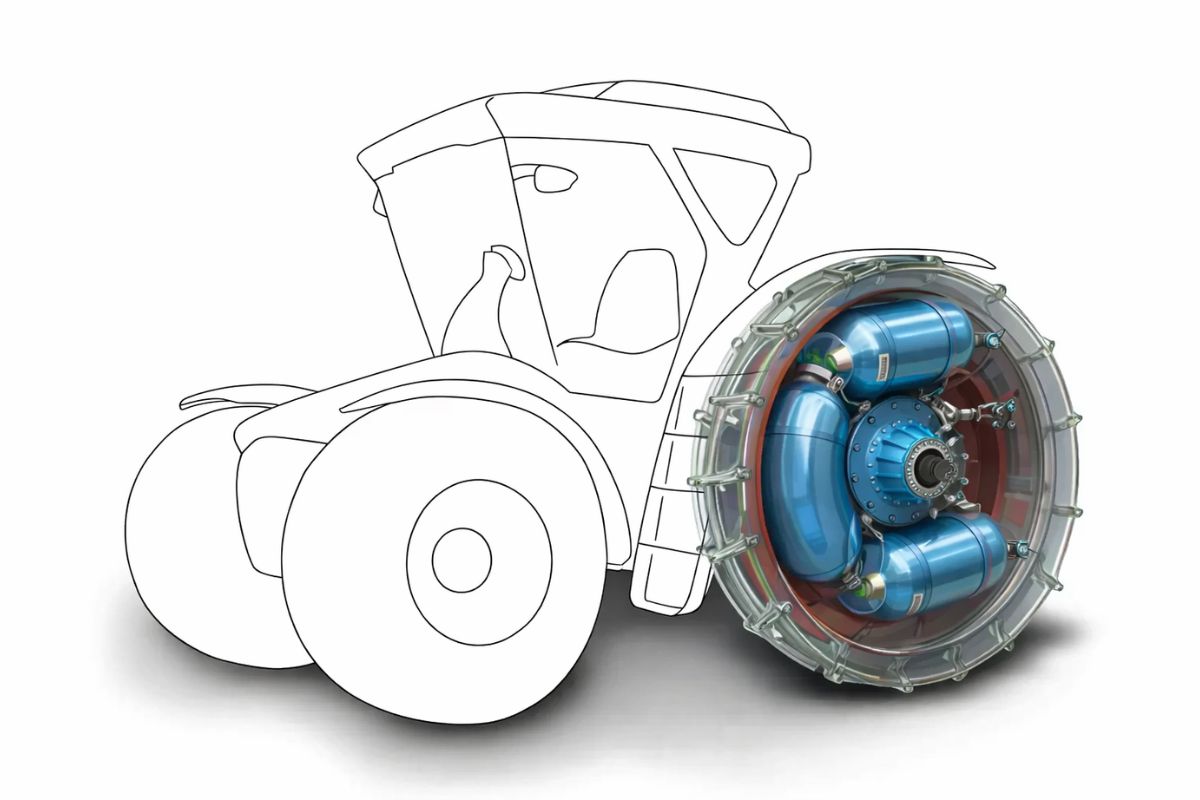

Engineers in Germany are developing tractors that store hydrogen inside their wheels, freeing up space in the body and extending the range of agricultural machines to operate from dawn to dusk without a drop of diesel.
The idea seems too simple for no one to have thought of it before. German engineers are exploring the possibility of transforming the hollow wheels of tractors into hydrogen tanks, integrating fuel storage directly into the structure that already exists in the machine. The concept, announced this week by Fuel Cells Works, addresses one of the most persistent problems of hydrogen-powered agricultural equipment: where to store enough fuel to keep the tractor running all day in the field without taking up space that the machine needs to work.
The context of this development is the H2Agrar project, a publicly funded initiative in Lower Saxony, Germany, which has already produced concrete results, according to Daily Galaxy. The Fendt Helios prototype, a hydrogen-powered tractor, operates with five tanks mounted on the roof that together hold 21 kilograms of hydrogen compressed to 700 bar, providing fuel for 5 to 8 hours of operation in the field. The proposal to move the storage into the wheels is an attempt to overcome this autonomy limitation without compromising the balance and functionality of the tractor.
What the Fendt Helios prototype has already proven about hydrogen-powered tractors

Before understanding the innovation in the wheels, it is worth knowing what already works. The Fendt Helios uses a 100 kW fuel cell to convert hydrogen into electricity, supported by a 25 kWh backup battery.
-
AI Radar Built with Old Camera and $20 Gains Attention After Alleged $317,000 Sale to Chinese Government, But Lack of Documentation and Official Confirmation Raises Questions

-
Amateur Detectorist Discovers 3,400-Year-Old Bronze Age Gold Treasure with 121 Pieces in Transylvania, Including a Unique Ring

-
Italian Designer Develops Solar-Powered Terracotta Water Purifier Producing Up to 5 Liters of Drinking Water Daily Without Electricity

-
New Hydrogel Made from Algae and Shrimp Shells Absorbs 60 Times Its Weight in Water to Combat Drought in Spanish Agriculture


The combined system powers a 100 kW electric motor and all auxiliary systems of the tractor. According to Dr. Benno Pichlmaier, Global Research Director at AGCO, the performance is comparable to that of a similarly powered diesel machine.
Two prototypes of the Fendt Helios are already operating on farms in the Emsland region of Germany. In 2024, the hydrogen tractor was tested for the first time in real harvesting operations, providing consumption data under high load field conditions.
These results are guiding the next stage of development, which includes the evaluation of alternative storage configurations. The concept of integrating hydrogen tanks into the wheels is one of the directions that emerged from this practical experience.
Why hiding hydrogen inside the wheels is such a relevant idea

The central problem is space. The energy density of hydrogen by volume is significantly lower than that of diesel, even when compressed to 700 bar. This means that, to store the same amount of energy, hydrogen needs much more physical space.
In a tractor, every centimeter occupied by fuel tanks competes with the structure, balance, and working capacity of the machine.
The wheels of large agricultural tractors are robust structures with considerable internal volume. By transforming this idle space into hydrogen reservoirs, engineers would redistribute the weight closer to the axles and free up the body for other uses.
Professor Ludger Frerichs from the Institute of Mobile Machines at TU Braunschweig, a partner in the H2Agrar project, described the challenge directly: adapting the tractor to the lower storage capacity of hydrogen compared to diesel is one of the central obstacles his team is evaluating.
The engineering challenges of putting hydrogen inside a spinning wheel
The idea is elegant, but the execution involves considerable technical complexity. Any hydrogen storage system inside a spinning wheel needs to manage fuel transfer, maintain pressure integrity under continuous mechanical stress and ensure safe access for refueling.
These requirements go far beyond simply creating a cavity inside the wheel and filling it with gas.
Röchling Engineering Plastics, a partner of H2Agrar, is already working with high-pressure hydrogen containers reinforced with carbon fiber.
This technology is a key piece to enable hydrogen storage in unconventional spaces like the interior of the wheels.
It has not yet been confirmed whether the approach will reach the prototype phase or remain as a design study, but the fact that engineers with practical experience in hydrogen tractors are investigating this solution indicates that it has moved from theory to real technical analysis.
The hydrogen infrastructure that already exists to refuel tractors in Germany
The H2Agrar project is not limited to the tractor. It integrates production, infrastructure, and agricultural machinery into a single regional system. The hydrogen used in the Fendt Helios comes from a community wind farm with 16 turbines near Haren, Lower Saxony.
Two electrolyzers, each with a power of 1 MW, produce up to 900 kilograms of hydrogen per day on-site.
A refueling station specifically built for the project stores up to 480 kilograms of hydrogen and can supply fuel simultaneously at 350 and 700 bar.
The project received funding of about 7.6 million euros from the state of Lower Saxony and attracted approximately 160 participants from industry, politics, and science when it was presented at the German Hydrogen Week in June 2024.
The complete chain is already functioning: wind energy generates green hydrogen, which fuels tractors operating on real farms. What is lacking is increasing the autonomy of the machines, and that is where the wheels come into play.
The environmental impact that motivates the search for hydrogen-powered tractors
The pressure for alternatives to diesel in agriculture has concrete reasons.
According to federal data cited in the H2Agrar project documentation, agricultural machines are responsible for about 8.5% of total emissions in German agriculture.
This percentage may seem modest, but it represents a significant volume when considering the scale of agricultural production in the country.
What do you think of the idea of hiding the hydrogen tank inside the tractor wheels? Do you believe this technology can reach Brazilian agribusiness, where diesel still completely dominates? Leave your comment. The conversation about the future of energy in agriculture is just beginning and promises to change everything.


