





 Portuguese
  English
  Spanish
  5 min of reading
  43 comments


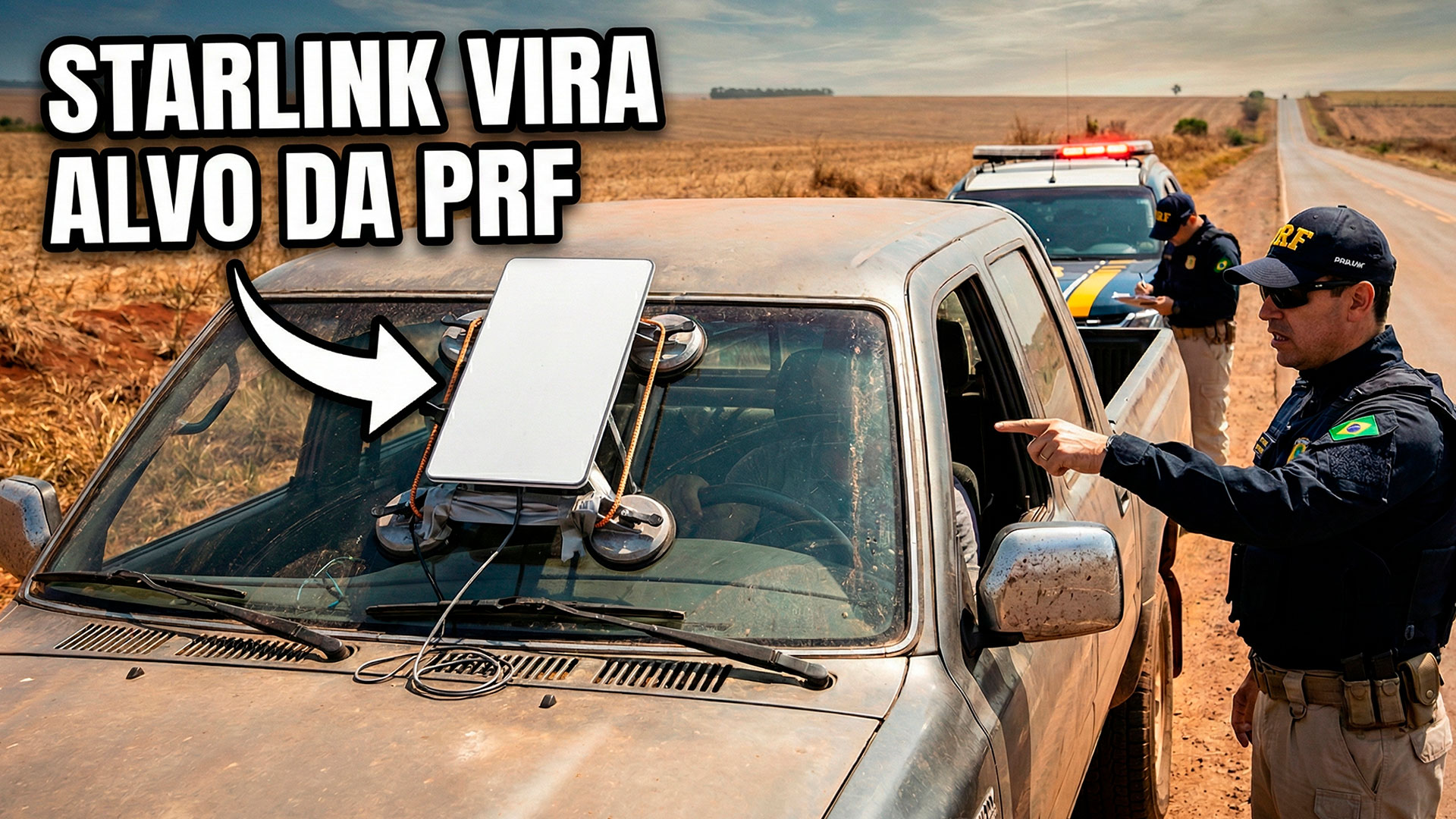


The Popularization of the Starlink Antenna Among Drivers and Rural Producers Increases Connectivity in Remote Areas, But Incorrect Use on Windshields and Front Windows Already Results in Fines, Points on the Driver’s License, Vehicle Seizures, and a Direct Alert from the Federal Highway Police About Traffic Safety
Satellite internet from Starlink, a service from SpaceX, founded by Elon Musk, has become the preferred solution for many drivers, travelers, and rural producers in Brazil. The equipment ensures connectivity on isolated roads, remote farms, and regions without 4G or fiber optic coverage. For those living “in the middle of nowhere,” having signal all the time has stopped being a luxury and has become a tool for work and safety.
However, the way some users are installing the antenna has raised concerns for the Federal Highway Police (PRF). In several states, agents have caught the equipment mounted on windshields, over the dashboard, or on front windows. These areas are considered essential for the driver’s visibility and cannot be covered by objects.
The problem is not the technology itself, which is legal and approved for use in vehicles. The issue is where and how the antenna is installed. When poorly positioned, the structure creates blind spots, hampers the perception of pedestrians, cyclists, and other vehicles, and increases the risk of accidents, according to the PRF.
-
With over 14 million baskets of earth moved, an ancient North American metropolis built a monumental pyramid of 30 meters and established a city with 20,000 inhabitants nearly a thousand years ago.

-
A 1,900-year-old treasure emerges from a Roman house destroyed by fire and sealed since antiquity in Romania, with coins and metals fused among the ashes.

-
The Brazilian colonial city that stopped in time and shares territory with a rocket launch base.

-
79-year-old woman challenges limits, visits 193 countries in the world after 56 years of planning and reveals the behind-the-scenes of a global journey that few have managed to accomplish.


Recent data shows that the issue is already having a concrete impact on traffic statistics. According to numbers cited by the PRF and specialized portals, about 33,555 infractions in 2024 were registered for obstructing visibility, and more than 15,000 fines were recorded in the first half of 2025 for the same reason, including cases related to internet antennas. States like Bahia, Minas Gerais, Paraná, and São Paulo are among the leaders in occurrences.
Why the Starlink Antenna Came Under the PRF’s Spotlight
In recent months, images of cars, trucks, and motorhomes with Starlink antennas fixed right in front of the driver have proliferated on social media. In many cases, the equipment appears stuck to the glass, almost in the driver’s line of sight. This type of makeshift solution prompted official statements, reports, and educational campaigns.
The PRF has reiterated that there is no general prohibition on the use of Starlink in vehicles. What is prohibited is installing any object in critical glass areas essential for driving, such as the windshield and front windows. According to statements from the agency, the antenna should be placed in locations that do not obstruct the field of vision, under the penalty of fines, points on the driver’s license, and retention of the vehicle until regularization.
In some regional superintendencies, such as in Piauí and Tocantins, monitoring has been intensified precisely after the increase in vehicles with satellite internet equipment stuck to the glass. The guidance is clear: connectivity is welcome, but it cannot compromise road safety.
What the Traffic Code Says About Objects on the Windshield
The legal basis used by the PRF is in Article 230, Section XVI, of the Brazilian Traffic Code (CTB). The rule prohibits driving a vehicle “with windows wholly or partially covered by films, panels, or objects” that obstruct visibility. The infraction is classified as serious, with a fine of R$ 195.23, five points on the driver’s license, and the vehicle’s seizure to remove the irregularity.
When the obstruction is so significant that it characterizes dangerous or inattentive driving, agents can also classify the case under Article 169 of the CTB. In this situation, the conduct is treated as a very serious infraction, with a fine of R$ 293.47 and seven points on the driver’s license, in addition to other administrative measures. Practically speaking, a poorly installed antenna can turn a useful device into an expensive and immediate liability.
Fines, Operations, and Real Cases in Several States
With the advancement of satellite internet, the PRF has intensified operations in areas with high traffic of trucks, tourist vehicles, and agribusiness convoys. In Piauí, for example, specific actions targeted cars with antennas attached to the windshield, resulting in fines and guidance on the shoulder.
On a national level, the finalized data for 2024 indicates more than 33,000 records of infractions related to obstructed visibility, including illegal films, stickers, and objects like antennas. In the first half of 2025 alone, the volume exceeded 15,000 notifications, showing that the problem is far from isolated.
Surveys released by media outlets and the PRF itself indicate that Bahia, Minas Gerais, Paraná, and São Paulo are among the states with the highest number of infractions of this kind. These are regions with a high flow of cargo, tourism, and agribusiness vehicles, where the demand for internet on the move is intense.
In Tocantins, the agency reported registering more than a hundred fines for the improper use of internet antennas on federal highways just in 2025. In public statements, agents reinforce that, even when the antenna is not directly in the center of the vision, it can create blind spots sufficient to prevent the driver from seeing a pedestrian on the crosswalk or a vehicle making a turn.
Additionally, the PRF and military police remind of another physical risk that is little discussed. In a sudden stop, a pothole in the road, or a collision, the antenna or its base can become detached and act as a projectile inside the cabin. In other words, besides obstructing vision, the makeshift equipment turns into a blunt object at high speed.
How to Use Starlink in the Car Legally and Safely
For those who depend on internet access on the road, the solution is not to abandon Starlink, but rather to install the equipment correctly. The PRF itself recommends that the antenna be installed on the vehicle roof, on racks or supports designed for automotive use, where it does not interfere with the field of vision and still has better satellite signal reception.
Another option is to position the antenna in the rear parts of the bodywork, in the trunk, or in external structures meant for accessories. Inside the vehicle, the equipment should only be in areas that do not compromise the use of rearview mirrors and front visibility, completely avoiding the windshield and front windows. Makeshift solutions with double-sided tape or suction cup mounts on the glass tend to be precisely what causes fines.
Experts in connectivity and vehicle safety also recommend checking local regulations and the manufacturer’s warranty before drilling holes in the roof, adapting mounts, or using magnetic bases. The advice is simple: if the solution seems like a “quick fix,” it probably isn’t the best choice for driving on federal and state highways without headaches.
In your case, do you think the PRF is overreacting by fining those who use the Starlink antenna on the windshield, or is the measure necessary to prevent serious accidents? Do you agree that any object on the glass should be prohibited, or do you believe that more specific rules for internet equipment would make sense? Leave your comment and tell us if you would use Starlink in your car.








como está na foto e perigoso e ilegal eu uso no teto da cabine e nunca tive complicações estou dentro do código de trânsito, e já fui fiscalizado pela PRF e não tive aplicação de multa
Uma advertência seria o correto, a reincidência seria caso pra multa leve. Estamos cansados de multas, muitas sem necessidade. Pagamos ipva, pecas, e manutenção do carro. Quanto temos estradas esburacadas, sem sinalização, sem cobertura de área telefônica e Internet, animais nas rodovias. Quem vai multar o estado pelo descaso? Por nao cumprir com suas obrigações aos cidadãos.
Não temos mais TELEBRÁS meu caro mimimizento bovino de direta, a internet em locais assim não interessa pra iniciativa privada…mas vocês gadoloides quiserem eleger pessoal de direita pra não darem palco pra governos que cuidem de todos 😂
Caro **** **** de esquerda, vc acha mesmo que “governos” resolve algo? Principalmente o governo do condenado cachaceiro?
Desculpa, mas não tem outra forma de abordar isso: ESSE POVO TEM **** NA CABEÇA?