





 Portuguese
  English
  Spanish
  5 min of reading
  0 comments


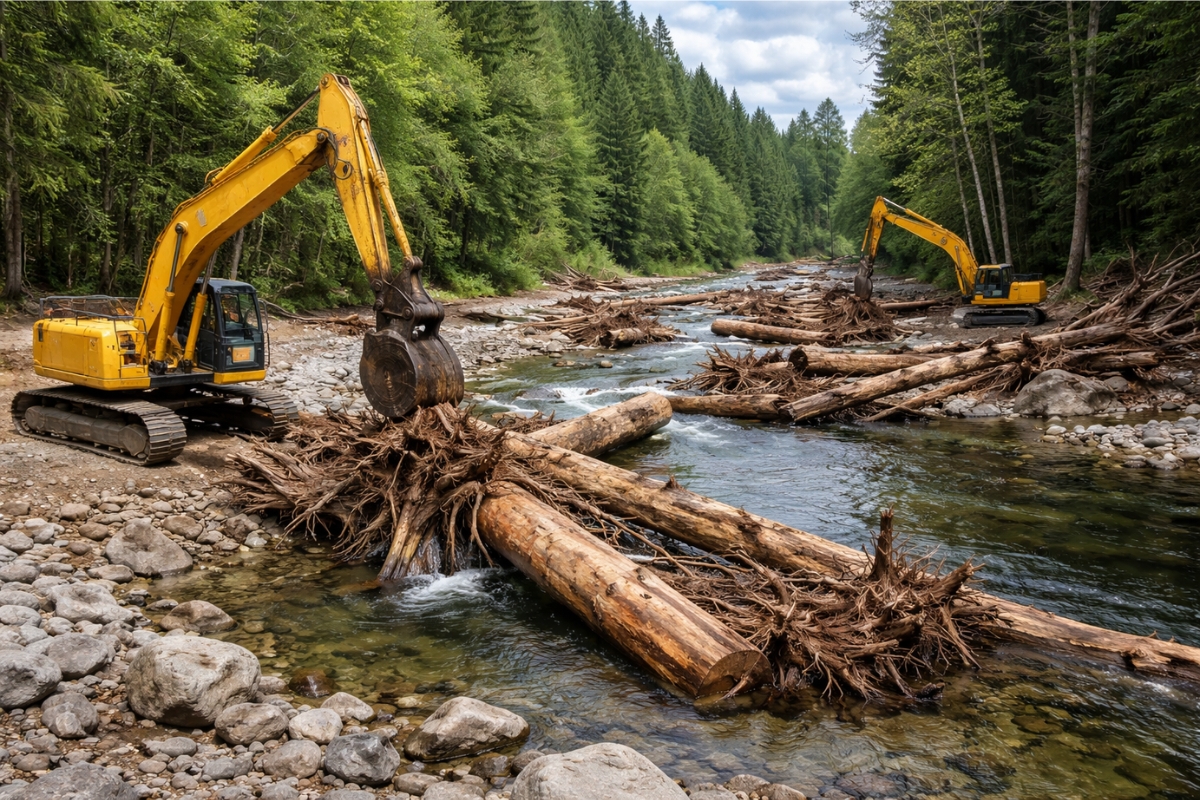
In Areas of the United States and Canada, Teams of Biologists and Engineers Carried Out the Strategic Burying of Dead Trees in the Beds of Rivers to Recreate Natural Habitats, Triggering the Recovery of Pools and Refuges and Calling the Attention of Scientists and Managers
In the Northwest of the United States and Canada, a scene has been drawing attention: excavators working inside rivers and streams to “plant” dead trees in the beds.
At first glance, it seems like a contradiction. However, the logic is precisely to bring back a type of natural disorder that many waterways have lost after decades of human interventions.
The proposal is straightforward: to return trunks, roots, and large wood to the river to recover deep pools, low-velocity areas, and shelters, creating conditions for aquatic insects, fish, and especially salmon to reproduce again.
-
With a cost per shot close to zero, the DragonFire laser could change naval warfare in 2027 and provide British ships with nearly unlimited defense against drones.

-
A British startup creates tires that generate electricity in electric vehicles when passing over potholes, speed bumps, and cracks.

-
Scientists have created robots made with living cells that have their own nervous system, swim on their own, explore the environment, and self-organize without any genetic engineering, and now they want to do the same with human cells.

-
Students create a solar-powered ambulance that operates without a plug, without fuel, and still keeps medical equipment running in remote areas.

The investigation was published by nwtreatytribes, an informational website about salmon habitat restoration.
The “Cleaning” of Rivers in the 20th Century Changed Everything and Paid a High Price
For much of the 20th century, in many places, the order was to straighten, dredge, and “clean” rivers and streams.
Trunks, roots, and dead wood were removed to facilitate navigation, allow the transport of logs by the timber industry, and, according to the logic of the time, reduce flooding.
The result was a repeated pattern: straighter, deeper, and faster rivers, with fewer bends, less shade, and almost no refuge for young fish. For salmon, which depend on cold water and varied habitats, this meant losing essential areas for growth and protection.
In several watersheds in the Pacific Northwest, the combination of industrial tree cutting and channelization degraded spawning streams, reducing calm pools and low-velocity stretches where young fish can develop.

The Scientific Turn: Large Wood Is a Key Piece of a Healthy River
With the advancement of research, “large wood” has gained another status. Trunks, roots, and fallen trees have come to be seen as a structural part of balanced rivers.
These trunks deflect flow, create eddies, retain sediments, and build a complex architecture of pools, riffles, islands, and secondary channels.
Without this structure, the river begins to behave like an artificial channel: fast-flowing water, a more uniform bottom, and little space for aquatic life to hide, feed, and reproduce. This is where the most striking detail appears: sometimes, the way to recover a river is to put back inside it what was once removed.
Excavators “Plant” Trunks and Create Structures That Mimic Nature
In practice, the solution seems simple, but it requires heavy planning. Teams use excavators to strategically position dead trees in the beds and banks, in some cases with the support of logs brought by trucks or helicopters.
In projects like those on the Nooksack River in Washington State and Horse Creek in the Klamath Basin, the work resembles civil engineering, but with an ecological objective.
The excavators open cavities in the bank or riverbed and bury the bases of large trunks, leaving part of the wood angled toward the current.
From this anchoring point, other logs, branches, and roots are stacked to form structures known as engineered logjams, which function like wooden “dams” and mimic the natural accumulations of fallen trees.
Nothing is left to chance: trunk size, position, distance between structures, and anchoring depth are calculated to withstand winter floods. The goal is to divert part of the flow to side channels, slow down the water in critical stretches, and force the river to carve out pools, bends, and gravel bars over time.

What Changes in the River When the Trunks Return and Why This Impacts the Salmon
Before-and-after monitoring indicates a pattern: where large wood returns, the river stops looking like a uniform “tube” and recovers shapes that had disappeared.
The number and depth of pools increase, especially in protected areas behind log accumulations.
The retention of gravel and fine sediment also increases, important materials for salmon nests, as well as more leaves, branches, and organic matter, which feed the base of the food chain.
Another relevant effect appears on a micro scale: trunks create shade and microcurrents that help reduce water temperature at specific points. This is significant in a climate warming scenario, when warmer rivers can exceed the survival threshold for salmon.
More Insects, More Food, and More Young, the “Invisible Effect” of Restoration
A central part of this recovery is almost invisible: aquatic invertebrates.
Submerged wood, low-velocity areas, and retained organic matter become ideal habitats for insect larvae, small crustaceans, and algae, which sustain the feeding of young fish.
Over time, studies have recorded an increase in the density of macroinvertebrates and the food supply for salmon, trout, and other native species.
In several projects in the Pacific Northwest, increases in the presence and density of juvenile salmon in restored areas have also been observed, where they find refuge from the current and from predators.
nwtreatytribes, an informational website about salmon habitat restoration, detailed results and goals in the case of the Nooksack River.
Nooksack and Horse Creek: Where Ecological Engineering Turned Into a Real-Scale Test
On the North Fork of the Nooksack River, the focus was on recovering shallow side channels, considered ideal for the rearing of young salmon.
Dozens of wood structures were installed to stabilize these channels, reconnect them to the floodplain and protect them from excessive erosion.
Over time, geomorphological changes were documented: in some stretches, the channel became narrower, gravel bars became more defined, and more riparian vegetation associated with the new flooding patterns appeared.
In the Horse Creek project in Oregon, excavators were used to carry logs directly from the bank and position them at strategic points, in combination with actions in other stretches of the basin.
Project reports highlight an increase in the number of coho salmon adults returning to spawn in the creek, suggesting that habitat improvement can translate into real gains for the population.
Point Experiment or New Rule: 20 Years of Evidence Change the Debate
The big question for scientists and managers is whether these interventions are just local corrections or a robust long-term solution.
An analysis of more than two decades of active wood reintroduction in North American watersheds indicates that the strategy not only alters the physics of the river but also improves connectivity with the banks and favors the regeneration of riparian forests.
Scientific reviews on log placement in rivers also point out that, in most cases, there is an increase in habitat complexity and fish abundance. At the same time, results may vary according to project scale and watershed factors, such as the presence of dams and water quality.
In the end, what seemed impossible takes shape: returning to the river its chaos of logs and bends is consolidating as one of the strongest tools of modern river restoration, with the potential to protect iconic species like salmon and rebuild entire ecosystems from the streambed.








Seja o primeiro a reagir!